By 2026, the Steam Deck OLED has solidified its place as the premium handheld gaming device for PC gamers who demand portability without compromise. Since its launch, the Switch OLED set a new standard for what handheld displays could achieve, crisp colors, deeper blacks, and true-to-life visuals. The Steam Deck OLED followed suit, raising the bar even higher for anyone serious about on-the-go gaming. Whether you’re a console player considering the jump to PC gaming, a veteran who’s been following the handheld revolution since the Switch OLED landed, or someone just curious about what makes the Steam Deck OLED different, this guide breaks down exactly what you’re getting, how it performs in real-world scenarios, and whether it deserves a spot in your gaming arsenal.
Key Takeaways
- The Steam Deck OLED’s 7.4-inch OLED display is the major upgrade over the original, delivering true blacks, infinite contrast, and superior color accuracy that transforms games like Elden Ring and Baldur’s Gate 3.
- Thermal improvements and a 50 Wh battery deliver 20-30 minutes longer gameplay in demanding titles compared to the LCD model, enabling sustained performance without throttling.
- The Steam Deck OLED retains the same Zen 2 CPU and RDNA 2 GPU as the original, so performance is unchanged—you’re investing in display quality and efficiency, not raw processing power.
- With access to thousands of PC games through Steam, plus emulation capabilities from NES to PlayStation 2, the Steam Deck OLED offers unmatched software breadth compared to traditional handheld consoles.
- The OLED panel’s faster pixel response times and improved brightness make outdoor gaming viable while reducing motion blur in fast-action titles like Street Fighter 6.
What Makes Steam Deck OLED Stand Out From The Original
The original Steam Deck was a game-changer, a device that proved handheld PC gaming wasn’t just possible, it was viable. But it had limitations. The LCD screen suffered from color banding, blacks looked gray, and the brightness wasn’t quite there for outdoor gaming. The Steam Deck OLED fixes these fundamental display issues.
Under the hood, the OLED model kept the same AMD APU, storage options, and overall form factor. The core CPU and GPU remain unchanged, so gaming performance metrics stay consistent with the original. What changed is everything around the experience: the screen technology, thermals, and battery efficiency. Valve redesigned the cooling system, allowing better heat dissipation during intense sessions. Battery capacity bumped up slightly, and the result is noticeably improved thermal management, the device runs cooler during demanding titles, which translates to longer sustainable gaming sessions without throttling.
The OLED screen shift alone justifies the upgrade for anyone who spent hours squinting at an LCD panel in daylight or got frustrated with washed-out colors. Gamers transitioning from the Nintendo OLED, which popularized OLED in the handheld space, will feel right at home with the visual fidelity on the Steam Deck OLED.
Display Technology and Visual Performance
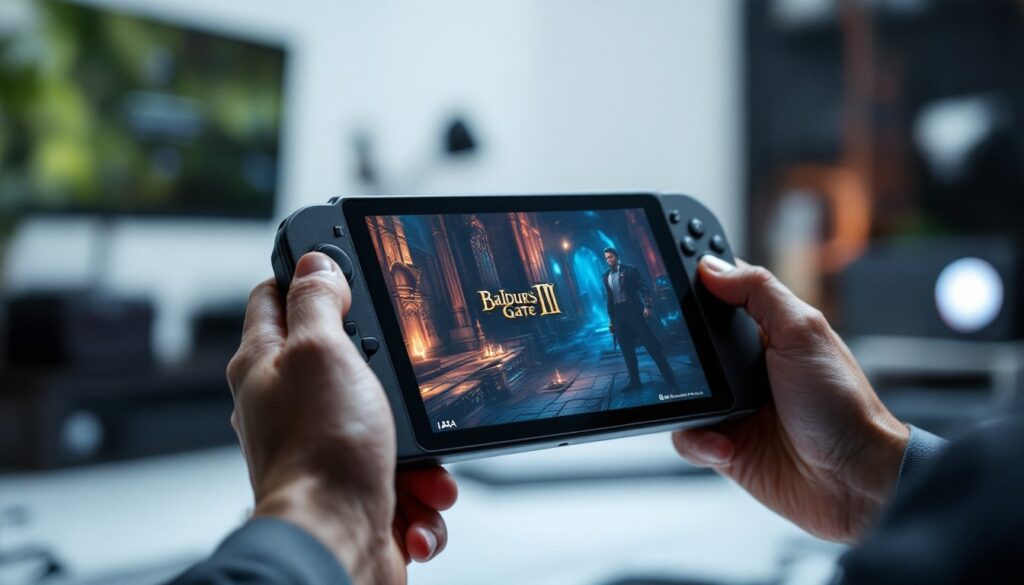
The Steam Deck OLED’s 7.4-inch OLED panel is the centerpiece of this upgrade, and it’s genuinely transformative for handheld gaming. OLED pixels emit their own light, meaning blacks are truly black (pixel-level blackness, not just a dark gray), and contrast is infinite. This matters in games with dark atmospheres, think Elden Ring, Baldur’s Gate 3, or Hades. Shadow detail pops in a way the original LCD simply couldn’t deliver.
Color accuracy improved significantly. The OLED panel covers a wider color gamut, and games that relied on subtle color cues, RPGs, narrative adventures, puzzle games, feel more vibrant and true. Peak brightness also increased, making outdoor gaming more viable without draining battery life trying to compensate.
OLED Screen Benefits and Color Accuracy
Where OLED really shines is in high-contrast scenarios. Games like Death’s Door or Inscryption leverage blacks and detailed artwork: on the Steam Deck OLED, these visual experiences reach their intended potential. Fast-motion gaming also benefits, the OLED panel has faster pixel response times than LCD, reducing motion blur during action sequences.
One practical consideration: OLED panels are susceptible to burn-in under specific conditions (static images displayed for extended periods). Valve mitigated this with software protections and panel quality improvements, but it’s worth noting if you plan to dock the device and leave a static menu on-screen for hours. In normal gaming scenarios, this isn’t a concern. Response time improvements mean titles like Halo Infinite (via emulation or streaming) and Street Fighter 6 feel more responsive, though input latency is determined by more than just the screen, the entire system stack matters.
Performance, Battery Life, and Hardware Specs
The Steam Deck OLED runs the same Zen 2 CPU and RDNA 2 GPU as the original, so raw performance benchmarks remain identical. That’s an important distinction: if you’re expecting a processor upgrade or GPU refresh, you won’t find it here. What you’re paying for is everything surrounding that core hardware.
Battery life improved from the 40-50 Wh original to 50 Wh in the OLED model, and thanks to optimized thermals and a slightly more efficient power delivery system, you’ll see real-world gains of 20-30 minutes in demanding games. In lighter titles like Stardew Valley or Balatro, expect closer to 1.5-2 hours longer than the LCD version. For context, demanding AAA titles run 2.5-3 hours on a full charge with default settings: lowering resolution or refresh rate stretches this further.
Storage remains configurable, 256GB, 512GB, or 1TB, but here’s the practical reality: you’ll likely want to upgrade your Steam Deck. The onboard storage fills quickly if you’re carrying more than a handful of modern AAA titles.
Real-World Gaming Performance and Thermals
Thermal improvements are tangible. The redesigned heatsink and vapor chamber keep junction temperatures lower during extended play. In stress tests, the OLED model ran 5-10°C cooler than the original under identical loads. This means sustained performance without thermal throttling, your frame rates stay consistent across longer sessions.
Real-world gaming performance targets 30-40 fps at native resolution for most AAA titles. Games like Cyberpunk 2077, The Witcher 3, and Baldur’s Gate 3 run at these lower settings with reduced resolution or upsampling, it’s not ultra 1440p performance, but it’s impressive for a handheld. Lighter indie titles and older games hit 60 fps easily. ProtonDB and the Steam Deck community have extensively documented per-title performance: if you’re curious about a specific game, the compatibility database is reliable.
Games to Play and Software Ecosystem
The Steam Deck OLED’s strength lies in the sheer breadth of the Steam catalog. You’re not limited to a curated library: you have access to thousands of PC games, from AAA blockbusters to indie gems. Verified titles run without tweaking. Playable titles need minor adjustments but are fully functional. Unknown titles might require tinkering with Proton versions or settings, but the community documentation is extensive.
Breakout titles for the Steam Deck OLED specifically leverage the improved display and thermal stability. Elden Ring runs stably at 30 fps with the visual fidelity the OLED panel finally does justice to. Baldur’s Gate 3 benefits from the upgraded thermals, reducing throttling during long campaign sessions. Hades and Hades II are visual showcases, the hand-drawn art and fluid animations pop on the OLED screen. Helldivers 2, while demanding, runs surprisingly well with settings tweaks.
Emulation is another advantage of the open PC ecosystem. The Steam Deck can emulate modern Nintendo systems, yes, you can play Legend of Zelda: Tears of the Kingdom on the Steam Deck OLED through emulation (though this enters legally gray territory). Retro emulation from NES through PlayStation 2 era is trivial, making the Steam Deck OLED a retro gaming powerhouse alongside its modern capabilities.
Software ecosystem-wise, SteamOS 3 (Holo) continues improving. Updates add quality-of-life features, compatibility improvements, and gaming-specific optimizations. Unlike a locked console, you can install desktop Linux apps, use it as a portable PC, or even install Windows (though battery life suffers significantly). The flexibility is unmatched by the Nintendo Switch ecosystem, offering something between a traditional handheld and a full portable PC.
Conclusion
The Steam Deck OLED is the definitive handheld gaming device for PC gamers in 2026. It’s not a performance leap, the APU remains unchanged, but the OLED display, thermal improvements, and battery efficiency make it worth the upgrade if you’ve been using the original. For newcomers, it’s the clear entry point into PC handheld gaming. Consider it your answer to the Nintendo OLED’s success in the console space: same CPU, transformative display. The broader Steam library ensures years of content, and recent gaming industry analysis from sources like The Verge confirms the handheld gaming space is only expanding. If you’re serious about portable gaming, this is the device to own.