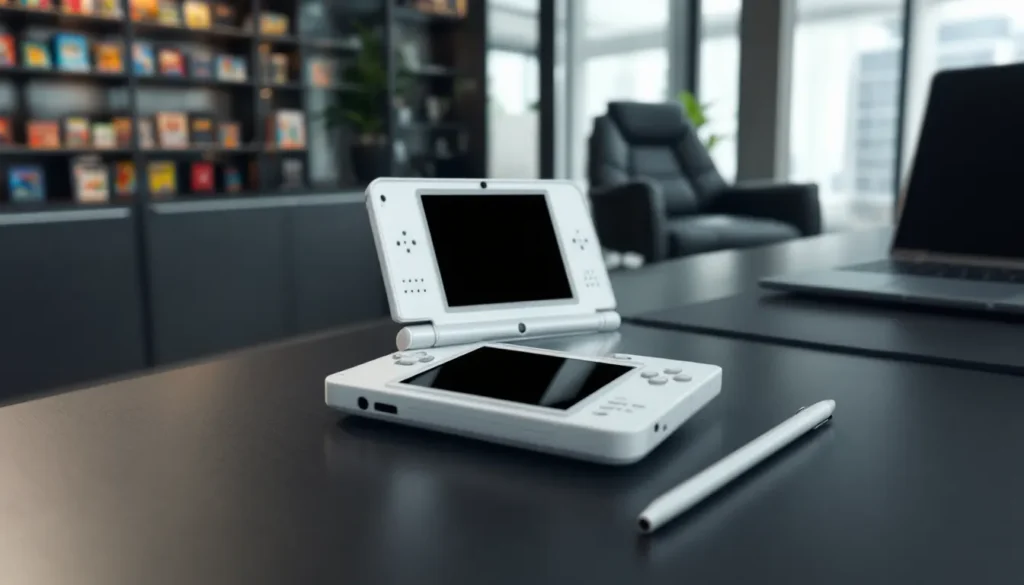
The Nintendo DS didn’t just compete in the handheld market, it redefined what portable gaming could be. Launched in 2004, this dual-screen device brought touchscreen controls to the mainstream years before smartphones made them ubiquitous. With over 154 million units sold worldwide, the DS became the second best-selling video game console of all time, trailing only the PlayStation 2. Its innovative design, robust library spanning over 1,800 titles, and backward compatibility with Game Boy Advance cartridges made it a powerhouse that dominated gaming for nearly a decade. Whether you’re a veteran collector or a curious gamer discovering the DS for the first time in 2026, understanding this handheld’s legacy is essential to appreciating how modern gaming evolved.
Key Takeaways
- The Nintendo DS redefined portable gaming with its innovative dual-screen and touchscreen design, selling over 154 million units and becoming the second best-selling console of all time.
- The DS introduced groundbreaking features like resistive touch technology, Download Play wireless multiplayer, and Wi-Fi connectivity that influenced every handheld system that followed, including the Switch.
- The DS library contains exclusive experiences that cannot be properly ported to other platforms due to dual-screen design and specialized input methods like microphone and stylus controls.
- Common maintenance issues like hinge cracks, touchscreen calibration drift, and battery degradation are manageable through affordable repairs using replacement parts and DIY methods.
- Authentic Nintendo DS games can be distinguished from counterfeits by examining cartridge materials, label quality, internal codes, and functionality, making authenticity verification essential for collectors in 2026.
- The DS’s cultural impact extends beyond gamers—titles like Nintendogs and Brain Age introduced millions of non-traditional audiences to gaming, fundamentally expanding the medium’s mainstream appeal.
What Made the Nintendo DS a Game-Changer?
Nintendo took a massive risk with the DS, diverging from the straightforward upgrade path that defined the Game Boy line. The gamble paid off in ways that reshaped the industry.
Dual Screens and Touch Innovation
The dual-screen layout fundamentally changed how developers approached game design. The top screen typically displayed the main action, while the bottom resistive touchscreen handled menus, maps, inventory management, or secondary gameplay elements. This wasn’t a gimmick, it solved real UI problems that plagued handheld games.
Resistive touch technology was crucial here. Unlike modern capacitive screens, resistive displays responded to pressure, meaning you could use the included stylus with precision. Games like The Legend of Zelda: Phantom Hourglass required you to draw paths and solve puzzles directly on the screen. Elite Beat Agents turned rhythm gaming into a tap-and-slide experience that still holds up today.
The microphone added another input layer. Games like Nintendogs let you call your virtual pet by actually speaking into the device. The Legend of Zelda: Spirit Tracks required you to blow into the mic to play the Spirit Flute. These weren’t just tech demos, they were core mechanics that couldn’t exist on traditional handhelds.
Wireless Connectivity and Multiplayer Features
DS Download Play was revolutionary for its time. One player with a game cartridge could wirelessly transmit a demo version to up to seven other DS owners, enabling instant multiplayer without everyone buying the game. Mario Kart DS let an entire room race together with only one cartridge. New Super Mario Bros. included competitive minigames that spread through Download Play.
The Nintendo Wi-Fi Connection service launched alongside the DS, bringing online multiplayer to Nintendo’s handheld ecosystem for the first time. Mario Kart DS and Metroid Prime Hunters offered ranked online matches. Animal Crossing: Wild World let players visit each other’s towns globally. Yes, the friend code system was clunky by modern standards, but it worked when Xbox Live was still finding its footing and PSP’s online features barely registered.
Pictochat deserves mention too. This built-in messaging app let DS owners within wireless range send text and doodles to each other. It turned school cafeterias and airport waiting areas into impromptu chat rooms, creating spontaneous social experiences that felt genuinely novel in 2004-2008.
The Complete Nintendo DS Family: Models and Variants
Nintendo released four distinct DS models over five years, each addressing specific complaints and expanding the user base.
Original Nintendo DS (2004)
The original DS (often called the DS Phat) launched November 21, 2004 in North America for $149.99. It featured a chunky, rounded design with a silver-and-black color scheme that aged quickly. The screens measured 3 inches diagonally with a resolution of 256×192 pixels each.
Key specs:
- Dual ARM processors: ARM946E-S at 67 MHz and ARM7TDMI at 33 MHz
- 4 MB RAM with 656 KB VRAM
- Game Boy Advance slot for backward compatibility
- Battery life: 6-10 hours depending on screen brightness
- Weight: 275 grams
The original model had notable quirks. The hinge felt loose compared to later versions. Screen quality varied between units, some had dead pixels right out of the box. The stylus stored in the back was short and awkward to hold for extended play.
Still, it established the blueprint. The D-pad, face buttons, L/R shoulder buttons, Start, and Select were all perfectly positioned. The cartridge slot on the back prevented accidental ejections during play.
Nintendo DS Lite (2006)
The DS Lite arrived March 2, 2006 in Japan (June 11, 2006 in North America) and immediately became the definitive version. Priced at $129.99, it offered massive improvements:
- 42% smaller and 21% lighter than the original (218 grams)
- Four brightness settings instead of two
- Significantly brighter screens that made games pop
- Relocated GBA slot moved to the front underside
- Longer stylus with better ergonomics
- Improved hinge with a satisfying click
The Lite came in numerous colors: Polar White, Onyx Black, Coral Pink, Crimson/Black, and limited editions tied to games like The Legend of Zelda: Phantom Hourglass (gold) and Pokémon Diamond/Pearl (Dialga & Palkia editions).
This model drove the DS to mainstream dominance. Its sleeker profile appealed to adults who found the original too toy-like. Battery life remained strong at 5-19 hours depending on brightness settings, the range was wider because those brightness options made a real difference.
The only downside? The Lite’s glossy finish scratched easily. Most well-used units from 2006-2009 show wear around the edges and hinge.
Nintendo DSi and DSi XL (2008-2009)
Nintendo split the line in its final years. The DSi launched November 1, 2008 in Japan (April 5, 2009 in North America) for $169.99. The DSi XL (called DSi LL in Japan) followed November 21, 2009 in Japan (March 28, 2010 in North America) for $189.99.
DSi introduced meaningful hardware changes:
- Dual cameras: VGA quality (0.3 megapixels) on the outside, same on the inside for self-portraits
- SD card slot for photo storage and DSiWare downloads
- DSi Shop: Digital storefront for downloadable games and apps
- Larger screens: 3.25 inches (up from 3 inches)
- Improved audio: Dedicated sound chip and built-in speakers with better quality
- Removed GBA slot: This killed backward compatibility with GBA games and accessories like the Guitar Hero grip
The DSi XL targeted older players and those with vision issues. Its 4.2-inch screens were 93% larger than the original DS. The device was heavier (314 grams) but came with a larger stylus that felt like an actual pen.
Both DSi models supported DSiWare, downloadable titles that ranged from throwaway apps to legitimate gems like Shantae: Risky’s Revenge and Mighty Flip Champs. When the DSi Shop closed April 1, 2017, hundreds of these titles became effectively lost media unless you’d already downloaded them.
The DSi family sold well but never eclipsed the Lite in popularity. The removed GBA slot alienated collectors, and the 3DS was announced just a year after the DSi XL launched, making these models feel like a transitional phase rather than a true evolution.
Best Nintendo DS Games You Need to Play
The DS library spans over 1,800 games across all regions. Quality varies wildly, but the peaks are unforgettable.
Must-Play First-Party Titles
Nintendo’s own output defined the platform. These aren’t just recommendations, they’re essential.
New Super Mario Bros. (2006) revitalized 2D Mario after a decade-long hiatus. The game sold over 30 million copies, featuring tight platforming, creative power-ups like the Mega Mushroom, and addictive minigames. It proved 2D platformers still had commercial viability, paving the way for New Super Mario Bros. Wii and the entire “New” series.
Mario Kart DS (2005) set the template for all future Mario Kart titles. Mission Mode added structured challenges. Retro tracks from SNES, N64, GBA, and GameCube appeared for the first time. Online multiplayer via Nintendo Wi-Fi Connection made it the first portable racer with legitimate online competition. Snaking, a controversial drift-boosting technique, defined the competitive meta until Nintendo patched it out in later games.
The Legend of Zelda: Phantom Hourglass (2007) and Spirit Tracks (2009) divided fans but showcased what the DS could do. Phantom Hourglass controlled entirely with the stylus, you drew your path, Link followed. You solved puzzles by closing the DS lid, blowing into the mic, or even transferring seal impressions between screens. Spirit Tracks added train navigation and multiplayer sword battles. Both games featured cel-shaded graphics that still look clean in 2026.
Pokémon Diamond, Pearl, and Platinum (2006-2009) brought the series to new technical heights. These Gen IV games introduced online trading and battling via Wi-Fi, physical/special split for moves, and 107 new Pokémon. Pokémon HeartGold and SoulSilver (2009) remain the gold standard for remakes, bundling a Pokéwalker pedometer accessory and letting your lead Pokémon follow you on-screen, a feature fans begged for until it returned in Let’s Go and Brilliant Diamond/Shining Pearl.
Nintendogs (2005) was a cultural phenomenon. This pet simulator sold 24.76 million copies, introducing millions of non-gamers to the DS. The voice recognition worked surprisingly well, and the daily care routines created genuine emotional attachment. Experts in Japanese gaming trends noted how Nintendogs bridged casual and dedicated audiences in ways few games have replicated.
Hidden Gems and Cult Classics
Beyond the blockbusters, the DS harbored incredible games that flew under the radar.
The World Ends With You (2007) remains Square Enix’s boldest handheld experiment. Set in modern-day Shibuya, it featured dual-screen combat where you controlled Neku on the touchscreen and his partner on the top screen simultaneously. The pin system let you equip over 300 psychic attacks, each with unique touch or mic controls. The soundtrack mixed J-pop, hip-hop, and rock into one of gaming’s best OSTs. A Switch port arrived in 2018, but the original DS version’s dual-screen combat can’t be replicated.
999: Nine Hours, Nine Persons, Nine Doors (2009) launched the Zero Escape series and proved visual novels could thrive in the West. This narrative puzzle game trapped nine people in a sinking ship, forcing them through deadly escape rooms. The dual screens served the plot, the bottom screen showed narration while the top displayed character dialogue, creating a narrative twist that only works on DS hardware.
Ghost Trick: Phantom Detective (2010) came from Ace Attorney creator Shu Takumi. You played as a ghost manipulating objects to solve murders and prevent deaths. The animation was fluid, the story twisted brilliantly, and the touchscreen controls felt natural. It sold poorly but earned a devoted following. Capcom finally released an HD remaster in 2023 for modern platforms.
Radiant Historia (2010) offered a time-travel JRPG with a grid-based battle system that rewarded positioning and turn manipulation. Atlus published it in limited quantities, making original cartridges expensive. A 3DS remake (Perfect Chronology) expanded the story in 2017, but purists prefer the DS original’s pacing.
Infinite Space (2009) let you design spaceships, recruit crew, and explore a massive sci-fi universe. PlatinumGames and Nude Maker developed it, Sega published it, and almost nobody played it. Battles mixed real-time positioning with menu-based commands. The story spanned decades. It’s a 70-hour space opera that never got a digital re-release, making physical copies increasingly valuable.
Etrian Odyssey series (2007-2010) brought hardcore dungeon crawling to handhelds. You drew your own maps on the touchscreen as you explored first-person dungeons. The difficulty was punishing, permadeath modes, brutal FOEs (field-on enemies), and party composition that mattered. Atlus released three DS entries, establishing a franchise that continues on modern platforms.
Rhythm Heaven (2008 in Japan, 2009 in North America) delivered dozens of surreal rhythm minigames: flicking forks, assembling widgets to a beat, plucking hairs in rhythm. The touchscreen made the tap-and-flick controls intuitive. Each game lasted 30 seconds but achieving “Perfect” ranks demanded precise timing. The sequel on Wii couldn’t match the simplicity of the DS controls.
How to Buy and Collect Nintendo DS Games in 2026
The DS market has matured into a collector’s ecosystem with clear rules and pitfalls.
Where to Find DS Consoles and Games Today
Physical retail dried up years ago, but several sources remain reliable:
eBay offers the widest selection, from bulk lots to graded sealed copies. Prices vary wildly. A loose copy of Pokémon SoulSilver runs $60-$80, while a complete-in-box version with the Pokéwalker fetches $150-$200. Use advanced search filters to find “Sold Listings” and gauge actual market value, not inflated asking prices.
Local game stores often stock DS games at competitive prices. Build relationships with staff, they’ll call you when rare titles arrive. Stores typically offer trade credit, letting you cycle through common games to fund grabs like Solatorobo: Red the Hunter or Suikoden Tierkreis.
Facebook Marketplace and Craigslist yield occasional goldmines: parents selling their kids’ old collections, estate sales, bulk lots where one gem hides among shovelware. Negotiate in person, inspect cartridges for authenticity, and always test before leaving if possible.
Retro gaming conventions concentrate sellers in one space. Prices run higher than online due to overhead, but you can inspect cartridges, haggle, and network with other collectors. Events like Portland Retro Gaming Expo and Classic Game Fest regularly feature robust DS sections.
Online storefronts like DKOldies, GameStop’s retro section, and Lukie Games sell tested consoles and games with return policies. You’ll pay a premium for convenience and guarantees, but it beats dealing with scammers.
Console pricing in 2026:
- DS Lite (tested, good condition): $60-$90
- DSi (tested): $70-$100
- DSi XL (tested): $90-$130
Factors affecting price include cosmetic condition, included accessories (charger, stylus), and firmware version (for DSi models, pre-2017 units with DSiWare still accessible command premiums).
Spotting Authentic Games vs. Counterfeits
DS game counterfeits flooded the market, especially for high-value titles. Spotting fakes requires attention to detail.
Cartridge color and material: Authentic DS carts are molded from specific plastics with a slight sheen. Counterfeits often use cheaper plastic that looks duller or too glossy. Hold a known authentic cart next to the suspect one, differences become obvious.
Label quality: Official labels have sharp printing with consistent colors. Fakes show blurry text, washed-out colors, or incorrect fonts. Check the Nintendo logo and age rating, these use specific fonts and positioning. Some counterfeiters reuse label scans, creating visible pixelation.
Cartridge code: Flip the cart over. Authentic games have a stamped code on the label’s back (visible when held to light) and molded codes on the plastic itself. The code format is typically NTR-XXXX-XXX (NTR = Nitro, the DS’s codename). Cross-reference this with online databases. Many fakes omit these codes or use incorrect formats.
Cart weight: Authentic carts have specific weight due to components inside. Counterfeits sometimes feel lighter or heavier. This requires experience, but once you’ve handled dozens of real carts, fakes feel off.
Screw position: Official DS games use small tri-wing screws in specific positions. Counterfeits often use Phillips screws or place them incorrectly.
Chip visibility: Hold the cart to a light source. Authentic games have a visible chip positioned consistently. Some counterfeits show different chip shapes or multiple chips taped together.
Functionality tests: Insert the cart and check for these red flags:
- Game doesn’t boot or shows error screens
- Saving fails or corrupts immediately
- Graphics glitch or music sounds wrong
- Game crashes during specific events
Pokémon-specific checks: Pokémon games are the most counterfeited. Boot Diamond/Pearl/Platinum/HeartGold/SoulSilver and try transferring Pokémon from a GBA game (for models with GBA slots) or accessing online features. Fakes fail these checks. The cartridge for HeartGold/SoulSilver is black with an infrared sensor on top for the Pokéwalker, this is difficult to counterfeit correctly.
Collectors following rare Nintendo releases have documented that sealed games require even more scrutiny. Counterfeiters reseal boxes with shrink wrap machines. Check for:
- H-seam vs. overlap seams (Nintendo used specific sealing methods per region)
- Seam placement and tightness
- Presence of original security stickers or seals
When in doubt, join DS collecting communities on Reddit (r/gamecollecting, r/NDS) or Discord servers. Post clear photos, experienced collectors spot fakes instantly.
Maintaining and Troubleshooting Your Nintendo DS
These devices are 15-20 years old now. Maintenance is essential.
Common Issues and How to Fix Them
Hinge cracks: The most common DS Lite failure. The plastic hinge cracks after thousands of open/close cycles. Symptoms include loose screens, creaking sounds, or complete separation. Replacement shells cost $15-$30 on Amazon or eBay. The repair requires:
- Tri-wing and Phillips screwdrivers
- Patience threading ribbon cables through the new hinge
- YouTube tutorials (iFixit has detailed guides)
Expect 1-2 hours for your first shell swap. It’s fiddly but manageable.
Touch screen calibration drift: The resistive touchscreen can lose accuracy. Dirt or worn digitizers cause this. Try:
- Clean the screen with microfiber cloth and isopropyl alcohol
- Recalibrate through System Settings
- If that fails, replace the digitizer (costs $8-$15, requires disassembly)
Cartridge slot issues: Games not reading consistently usually means dirty contacts. Use:
- Compressed air to blow out dust
- Isopropyl alcohol on a cotton swab for stubborn grime
- Cartridge slot replacement if corrosion is severe (advanced repair)
Shoulder button failures: L/R buttons stop clicking or responding. This happens when the rubber pad underneath deteriorates. Replacement pads cost $5. The fix:
- Open the console
- Remove the old rubber contact
- Install the new one
- Reassemble
Test before closing everything, aligning these pads correctly takes practice.
Wi-Fi connection errors: DS Wi-Fi only supports WEP and unencrypted networks. Modern routers default to WPA2/WPA3. To connect a DS in 2026:
- Create a guest network with WEP security (or no security, then isolate it)
- Use a mobile hotspot with WEP (some Android phones allow this)
- Accept that official Nintendo Wi-Fi Connection died in 2014, but fan servers like Wiimmfi revived some games
Boot failures: DS won’t turn on or shows a brief flash then dies. Check:
- Battery charge (swap with a known good battery)
- Fuse on the motherboard (requires multimeter testing)
- Power switch wear (can be cleaned or replaced)
Battery Replacement and Screen Care
Battery lifespan: Original DS lithium-ion batteries degrade after 500-1000 charge cycles. If your DS drains in under 2 hours on low brightness, the battery is spent.
Replacement batteries:
- OEM Nintendo batteries are rare and expensive ($30+) but guaranteed compatible
- Third-party batteries ($8-$15) work but quality varies. Buy from sellers with returns and check reviews for specific model numbers
DS Lite battery specs: 3.7V, 1000mAh (USG-003)
DSi battery specs: 3.7V, 840mAh (TWL-003)
DSi XL battery specs: 3.7V, 1050mAh (UTL-003)
Replacement process:
- Power off the device
- Remove the battery cover (single screw on DS Lite/DSi)
- Lift out the old battery
- Insert the new one, matching the contacts
- Replace the cover
No soldering required. Takes 60 seconds.
Screen care:
- Prevent scratches: Use screen protectors. Hori made official DS Lite screen protectors that are now rare, but modern universal protectors fit if cut to size.
- Clean gently: Microfiber cloths only. Avoid paper towels (they scratch). Use distilled water or 70% isopropyl alcohol for stubborn smudges.
- Fix dead pixels: You can’t. Dead pixels are permanent hardware failures. Stuck pixels (always red/green/blue) sometimes unstick if you gently massage the area or use pixel-fixing videos, but this rarely works on DS screens.
- Address yellowing: Older DS Lite screens yellow due to UV exposure. Retrobright treatments (hydrogen peroxide and UV light) can reverse this on plastic shells, but screens themselves can’t be treated without disassembly.
Top screen replacements are challenging. The LCD connects via fragile ribbon cables threaded through the hinge. One wrong move tears them. Bottom screen replacements (with digitizer) are easier but still require precision. Replacement screens cost $15-$40 depending on quality. Budget 2-3 hours and watch multiple tutorials before attempting.
Preventative care beats repairs. Store your DS:
- In a protective case (Club Nintendo pouches, modern hard cases)
- Away from direct sunlight (prevents yellowing)
- At moderate temperatures (extreme heat degrades batteries and screens)
- With the battery charged to 40-60% for long-term storage
The Nintendo DS Legacy and Impact on Modern Gaming
The DS didn’t just sell units, it changed how developers and players thought about handheld gaming.
How the DS Influenced the Nintendo Switch
The Switch’s DNA traces directly to DS innovations. Hybrid play, the ability to use a device in multiple contexts, started with the DS’s adaptability. You could play solo with headphones, share screens in multiplayer, or prop it up and use it semi-tabletop with Download Play.
The touchscreen became standard on handhelds after the DS. The 3DS doubled down with improved resistive touch. The Switch uses capacitive touch, but the DS proved interfaces beyond buttons could work in dedicated gaming devices.
Local wireless multiplayer reached its peak on DS. Download Play’s concept, share the game to bring others into the experience, reappeared in Switch games like Super Mario Party and Clubhouse Games: 51 Worldwide Classics. The Switch’s local wireless for games like Mario Kart 8 Deluxe and Super Smash Bros. Ultimate directly descends from the DS’s wireless infrastructure.
Portable-first design philosophy: The DS proved Nintendo could dominate the portable space even against technologically superior competitors (PSP). The Switch took that lesson and applied it to home consoles, creating a hybrid that prioritizes portability while offering TV docking.
Experimentation with accessories: The DS tested cameras (DSi), download platforms (DSi Shop), and bundled peripherals (Pokéwalker). The Switch expanded on these: detachable Joy-Cons, IR sensors, HD Rumble, and the eShop. Not all DS experiments succeeded, but they gave Nintendo data on what players wanted.
Analysts at Japanese game industry outlets have noted that the DS’s success in Japan particularly influenced the Switch’s design, portability matters more in commuter-heavy cultures, and the DS dominated Japanese public transit for years.
Why the DS Library Still Matters Today
The DS hosts exclusive experiences that can’t be properly ported. Games built around dual screens, resistive touch, microphone input, and the GBA slot lose essential elements on other platforms.
The World Ends With You was remastered for Switch and mobile, but the single-screen versions fundamentally altered combat. The original’s dual-screen simultaneity created unique tension that’s gone in adaptations.
999: Nine Hours, Nine Persons, Nine Doors uses the DS’s hardware for plot purposes. The twist hinges on the relationship between the two screens. The iOS/PC/PS4/Vita ports work around this, but veterans agree the reveal hits harder on DS.
Elite Beat Agents, Ouendan, and Rhythm Heaven all feel different on capacitive screens. Resistive touch offered precision, you could use a stylus tip or fingernail for exact taps. Capacitive requires fleshy finger contact, changing the tactile feedback.
Backward compatibility ended: The 3DS played DS games but the Switch doesn’t. Nintendo has shown no interest in DS Virtual Console or emulation on modern platforms. This makes original hardware and cartridges the only legal way to play most of the library.
Preservation concerns: DS game availability is shrinking. Physical carts degrade, batteries in certain games (like Pokémon) die, and counterfeits outnumber authentics for popular titles. The DSiWare shop closed in 2017, erasing hundreds of digital-only games from official access. Preservation communities dump ROMs for archival, but Nintendo’s stance makes legal preservation difficult.
Cultural significance: The DS introduced gaming to demographics that consoles missed. Brain Age brought in older adults. Nintendogs captured young children and non-gaming women. Professor Layton appealed to puzzle enthusiasts who’d never touched a Mario game. These audiences expanded gaming’s reach in the mid-2000s, making the medium more culturally acceptable before smartphones normalized gaming for everyone.
Design lessons: Modern developers study DS games for UI innovation. How do you convey information without cluttering the screen? The DS’s dual screens forced creative solutions, maps, inventories, and HUDs lived on the bottom screen, keeping the top screen clean. Games like Metroid Prime Hunters and Moon showed how FPS controls could work on handhelds, influencing later mobile and Switch shooters.
Speedrunning and competitive scenes: DS games remain staples in speedrunning. Super Mario 64 DS, New Super Mario Bros., Pokémon Platinum, and The Legend of Zelda: Phantom Hourglass all have active speedrunning communities. The hardware’s quirks, touchscreen exploits, RNG manipulation, sequence breaks, create unique routing challenges.
The DS library is a time capsule of an era when handhelds and consoles offered truly different experiences. The Switch blurred those lines, which is great for accessibility but means the DS’s specific design philosophy is functionally extinct.
Conclusion
The Nintendo DS earned its place as one of gaming’s most important devices, not through raw power, but through creative risk-taking. Its dual screens and touchscreen controls opened design possibilities that hadn’t existed before and haven’t been fully replicated since. The library spans casual hits that brought in millions of new players and hardcore experiences that challenged veterans.
In 2026, the DS sits at an interesting crossroads. It’s old enough that nostalgia drives collecting, but recent enough that hardware is still functional and games are (mostly) affordable. Whether you’re revisiting classics from your childhood, discovering hidden gems you missed the first time, or preserving a piece of gaming history, the DS offers something no modern platform can: a self-contained ecosystem designed for a specific vision of portable gaming that’s disappeared in the smartphone and Switch era. The games still hold up, the hardware is repairable, and the community remains active. That’s a legacy worth preserving.