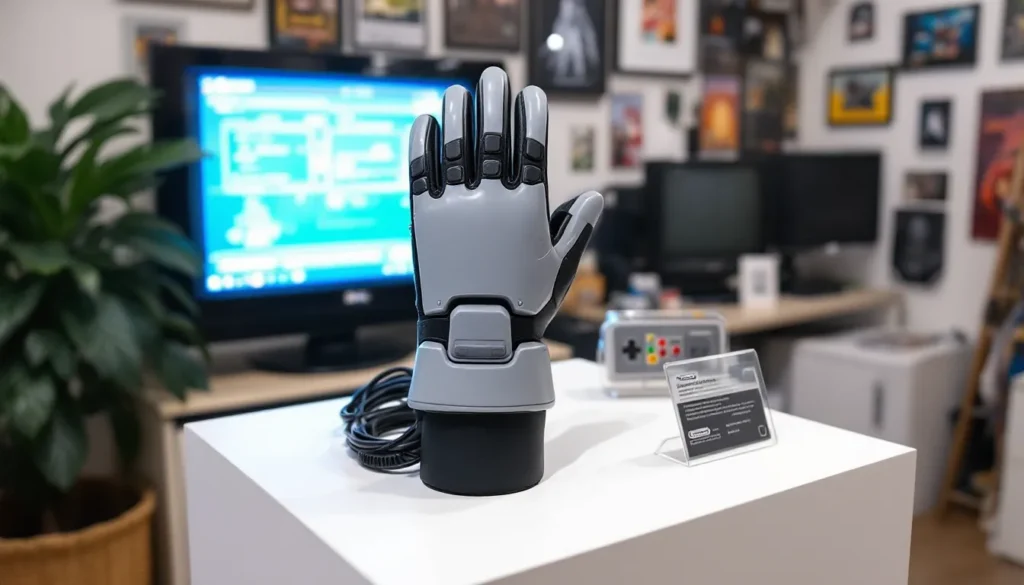
In 1989, Nintendo took a swing at the future of gaming with a gesture-controlled peripheral that looked like it belonged in a sci-fi movie. The Power Glove promised to let players control games with hand movements and finger gestures, no traditional controller needed. It was ambitious, futuristic, and backed by one of the most iconic marketing campaigns in gaming history. But while the Power Glove captured imaginations and became an instant cultural icon, its actual performance told a very different story. Decades later, this clunky piece of hardware remains one of gaming’s most fascinating failures: a device that couldn’t deliver on its promises but somehow became more legendary because of it. Whether you’re a retro collector eyeing one for your shelf or just curious about one of Nintendo’s strangest peripherals, here’s everything you need to know about the Power Glove.
Key Takeaways
- The Power Glove Nintendo peripheral pioneered motion-controlled gaming in 1989, but failed commercially due to poor tracking accuracy, physical fatigue, and limited gesture recognition capabilities.
- Despite technical shortcomings, the Power Glove achieved legendary cultural status through The Wizard movie and became an iconic symbol of 80s gaming innovation and ambitious failure.
- Only two games—Super Glove Ball and Bad Street Brawler—were officially designed for the Power Glove, leaving players with minimal gesture-based experiences and forcing most to use it as a standard controller.
- Modern retro collectors can purchase Power Glove units ranging from $80–$1,500+ depending on condition and completeness, with prices driven by increased collector interest in vintage gaming peripherals.
- The Power Glove’s limitations stemmed from ultrasonic tracking technology that required players to sit within three feet of their TV and caused constant calibration drift, making precise gameplay nearly impossible.
- Hardware modding communities have repurposed the Power Glove for Arduino projects, MIDI controllers, and VR experiments, proving the device’s enduring appeal beyond its original failed gaming purpose.
What Was the Nintendo Power Glove?
The Power Glove was a third-party controller accessory for the Nintendo Entertainment System (NES), released in October 1989 by Mattel. Even though being manufactured and marketed by Mattel, the device carried Nintendo’s official licensing, giving it legitimacy in an era when most third-party accessories were questionable knock-offs.
Designed to slip over the player’s right hand and forearm, the Power Glove used motion sensing and finger flex sensors to translate hand movements into game inputs. It represented one of the earliest consumer attempts at motion-controlled gaming, predating the Wii Remote by nearly two decades.
The glove came in two sizes to accommodate different hand sizes, though “small” and “large” were relative terms in 1989. The retail price hit $89.99, which was steep considering the NES console itself sold for around $100-130 at the time. Mattel positioned it as the next evolution in gaming, promising an immersive experience that would make traditional controllers obsolete.
Technologically, the Power Glove was based on patents from VPL Research, a company founded by virtual reality pioneer Jaron Lanier. Mattel licensed the technology and worked with Abrams Gentile Entertainment (AGE) to adapt it for the consumer gaming market. The result was a simplified, cost-reduced version of professional VR gloves that typically cost thousands of dollars.
The Origins and Development of the Power Glove
The Power Glove’s roots stretch back to VPL Research’s DataGlove, a high-end virtual reality input device developed in the mid-1980s. VPL’s gloves used fiber optic sensors to detect finger movements with precision, but they carried price tags between $9,000 and $15,000, firmly in research lab territory, not living rooms.
Mattel saw potential in bringing this technology to the mass market. The company licensed VPL’s patents and partnered with AGE to engineer a version that could be manufactured cheaply enough for retail. The development team faced significant challenges: they needed to strip out expensive components, simplify the tracking system, and make it durable enough for kids to use.
The final design used ultrasonic sensors instead of optical tracking, and replaced the DataGlove’s fiber optic finger sensors with flexible resistive strips. These compromises made the Power Glove affordable to produce, but they also introduced the accuracy problems that would plague the device.
Mattel’s marketing push was aggressive and savvy. The company secured product placement in Universal’s 1989 film The Wizard, where the Power Glove appeared as a coveted piece of gaming gear. The movie featured the now-infamous line: “I love the Power Glove. It’s so bad.” That word “bad” was meant as 80s slang for “cool,” but it became unintentionally prophetic.
How the Power Glove Actually Worked
From the player’s perspective, using the Power Glove involved strapping the device onto your hand and forearm with Velcro straps, then connecting it to the NES controller port. A separate sensor bar containing two ultrasonic microphones clipped to the top of your television.
The glove featured two rows of buttons along the forearm: programmable function keys that could be mapped to standard NES inputs (A, B, Start, Select), plus a numeric keypad for entering commands. A small joystick-style controller on the thumb allowed for directional input.
The finger flex sensors theoretically detected when you curled your fingers, translating those movements into button presses. In practice, this required deliberate, exaggerated hand gestures that quickly became tiring. The ultrasonic tracking system measured the glove’s position in 3D space relative to the TV-mounted sensor bar, but its effective range was limited to about three feet, and accuracy degraded significantly with distance or angle.
Players could switch between different control modes using the keypad, but most found it easier to just use the physical buttons and ignore the gesture controls entirely, defeating the entire purpose of the device.
How the Power Glove Worked: Technology Behind the Controller
Understanding why the Power Glove failed requires looking at its technical implementation. On paper, the technology was sound. In practice, 1989’s manufacturing capabilities and cost constraints created a device that couldn’t deliver on its promises.
Ultrasonic Sensors and Motion Tracking
The Power Glove’s spatial tracking relied on ultrasonic emitters embedded in the glove that transmitted high-frequency sound pulses. The sensor bar attached to your TV contained two microphones spaced apart horizontally. By measuring the time delay between when each microphone received the ultrasonic pulse, the system could triangulate the glove’s position in 3D space.
This approach had several critical flaws. Ultrasonic signals are easily disrupted by ambient noise, reflections off walls and furniture, and interference from other electronic devices. The effective tracking range maxed out at about three feet from the screen, forcing players to sit uncomfortably close to their TVs. Movement outside the narrow tracking cone caused the system to lose lock entirely.
The tracking update rate was also sluggish by modern standards, creating noticeable lag between hand movement and on-screen response. In fast-paced action games, this delay made precise control nearly impossible. Many gaming hardware reviews from the era noted that the tracking felt “mushy” and unresponsive compared to traditional controllers.
Button Configuration and Controls
The Power Glove’s physical interface consisted of several control systems that could work independently or together:
- 14 programmable buttons arranged in rows along the forearm
- Numeric keypad (0-9) for mode selection and programming
- Four flex sensors embedded in the fingers to detect curling motions
- Roll sensor to detect wrist rotation
- D-pad or joystick emulation through hand positioning
The glove supported multiple control schemes that could be switched via the keypad. In theory, this flexibility allowed developers to optimize controls for each game. In practice, the programming interface was clunky and non-intuitive, requiring players to memorize numeric codes.
The flex sensors used conductive ink on flexible plastic strips. When you bent your finger, the resistance changed, which the glove’s circuitry interpreted as input. But, the sensors required calibration and were sensitive to how tightly you wore the glove. Sweat, temperature changes, and normal wear degraded their accuracy over time.
Most frustrating was the fact that the glove’s best use case involved ignoring its headline features entirely. Players discovered that programming the forearm buttons to replicate standard NES controls and using it as an awkwardly-shaped traditional controller worked far better than attempting gesture control.
Games Compatible with the Power Glove
The Power Glove’s software library was thin, which contributed significantly to its commercial failure. While Mattel advertised compatibility with the entire NES library, that claim came with massive asterisks.
Officially Licensed Power Glove Games
Only two games were specifically designed for the Power Glove, both published by Mattel itself:
Super Glove Ball (1990)
This was the Power Glove’s flagship title, a 3D maze game where players navigated a ball through corridors using hand movements. The game attempted to showcase the glove’s motion-tracking capabilities with mechanics that required tilting and positioning your hand to steer. Reviews were mixed at best, the concept was novel, but imprecise controls made later levels exercises in frustration.
Bad Street Brawler (1989)
A side-scrolling beat-’em-up that supported both standard controllers and the Power Glove. Different hand gestures triggered different attacks: punch moves came from thrusting your fist forward, while uppercuts required raising your hand. The gesture recognition was unreliable enough that most players stuck with regular controllers.
Beyond these two titles, no other developers invested in creating Power Glove-specific games. The device launched too late in the NES’s lifecycle, and third-party developers weren’t willing to bet on an unproven peripheral with a small install base.
Playing Standard NES Games with the Power Glove
Mattel claimed the Power Glove was compatible with all NES games, which was technically true, but practically misleading. The glove could emulate a standard NES controller by programming its buttons to correspond to A, B, Start, Select, and the D-pad. But, this defeated the entire purpose of owning a gesture-controlled device.
Certain game genres were theoretically better suited to the Power Glove’s capabilities:
- Flight simulators like Top Gun could use tilt controls for banking and altitude
- Racing games including Rad Racer might benefit from steering via hand rotation
- Light gun games such as Duck Hunt were completely incompatible, even though early marketing suggestions otherwise
In practice, even games that should have worked well with gesture controls played worse than with a standard controller. The lag, inaccuracy, and limited range made the Power Glove inferior in virtually every scenario. Speedrunners and competitive players avoided it entirely, and casual players found it more gimmick than innovation.
Retro gaming enthusiasts who’ve tested the Power Glove with popular NES titles report that games like Super Mario Bros. and The Legend of Zelda are technically playable but unnecessarily difficult. Precise platforming becomes guesswork, and menu navigation turns into a chore.
Why the Power Glove Failed Commercially
The Power Glove’s commercial trajectory was brutal. Initial sales were strong thanks to holiday 1989 buzz and The Wizard marketing, but word-of-mouth quickly turned negative. By 1990, the device was being clearanced out at steep discounts. Mattel discontinued production after less than two years on the market.
Technical Limitations and Poor Accuracy
The fundamental problem was simple: the Power Glove didn’t work well enough to be fun. In gaming, precision matters. When a player presses a button on a traditional controller, they expect instant, reliable response. The Power Glove introduced uncertainty into every input.
Tracking drift was constant. The ultrasonic system would lose calibration mid-game, causing on-screen cursors to wander or directional input to become inverted. Recalibration required stopping gameplay and going through a reset procedure using the keypad, breaking immersion and interrupting flow.
The finger flex sensors were inconsistent. One player might need to barely curl their finger to trigger an input, while another had to make an exaggerated fist. The glove’s responsiveness changed based on how tightly it was strapped, whether your hand was sweaty, and even the ambient temperature. Some users reported the sensors working fine in air-conditioned rooms but becoming erratic after 15 minutes of play as their hands warmed up.
Physical fatigue was another issue. Holding your arm extended in the tracking zone while making deliberate gestures was exhausting. Traditional controllers let players relax their hands in their laps: the Power Glove demanded constant active positioning. Sessions longer than 30 minutes left players with sore arms and stiff shoulders.
Many technology reviews from the period noted that while the concept was innovative, the execution fell short of what gamers needed for an enjoyable experience. The gap between marketing promises and actual performance was too wide to ignore.
High Price Point and Limited Software Support
At $89.99, the Power Glove cost nearly as much as the NES console itself. That’s a tough sell for any accessory, but it’s especially problematic when the device doesn’t significantly improve the gaming experience. Parents who bought the Power Glove as a holiday gift faced disappointment when their kids reverted to standard controllers within days.
The pricing became even less defensible given the lack of software support. With only two dedicated games and no third-party developer interest, the value proposition collapsed. Compare this to successful peripherals like the NES Zapper, which launched with Duck Hunt bundled with many consoles and had a robust library of compatible titles.
Retailers were reluctant to dedicate shelf space to an accessory with weak sales velocity. By mid-1990, the Power Glove was relegated to bargain bins and closeout sales. Some stores sold remaining inventory for as low as $20-30, but even at steep discounts, demand was tepid.
The timing hurt as well. The Power Glove launched in late 1989, when the NES was nearing the end of its market dominance. The Sega Genesis arrived in North America in August 1989, and the Super Nintendo Entertainment System would launch in 1991. Developers were looking forward to next-generation platforms, not investing in peripherals for aging hardware.
The Power Glove’s Cultural Impact and Legacy
Here’s where things get interesting: even though its technical and commercial failures, the Power Glove achieved legendary status in gaming culture. It became an icon of retro gaming, 80s nostalgia, and the ambitious weirdness that defined Nintendo’s experimental era.
The Wizard Movie and Pop Culture Status
The Power Glove’s appearance in The Wizard cemented its place in pop culture history. The 1989 film was essentially a 100-minute Nintendo commercial disguised as a family adventure movie, and it worked. Kids who saw the movie wanted the Power Glove regardless of its actual capabilities.
The line “I love the Power Glove. It’s so bad” became one of gaming’s most enduring quotes. Delivered by antagonist Lucas Barton (played by Jackey Vinson) with smug confidence, the moment was meant to establish the Power Glove as the ultimate gaming flex. Instead, it became unintentionally prophetic, and eventually, ironic. Gamers quote it today with knowing winks, fully aware that “so bad” applies in the modern sense too.
The Wizard gave the Power Glove an outsized cultural footprint relative to its actual market presence. Many gamers who never owned or even saw a Power Glove in person still recognize it from the movie. That association kept the device in collective memory long after it disappeared from store shelves.
Modern Tributes and References in Gaming
The Power Glove frequently appears as an Easter egg or reference in modern games and media:
- Ready Player One (2018) featured the Power Glove prominently in both the novel and film adaptation
- Wreck-It Ralph (2012) included Power Glove imagery in background details
- Various indie games have included Power Glove-inspired unlockable items or achievements
- YouTube retrospectives about gaming history frequently highlight the Power Glove as a cautionary tale of overpromising
The device has become shorthand for “ambitious but flawed innovation” in gaming discussions. When new motion-control technology is announced, someone inevitably invokes the Power Glove as a warning about hype outpacing execution.
Ironically, the Power Glove was ahead of its time conceptually. Motion controls eventually became mainstream gaming with the Nintendo Wii (2006), PlayStation Move (2010), and various VR controller schemes. The core idea, using natural hand movements for game input, was sound. The Power Glove simply arrived too early, with too many technical compromises, and without the processing power and sensor technology needed to execute the vision properly.
Modern coverage on Nintendo news sites often revisits the Power Glove during retrospectives about Nintendo’s experimental peripherals, placing it alongside other oddities like the Virtual Boy and the R.O.B. robot.
Collecting the Power Glove in 2026: Value and Rarity
The retro gaming market has exploded over the past decade, and unusual peripherals like the Power Glove have benefited from increased collector interest. What once filled bargain bins now commands respectable prices, though not quite the stratospheric values of rare game cartridges.
Current Market Prices and Where to Find One
As of early 2026, Power Glove prices vary significantly based on condition, completeness, and included accessories:
- Loose glove only: $80-150
- Glove with sensors and manual: $150-250
- Complete in box (CIB): $300-500
- Sealed new-in-box: $800-1,500+
These prices represent typical marketplace listings. Actual sale prices can vary based on specific condition details, seller reputation, and whether the glove is tested and confirmed working. Power Gloves with damaged foam padding, broken Velcro straps, or non-functional sensors sell for less.
Where to find Power Gloves in 2026:
- eBay: The most active marketplace, with dozens of listings at any given time
- Retro gaming conventions: Often priced higher than online but allows in-person inspection
- Facebook Marketplace and Craigslist: Occasional deals from sellers who don’t know the collector value
- Specialty retro gaming stores: Usually carry tested, working units with return policies
- Online retro gaming retailers: Sites like DKOldies and JJGames stock them periodically
Avoid suspiciously cheap international listings, especially from unverified sellers. Reproduction sensors and modified gloves exist, which may not function properly with original NES hardware.
Condition Grading and What to Look For
When evaluating a Power Glove for purchase, inspect these critical areas:
Foam padding condition: The gray foam inside the glove deteriorates over time, becoming brittle and crumbly. Gloves with intact, supple foam are worth premium prices. Degraded foam doesn’t affect functionality but makes wearing the glove uncomfortable.
Velcro straps: Check that all straps are present and securely attached. Replacement Velcro can be sourced, but original straps in good condition add value.
Flex sensors: These are difficult to test without powering on the glove, but look for visible damage, tears, or separation in the finger sensor strips.
Cable integrity: The cable connecting the glove to the NES should be free of cuts, kinks, or exposed wiring. Cable damage often occurs near the connector ends.
Sensor bar: Complete sets should include the ultrasonic sensor bar that mounts to your TV. The sensor bar’s condition is crucial for gesture control functionality.
Documentation: Original manuals add value and provide programming codes needed to configure the glove for different games.
Testing: If possible, request that the seller test the glove before purchase. Non-functional units are worth significantly less unless you’re buying for repair or display purposes.
For serious collectors, graded and sealed Power Gloves exist but command premium prices. The collector market values originality, avoid units with aftermarket modifications unless you’re specifically interested in modded hardware.
Modern Uses and Modifications for the Power Glove
While the Power Glove failed as a mainstream gaming peripheral, it found a second life in the maker and modder communities. Hardware hackers saw potential in the device’s sensors and have repurposed Power Gloves for projects Nintendo and Mattel never imagined.
Hacking and Reprogramming Projects
The modding community has extensively documented Power Glove internals and created numerous projects:
Arduino integration: Several projects connect Power Glove sensors to Arduino microcontrollers, reading finger flex and tilt data to control robotics, drones, or custom electronics. The ultrasonic tracking is typically abandoned in favor of modern IMU (inertial measurement unit) sensors.
MIDI controller conversion: Musicians have reprogrammed Power Gloves to function as MIDI controllers, using finger gestures to trigger samples, adjust parameters, or control synthesizers. The theatrical appeal of wearing a glove on stage adds to the attraction.
VR controller experiments: Before consumer VR took off, DIY enthusiasts experimented with using modified Power Gloves as hand-tracking input for early VR setups. Modern commercial VR gloves are far superior, but Power Glove mods represented early proof-of-concept work.
Art installations: Interactive art pieces have incorporated Power Gloves as gesture input devices, allowing viewers to control projections, lighting, or sound through hand movements.
Custom game projects: Some indie developers have created modern games specifically designed around Power Glove input, either as experiments or novelty projects. These typically run on PC with custom driver software translating glove inputs.
Modification difficulty ranges from beginner-friendly Arduino hookups to advanced projects requiring circuit board reverse-engineering and custom firmware development. The Power Glove’s relatively simple electronics make it more accessible than modern sealed peripherals.
Using the Power Glove with Modern Devices
Several community-created solutions allow Power Gloves to interface with modern gaming systems:
USB adapter projects: Hardware hackers have built adapters that connect the Power Glove to PC via USB, with software drivers translating inputs into standard gamepad or mouse commands. Accuracy and latency remain issues, but it’s functional for casual play.
RetroUSB adapter: This commercial adapter allows NES peripherals, including the Power Glove, to connect to PC. Configuration software lets users map glove inputs to keyboard keys or gamepad buttons.
RetroPie and emulation: Power Gloves can be connected to Raspberry Pi-based retro gaming setups through USB adapters. This allows playing NES ROMs with original Power Glove hardware, complete with all the original limitations.
Streaming and content creation: Some gaming streamers and YouTubers use Power Gloves for challenge runs or novelty content. Playing modern games with Power Glove input through adapter setups generates views, even if the actual gameplay is predictably clumsy.
The modding community maintains active forums and GitHub repositories with schematics, code, and documentation. Power Glove hacking attracts both retro gaming enthusiasts and electronics hobbyists interested in repurposing vintage hardware.
It’s worth noting that for most gaming purposes, modded or adapted Power Gloves still suffer from the original’s fundamental accuracy problems. The hardware limitations that plagued the device in 1989 haven’t changed. But for experimentation, learning electronics, or just having a conversation piece, the Power Glove offers unique possibilities that generic controllers don’t.
Conclusion
The Power Glove represents one of gaming’s most fascinating what-ifs. It was ambitious, innovative, and backed by solid marketing, but eventually undone by technical limitations that 1989’s technology couldn’t overcome. As a functional gaming peripheral, it failed. Players found it frustrating, developers ignored it, and retailers clearanced it out within two years.
Yet the Power Glove succeeded in ways Mattel never anticipated. It became a cultural icon, a nostalgic symbol of 80s gaming excess, and a cautionary tale about overpromising. It inspired a generation of hardware hackers and proved that even failed experiments can leave lasting legacies. The device demonstrated that gamers were ready for motion controls, just not that particular implementation.
For collectors in 2026, the Power Glove occupies a sweet spot: recognizable enough to be desirable, rare enough to hold value, but not so expensive that it’s unattainable. For modders, it’s a playground of vintage sensors and quirky electronics waiting to be repurposed. And for gaming historians, it’s a reminder that innovation requires risk, and sometimes the most memorable products are the ones that didn’t quite work.
Whether you’re hunting for one to add to your retro collection or just appreciate it from afar as a monument to gaming’s experimental spirit, the Power Glove remains relevant decades after its commercial death. It’s so bad, and that’s exactly why we still love it.