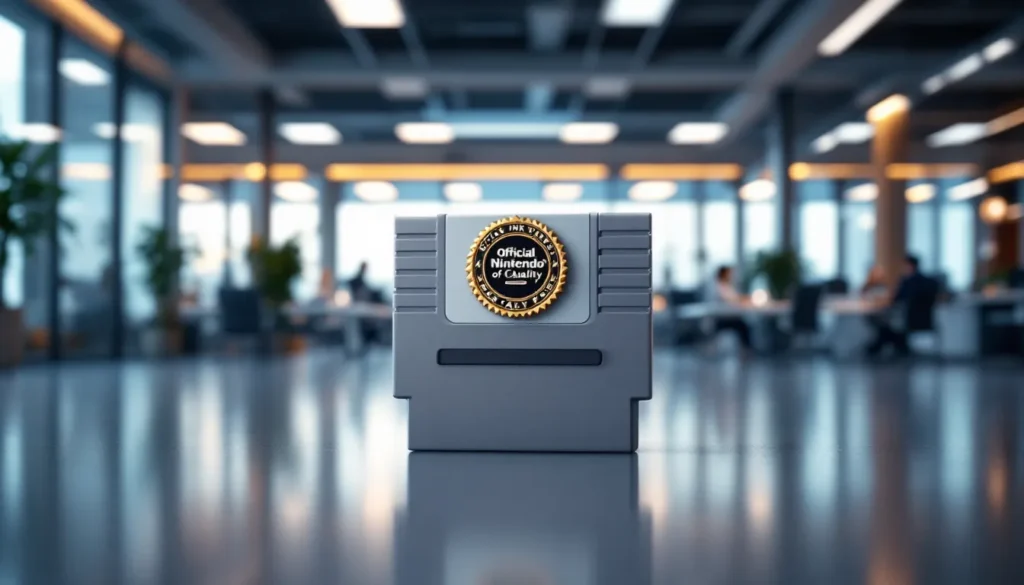
That little circular stamp on NES cartridges, Official Nintendo Seal of Quality, probably didn’t mean much to you as a kid. You just wanted to play the game. But that seal wasn’t just a logo. It was Nintendo’s answer to one of the biggest disasters in gaming history, a regulatory system disguised as a quality promise, and the foundation for how console makers control their ecosystems to this day.
In 1985, American retailers wouldn’t touch video games with a ten-foot pole. The industry had imploded two years earlier, leaving warehouses full of unsold cartridges and burned investors. Nintendo had to convince skeptical stores, and traumatized consumers, that their games wouldn’t be shovelware garbage. The seal was their weapon, backed by aggressive licensing terms and proprietary lockout technology that fundamentally reshaped the relationship between platform holders and third-party developers.
This isn’t just a nostalgia trip. The Nintendo Seal of Quality established principles that echo through PlayStation certification, Xbox’s policies, and even Apple’s App Store approval process. Understanding how Nintendo weaponized a tiny stamp reveals how the modern gaming industry actually works.
Key Takeaways
- The Nintendo Seal of Quality was a licensing and control system designed to restore consumer trust after the 1983 video game crash, not a guarantee of game quality or entertainment value.
- Nintendo used proprietary lockout chip technology (10NES) and strict licensing agreements to enforce complete control over third-party developers, establishing a gatekeeping model that modern platforms still follow today.
- The seal certified only that games were officially licensed, would function in the console, and met content guidelines—it explicitly did not promise fun or quality gameplay, as evidenced by numerous poorly-reviewed licensed games that still bore the seal.
- Legal battles like Nintendo vs. Tengen established that platform holders have the right to restrict software development through technical measures, a precedent that continues through PlayStation, Xbox, and App Store certification processes.
- Today’s digital gaming platforms inherit the Nintendo Seal of Quality’s legacy of platform holder control through certification, revenue cuts, and release approval systems, though modern methods use digital storefronts and user reviews instead of physical stamps.
What Is the Nintendo Seal of Quality?
The Official Nintendo Seal of Quality appeared on every licensed NES game cartridge starting in 1985 (1986 in Europe, 1987 in Australia). Originally gold in North America and later changed to black in the early 1990s, the circular seal served as Nintendo’s stamp of approval that a game was an authorized product manufactured under their licensing agreement.
The seal communicated three things to consumers: the cartridge would physically work in your NES console, Nintendo had approved the developer to make games for their platform, and the game met Nintendo’s content guidelines. Note that last part, content guidelines, not quality standards. The seal never actually promised a game would be good, fun, or worth your money.
From a business standpoint, the seal represented Nintendo’s unprecedented control over third-party software. Developers couldn’t just make NES games and sell them. They needed Nintendo’s permission, paid royalties on every cartridge manufactured, and submitted to strict contractual terms that limited how many games they could release per year. The seal was visible proof of Nintendo’s licensing gatekeeping in action.
The physical seal appeared on game packaging and cartridge labels, but the real enforcement mechanism lived inside the console itself. The NES hardware included a proprietary lockout chip that prevented unauthorized cartridges from functioning, technology that made the seal more than just a sticker. It was a legally and technically enforced monopoly on NES software production.
The Video Game Crash of 1983 and Why Nintendo Needed the Seal
The Great Collapse: What Went Wrong
The North American video game market didn’t just decline in 1983, it collapsed so catastrophically that major retailers like Toys “R” Us started clearing out gaming sections entirely. Industry revenue plummeted from $3.2 billion in 1983 to around $100 million by 1985, a 97% crash that sent Atari’s parent company Warner Communications into a tailspin and bankrupted multiple publishers.
Several factors converged to create the disaster. First, there was zero quality control. Anyone could manufacture Atari 2600 cartridges, flooding the market with shovelware. Second, insane overproduction, Atari famously manufactured more copies of E.T. than there were console owners, burying unsold cartridges in a New Mexico landfill. Third, consumer confidence evaporated when they realized a $30-$40 game purchase might deliver an unplayable mess.
The crash taught the industry a brutal lesson: without gatekeepers, the market drowns in garbage. Retailers got burned by unsold inventory. Consumers got burned by terrible games. Publishers went bankrupt. The whole ecosystem needed someone to say “no” before a game reached store shelves.
Nintendo’s Solution to Restore Consumer Trust
Nintendo president Hiroshi Yamauchi understood that launching a console in post-crash America required more than good hardware. They needed to guarantee retailers and consumers that the NES wouldn’t repeat Atari’s mistakes. The Seal of Quality was Nintendo’s public-facing promise, but the real solution was a comprehensive licensing system that gave Nintendo total control over their platform.
Nintendo’s pitch to retailers emphasized the lockout chip technology that prevented unlicensed games from functioning. No more fly-by-night publishers dumping garbage onto shelves. Every cartridge bearing the seal had to be manufactured by Nintendo or with Nintendo’s explicit approval, creating a bottleneck that ensured only committed developers with real budgets could enter the market.
The strategy worked brilliantly. Retailers who’d sworn off video games gave Nintendo shelf space because the licensing system meant they weren’t gambling on unknown publishers. Consumers saw the seal and knew the cartridge would at least boot up. Nintendo positioned themselves as the gaming industry’s quality police, whether they actually delivered on that promise is another question entirely.
How the Seal of Quality Program Actually Worked
Licensing Requirements and Approval Process
To earn the seal, third-party developers had to sign Nintendo’s licensing agreement, which was notoriously restrictive. Publishers paid Nintendo a manufacturing fee for each cartridge, initially around $10-$14 per cart plus royalties. Nintendo required minimum production orders (typically 10,000 units), which meant small developers couldn’t afford the entry cost.
The licensing terms included a two-year exclusivity clause: games published on NES couldn’t appear on competing consoles for 24 months. Nintendo also limited third-party publishers to five games per year, preventing any single company from flooding the market. Want to release more? Some publishers like Konami created subsidiary labels (Ultra Games) to circumvent the limit.
Nintendo’s approval process reviewed games for content, no excessive violence, no profanity, no religious imagery that might offend retailers, no nudity. They didn’t evaluate whether a game was fun, balanced, or bug-free. Plenty of broken, frustrating games sailed through approval because they met content guidelines. The seal certified compliance with Nintendo’s rules, not entertainment value.
Developers also faced technical requirements submission (TRS) guidelines that dictated how games should handle controller input, save data, and system resets. These were actual quality standards, ensuring games wouldn’t brick consoles or corrupt save files. But these technical requirements were separate from the marketing promise implied by the seal’s name.
The 10NES Lockout Chip: Enforcing Quality Through Technology
The 10NES chip (Checking Integrated Circuit) was Nintendo’s secret weapon, a proprietary authentication system that performed a handshake between the console and cartridge at boot. If the cartridge didn’t contain the corresponding CIC chip programmed with Nintendo’s authentication code, the console refused to run it.
This wasn’t just DRM: it was hardware-enforced market control. Every licensed cartridge required a CIC chip that Nintendo supplied and charged for. Unlicensed developers couldn’t legally obtain the chips, effectively making it impossible to sell NES games without Nintendo’s permission. Nintendo’s proprietary lockout technology set the precedent for console security that continues through modern platforms.
The 10NES system caused the infamous blinking red light issue when cartridge contacts corroded or the chip connection failed. That frustrating experience of blowing into cartridges? You were trying to clean contacts to restore the chip authentication handshake. The lockout chip’s sensitivity to poor connections created one of gaming’s most widespread technical problems.
Nintendo’s control was so absolute that even licensed developers had to order chips from Nintendo with lead times measured in months. If a publisher underestimated demand, they couldn’t quickly manufacture more cartridges, Nintendo’s manufacturing bottleneck ensured they controlled the entire supply chain from chip to cartridge to retail.
Production Limits and Nintendo’s Control Strategy
Beyond the five-game annual limit, Nintendo controlled manufacturing capacity strategically. During high-demand periods like Christmas seasons, Nintendo prioritized their first-party titles over third-party releases. Third-party publishers often faced chip shortages or manufacturing delays while Nintendo ensured Mario and Zelda inventory stayed healthy.
This production control gave Nintendo enormous leverage in negotiations. Publishers desperate for holiday release slots would accept less favorable terms or prioritize Nintendo platforms over competitors. The seal wasn’t just about quality, it was about Nintendo maintaining iron-fisted control over their ecosystem’s economics.
Nintendo also required developers to submit finalized game code months before release to accommodate manufacturing and approval timelines. This prevented last-minute patches or updates, meaning any bugs that shipped were permanent. The seal certified a snapshot of the game at submission, not the best possible version developers could create.
Did the Seal Actually Guarantee Quality?
Notable Bad Games That Still Got the Seal
Let’s be brutally honest: the seal appeared on some absolute garbage. LJN’s library alone disproves any claim that the seal meant quality games. Friday the 13th, Dr. Jekyll and Mr. Hyde, The Karate Kid, these licensed disasters bore the seal proudly even though being nearly unplayable.
Back to the Future (1989) featured nonsensical gameplay and controls so bad they’ve become memes. It had the seal. Total Recall (1990) was a broken mess that barely resembled its source material. It had the seal. Bill & Ted’s Excellent Video Game Adventure (1991) was so terrible it made players question reality itself. Yep, sealed.
Many publishers focused on licensed properties knew they’d make money on brand recognition regardless of game quality. As long as games met Nintendo’s content guidelines and technical minimums, the seal was granted. The market got flooded with mediocre licensed games that damaged the seal’s credibility as a quality indicator.
Even first-party Nintendo games weren’t immune to quality issues. Urban Champion was boring. Golf was functional but bland. These weren’t broken, but they certainly weren’t fun for most players. The seal couldn’t guarantee entertainment value because fun is subjective and Nintendo never claimed to judge that.
What the Seal Really Meant for Gamers
The seal’s actual promise was simple: this cartridge is officially licensed, will physically work in your console, and meets Nintendo’s content standards. That’s it. It guaranteed legal compliance and basic functionality, not enjoyment.
For 1980s gamers, that baseline guarantee mattered more than it might seem today. The seal meant you weren’t buying a bootleg that might damage your console. It meant the game wouldn’t have pornographic content that’d get your parents to throw out your NES. It meant some company had invested enough to meet Nintendo’s requirements rather than churning out a quick cash-grab.
The seal also provided consistency in cartridge quality, the physical manufacturing was reliable, labels were professionally printed, instruction manuals existed. Compare that to the Atari era’s inconsistent cartridge quality and packaging, and the seal represented a significant improvement in product baseline standards.
Did it prevent bad games? Absolutely not. But it prevented the absolute bottom-tier trash that killed the Atari 2600. The seal raised the floor, even if it didn’t guarantee the ceiling. In a post-crash market, raising the floor was exactly what the industry needed to survive.
The Legal Battles: Tengen, Atari Games, and Breaking Nintendo’s Grip
Not everyone accepted Nintendo’s monopoly quietly. Tengen, the home video game division of Atari Games (not the same company that crashed), became the seal’s most famous challenger. After initially licensing with Nintendo, Tengen grew frustrated with manufacturing delays, limited release slots, and Nintendo’s control over pricing and distribution.
In 1988, Tengen reverse-engineered the 10NES lockout chip to manufacture unlicensed NES cartridges without Nintendo’s approval. They released games like R.B.I. Baseball, Gauntlet, and their own version of Tetris in distinctive black-and-gold cartridges that lacked the seal but worked in NES consoles. Tengen argued they were breaking an illegal monopoly.
The resulting legal battle was complex. Tengen obtained documents from the US Patent Office under false pretenses to understand the 10NES system, which destroyed their legal position. Nintendo sued for patent and copyright infringement. The courts sided with Nintendo in most key decisions, establishing that console makers had the right to control software for their platforms.
The Tengen case set precedent that echoes through gaming law today. Platform holders can legally restrict who develops for their systems and enforce those restrictions through technical measures. The seal represented Nintendo’s right to gatekeep their ecosystem, and courts upheld that right even though monopolistic concerns.
Other companies like Color Dreams and Wisdom Tree manufactured unlicensed cartridges using different workarounds, but they remained niche products. Industry observers and gaming publications closely followed these legal battles, recognizing they would define platform holder rights for generations. Nintendo’s legal victories cemented the licensing model that Sony, Microsoft, and modern platform holders still use today.
Evolution of the Seal Across Nintendo Consoles
From NES to SNES: Design Changes and Refinements
The seal changed appearance when the Super Nintendo launched in 1991. The SNES version featured a circular gold seal reading “Official Nintendo Seal of Quality,” slightly larger and more prominent than the later NES black version. The SNES cartridges used an updated lockout chip system (CIC variants by region) that was more sophisticated than the 10NES.
Nintendo’s licensing terms evolved with SNES, slightly relaxing some NES-era restrictions but maintaining firm control over manufacturing and content approval. The seal’s meaning remained consistent: official license, content approval, technical compliance. Third-party developers still paid substantial royalties and faced minimum order quantities.
The seal text shifted subtly during this era. By the mid-1990s, Nintendo changed the language from “Seal of Quality” to “Official Nintendo Seal” in North America, quietly backing away from explicit quality claims. This change reflected growing awareness that the seal couldn’t actually promise game quality, only authorization.
Nintendo 64, GameCube, and the Modern Era
The Nintendo 64 (1996) maintained the circular seal design with updated text: “Official Nintendo Seal.” N64’s cartridge-based format meant Nintendo still controlled manufacturing, though the five-game annual limit had been abandoned by this point. The seal appeared on cartridge labels and game boxes but with less marketing emphasis than the NES era.
The GameCube (2001) switched to proprietary mini-DVDs, maintaining the seal on disc labels and packaging. By this generation, the seal had become routine branding rather than a major selling point. Digital distribution was emerging, and the seal’s role as a physical authenticity marker was beginning its decline.
The Wii (2006), Wii U (2012), and Nintendo Switch (2017) all feature variations of the seal on physical media and packaging. Modern versions typically read “Official Nintendo Seal” or display just the Nintendo logo without quality language. Japanese gaming coverage sources note that regional seal variations persist, with different text for North America, Europe, and Japan.
Today’s seal is vestigial branding rather than a revolutionary quality control system. Physical Switch cartridges display it, but the seal’s original purpose, preventing unauthorized software and restoring post-crash consumer trust, has been replaced by digital storefronts, user reviews, and platform certification processes that operate behind the scenes.
The Seal’s Legacy in Today’s Digital Gaming Marketplace
Platform Holders Still Control Quality Standards
The Nintendo Seal of Quality pioneered the certification model that every major platform uses today. Sony’s PlayStation certification, Microsoft’s Xbox certification, Apple’s App Store review, Steam’s (minimal) quality baseline, all descend from Nintendo’s 1985 innovation. Platform holders still decide who can sell software on their ecosystems and under what terms.
Modern certification processes evaluate technical performance (frame rate stability, crash frequency, trophy/achievement implementation), content appropriateness (age ratings, prohibited content), and platform-specific requirements (HDR support, controller compatibility, online functionality). These standards are more sophisticated than Nintendo’s original approval process but serve the same gatekeeping function.
The financial model persists too. Platform holders take a 30% revenue cut on digital sales, echoing Nintendo’s royalty fees. First-party titles receive priority in marketing and storefront placement, just as Nintendo prioritized Mario over third-party games. The seal’s lessons about platform control remain fundamental to the business model.
Developers still complain about arbitrary rejection, slow approval processes, and platform holders changing requirements mid-generation. The same frustrations that drove Tengen to reverse-engineer the 10NES chip now drive complaints about App Store rejections and console certification delays. The technology changed: the power dynamics didn’t.
How Modern Certification Differs from the Original Seal
Today’s certification is less visible but more technically rigorous. Modern platforms test for bugs, performance issues, and compliance with hundreds of technical requirements. The original seal verified that a game met basic content guidelines and contained the proper lockout chip. Modern cert catches crashes, frame rate problems, save corruption, and accessibility failures.
Digital distribution eliminated manufacturing bottlenecks. Nintendo controlled NES cartridge production, creating artificial scarcity. Today’s platforms allow unlimited digital copies, though platform holders still control release timing through certification approval. Patches and updates mean games can launch broken and get fixed later, something impossible in the cartridge era.
User reviews and aggregation sites like Metacritic provide the quality information the seal promised but never delivered. Gamers don’t need Nintendo’s seal to know if a game is good: they check Reddit, YouTube, and review scores. The seal certified authorization: the internet certifies quality.
The seal’s physical presence has faded. Most Switch owners probably don’t notice it on cartridge labels. Digital-only players never see it at all. Yet its legacy, platform holders as gatekeepers who control access, pricing, and content on their ecosystems, defines how we buy and play games in 2026. That tiny NES stamp established rules the industry still follows four decades later.
Conclusion
The Nintendo Seal of Quality wasn’t really about quality. It was about control, market recovery, and establishing a business model that would dominate gaming for generations. Nintendo used a simple stamp, backed by aggressive licensing and proprietary technology, to rebuild an industry that had collapsed under the weight of unregulated garbage.
Did it work? Absolutely. The NES revived console gaming in North America and established Nintendo as the industry’s dominant force through the early 1990s. The seal communicated stability and legitimacy to a burned market, even if it couldn’t prevent bad games from reaching shelves.
The seal’s real legacy isn’t the circular logo on cartridges, it’s the platform holder control model that defines gaming today. Every certification process, every storefront approval, every developer complaining about platform requirements traces back to Nintendo’s decision in 1985 to gatekeep their ecosystem. The seal changed gaming forever, just not in the way that marketing promised.