Nintendo made a lot of bold bets in the 2000s, but few were as risky, or as wildly successful, as the original DS. Launched in November 2004, this chunky, dual-screened oddity faced immediate skepticism from critics, competitors, and even Nintendo’s own fans. Why mess with the Game Boy formula that had dominated portable gaming for over a decade? Why split the focus with two screens when one had always been enough? But Nintendo saw something the rest of the industry didn’t: an opportunity to redefine what handheld gaming could be. The DS didn’t just iterate on what came before, it introduced touch controls, stylus-based gameplay, and wireless features that opened doors to entirely new genres and audiences. Over its lifespan, the DS family sold over 154 million units worldwide, making it the second best-selling game console of all time. More importantly, it changed how developers thought about portable games and proved that innovation could trump raw processing power. This is the story of the original DS, the “Phat” model that started it all.
Key Takeaways
- The original Nintendo DS revolutionized handheld gaming by introducing dual touchscreens and stylus-based gameplay that created entirely new genres and gaming experiences.
- Despite initial skepticism, the original Nintendo DS outsold the Sony PSP by focusing on innovative gameplay and accessible experiences like Nintendogs and Brain Age rather than raw processing power.
- The original Nintendo DS sold over 154 million units worldwide, making it the second best-selling console of all time and proving that unique design could expand gaming to non-traditional audiences.
- Today, original DS Phat models remain affordable and collectible at $40-$150 depending on condition, with plenty of games available and active emulation support for preservation efforts.
- The original DS demonstrated that touch controls, dual screens, and accessible design could coexist with hardcore gaming titles, offering versatility that influenced Nintendo’s entire strategic direction.
What Made the Original Nintendo DS Different?
Dual Screens and Touch Technology
The DS’s defining feature was right there in its name: Dual Screen. Nintendo gave players two 3-inch LCD screens stacked vertically in a clamshell design, with the bottom screen featuring resistive touch technology. This wasn’t just a gimmick, it fundamentally changed how games presented information and accepted input.
The top screen typically displayed the main gameplay view, while the bottom touchscreen handled menus, maps, inventory management, or entirely new control schemes. Games like The Legend of Zelda: Phantom Hourglass let players draw paths for Link’s boomerang, while Nintendogs had players petting virtual puppies with the included stylus. The resistive touchscreen required physical pressure, which is why the stylus was essential, and why so many DS units are missing theirs today.
This dual-screen setup gave developers a canvas that had never existed in portable gaming before. It wasn’t about more screen real estate: it was about reimagining how players interacted with games.
Built-In Microphone and Wireless Connectivity
Nintendo packed even more tech into the original DS beyond the screens. A built-in microphone opened up voice-activated gameplay, from blowing out candles in Super Mario 64 DS to shouting commands in Nintendogs. Some games, like Brain Age, used it for voice recognition puzzles.
Then there was PictoChat, the DS’s built-in local wireless chat application. Before smartphones dominated communication, PictoChat let nearby DS users send text and doodles to each other within about 30-65 feet. It became a phenomenon in schools, airports, and anywhere gamers congregated.
The DS supported Download Play, allowing one cartridge to beam a limited version of certain games to nearby DS systems for local multiplayer, no extra purchases required. This feature was massive for games like Mario Kart DS and turned the system into a social gaming device long before online multiplayer became standard on handhelds. The DS also featured Wi-Fi connectivity for online play through Nintendo Wi-Fi Connection, though this service was discontinued in 2014.
Technical Specifications and Hardware Design
Processing Power and Display Features
The original DS shipped with two processors: a 67 MHz ARM9 and a 33 MHz ARM7. The ARM9 handled DS-specific tasks, while the ARM7 provided backward compatibility with Game Boy Advance cartridges. This dual-CPU setup gave the DS roughly the graphical capabilities of the Nintendo 64, though with significant differences in architecture.
Both screens measured 3 inches diagonally with a resolution of 256 × 192 pixels each. Not exactly high-definition by any measure, even in 2004, but the resistive touchscreen was the real star. The displays could render up to 262,144 colors and supported basic 3D polygon graphics alongside traditional 2D sprites.
The system included 4 MB of RAM, with an additional 656 KB of video RAM. Game cartridges used a proprietary format that could hold anywhere from 8 MB to 512 MB of data, significantly larger than GBA carts. Audio was handled by a 16-channel stereo speaker system, with support for PCM and ADPCM sound formats, a notable upgrade from the Game Boy line.
Battery Life and Physical Build Quality
Nintendo rated the original DS’s battery life at 6-10 hours of gameplay on a full charge, depending on screen brightness and wireless usage. The system used a rechargeable 850 mAh lithium-ion battery. In practice, most players got about 8 hours with moderate brightness settings, solid for 2004, though later revisions would improve on this.
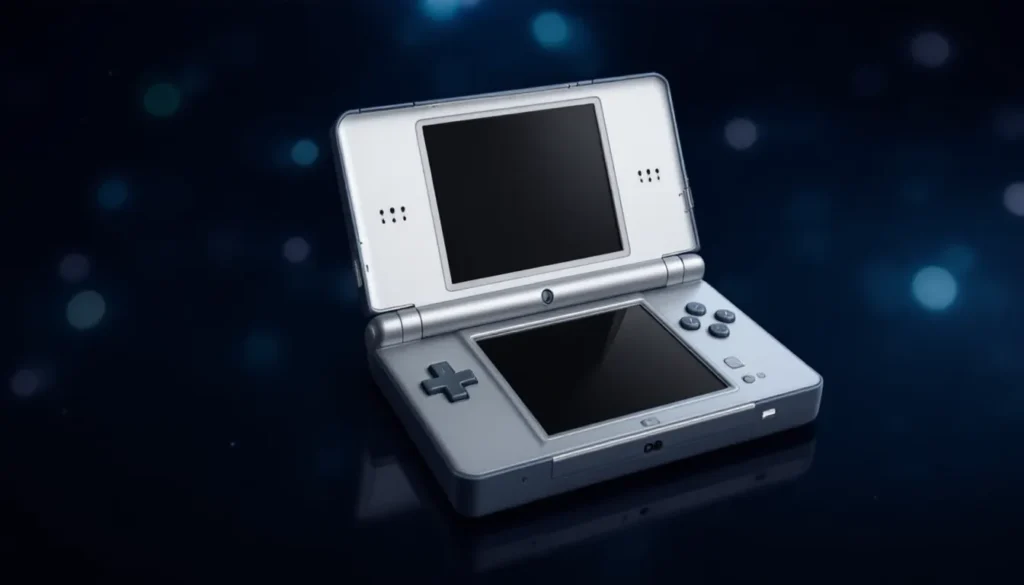
The physical build was divisive. The “Phat” DS, as it came to be known after the DS Lite’s release, measured 148.7 × 84.7 × 28.9 mm when closed and weighed 275 grams. It felt substantial, chunky, even, with a matte silver and dark gray finish on the launch model. The build quality was typically Nintendo: durable, but not premium.
The clamshell hinge was sturdy, though the system’s overall bulk made it less pocketable than the Game Boy Advance SP. The button layout featured a D-pad and four face buttons (A, B, X, Y) on the right side, plus Start, Select, and dedicated power and volume controls. The shoulder buttons (L and R) sat on the top edge, flanking the GBA cartridge slot.
Launch, Reception, and Market Impact
Initial Skepticism and Critical Response
When Nintendo revealed the DS at E3 2004, the reaction was… mixed. Industry observers questioned whether the dual screens were necessary or just Nintendo being weird for the sake of it. Sony’s upcoming PSP promised multimedia features, a gorgeous widescreen display, and graphics approaching PS2 quality. The DS looked like a toy by comparison.
The system launched in North America on November 21, 2004 for $149.99, with Super Mario 64 DS as the flagship title. Japan got it on December 2, 2004, followed by Europe and Australia in early 2005. Early reviews praised the hardware’s innovation but noted a weak launch lineup, most games felt like tech demos rather than must-own experiences.
Gaming publications on Gematsu and similar outlets covering Japanese gaming trends noted that Japanese developers seemed more willing to experiment with the touch controls early on, while Western studios remained cautious. The first few months saw decent but not spectacular sales, with many assuming the DS was just a stopgap until Nintendo’s “real” Game Boy successor arrived.
Sales Success Against the PSP
Then something unexpected happened: the DS started selling. A lot. Nintendogs, released in 2005, became a cultural phenomenon and moved hardware units by the millions. Brain Age followed in 2006, appealing to non-traditional gamers and expanding the market in ways Sony’s multimedia-focused PSP couldn’t match.
By the end of 2006, the DS had outsold the PSP globally even though the latter’s superior graphics and media capabilities. Nintendo’s strategy of focusing on unique gameplay experiences rather than technical specs had paid off. The DS family would go on to sell 154.02 million units worldwide by the time production ended in 2013, with the original model accounting for a significant chunk before the DS Lite took over in 2006.
The PSP sold a respectable 80 million units, but it never came close to the DS’s dominance. Coverage on Siliconera frequently highlighted how Japanese developers embraced the DS for experimental titles that wouldn’t have worked on traditional consoles, further cementing its position in the market. Nintendo had won the handheld war by changing the battlefield entirely.
Must-Play Games That Defined the System
Innovative First-Party Titles
Nintendo’s first-party lineup on the DS was nothing short of exceptional, with many titles becoming the gold standard for how to use dual screens and touch controls:
-
Nintendogs (2005): The virtual pet sim that convinced millions of non-gamers to buy a DS. Touching, petting, and training puppies felt remarkably tactile thanks to the stylus.
-
Brain Age (2006): Dr. Kawashima’s daily mental exercises became a global phenomenon, selling over 20 million copies and spawning countless brain training imitators.
-
Mario Kart DS (2005): The first truly great online multiplayer experience on a Nintendo handheld, with Download Play support for local racing.
-
The Legend of Zelda: Phantom Hourglass (2007): Entirely stylus-controlled gameplay that proved touch controls could work for action-adventure games. Drawing paths, solving puzzles, and even marking maps felt natural.
-
New Super Mario Bros. (2006): Brought 2D Mario back after a long absence, selling over 30 million copies and revitalizing the franchise.
-
Pokémon Diamond/Pearl (2006): The first mainline Pokémon games on DS introduced online trading and battling, moving the series into the modern era.
Third-Party Gems and Hidden Classics
Third-party developers created some of the most creative and memorable DS experiences:
-
Castlevania: Dawn of Sorrow (2005): Koji Igarashi’s Metroidvania masterpiece used the touchscreen for magic seals and proved hardcore games could thrive on DS.
-
Phoenix Wright: Ace Attorney (2005): The visual novel/adventure series found its perfect home on DS, with stylus-based evidence examination and cross-examination sequences.
-
The World Ends with You (2007): Square Enix’s wildly original action RPG used both screens simultaneously for combat, creating a system that’s never been replicated.
-
Professor Layton and the Curious Village (2007): Level-5’s puzzle-adventure game launched a beloved franchise and showed the DS was ideal for brain-teasing gameplay.
-
Elite Beat Agents (2006): A rhythm game where players tapped and slid the stylus to the beat, helping people through absurd crises with the power of dance.
-
Advance Wars: Dual Strike (2005): Intelligent Systems’ turn-based strategy series used the dual screens perfectly, map on top, unit details below.
-
Trauma Center: Under the Knife (2005): Surgery simulation that made players feel like actual doctors, performing operations with stylus-based precision.
How the DS Changed Handheld Gaming Forever
Touch Controls and New Gameplay Possibilities
The DS’s touchscreen didn’t just add a new input method, it created entirely new genres and gameplay styles that hadn’t existed before. Point-and-click adventures thrived. Real-time strategy games became viable on a handheld. Puzzle games exploded in creativity.
Developers started thinking about handheld games differently. Instead of just shrinking console experiences, they designed around the DS’s unique capabilities. Games like Scribblenauts let players summon any object they could imagine by writing it on the touchscreen. Cooking Mama turned meal preparation into a series of stylus-based mini-games that felt surprisingly tactile.
The microphone enabled voice-controlled games, though this feature saw less consistent use than touch controls. Still, moments like shouting “Objection.” in Phoenix Wright or blowing into the microphone to solve puzzles in Zelda created memorable interactions impossible on other systems.
Multiple screen real estate meant developers could present information without cluttering the main gameplay view. Strategy games displayed unit stats on one screen while showing the battlefield on the other. RPGs kept maps constantly visible. This quality-of-life improvement became so standard that its absence feels jarring when returning to single-screen handhelds.
Expanding the Gaming Audience
The DS accomplished something few consoles ever achieve: it genuinely expanded the gaming audience beyond traditional demographics. Brain Age and Nintendogs brought in older adults and women in significant numbers, groups that marketing typically ignored.
Nintendo’s “Touch. Generations” branding positioned games as accessible to everyone, not just dedicated gamers. This philosophy would later inform the Wii’s development and Nintendo’s overall strategy during this era. The DS made gaming feel approachable, with intuitive stylus controls that didn’t require mastering button combinations.
Educational software flourished on DS in ways it never had on previous Nintendo systems. Language learning apps, cooking guides, and even dictionaries found audiences. While hardcore gamers sometimes scoffed at this “casual” focus, the reality was that the DS library had depth in both directions, something for everyone.
The system’s success proved that innovation and accessibility could coexist with traditional gaming experiences. You could play Pokémon, Castlevania, and Mario on the same device that your mom used for Brain Age. That versatility was unprecedented and hasn’t really been replicated since.
Evolution: From DS Phat to DS Lite
The original DS, later nicknamed the “Phat” model by the community, had a relatively short time as Nintendo’s flagship before being replaced by the DS Lite in June 2006. The Lite addressed nearly every physical criticism of the original while maintaining full compatibility.
The DS Lite was significantly smaller and lighter, measuring 133 × 73.9 × 21.5 mm closed and weighing just 218 grams, a 57-gram reduction. The redesign featured a sleeker, glossy finish available in multiple colors beyond the original’s limited palette. The screens were the same size and resolution, but Nintendo improved the backlighting dramatically, adding four brightness settings compared to the original’s two.
Battery life improved to 15-19 hours on the lowest brightness setting, though real-world usage at higher settings still hovered around 10-12 hours. The stylus was relocated to the side of the unit and made longer, addressing one of the Phat’s minor annoyances.
The DS Lite became the definitive version for most players and sold over 93 million units compared to the original’s estimated 20-25 million. But, the Phat model maintained one advantage: the GBA cartridge slot was more accessible, sitting flush with the bottom of the device rather than protruding slightly like on the Lite.
Nintendo would continue iterating with the DSi (2008) and DSi XL (2009), which added cameras and removed GBA compatibility entirely. But for many, the original DS Phat represents the purest expression of Nintendo’s vision, unrefined, chunky, and unapologetically experimental.
Collecting and Playing the Original DS in 2026
Where to Find and Buy an Original DS Today
The original DS Phat has become a collector’s item, though it’s still relatively affordable and easy to find. eBay, Mercari, and local retro game stores typically stock units ranging from $40-$80 depending on condition. Complete-in-box examples with all original packaging can fetch $100-$150, especially for rarer color variants.
Japanese import models are often cheaper and work perfectly with US games, the DS has no region locking for DS cartridges, though GBA games are region-locked. Sites like eBay and specialty import retailers offer these options.
Facebook Marketplace and local classifieds like Craigslist or OfferUp can yield excellent deals, though you’ll want to test the unit before buying. Check that both screens work, the touchscreen responds accurately, speakers function, and the GBA slot reads cartridges properly.
Flea markets and garage sales occasionally surprise collectors with underpriced units, though this has become less common as sellers wise up to retro gaming values. Patient hunters can still score systems for $20-$30 if they’re persistent.
Maintenance Tips and Common Issues
The original DS is generally reliable, but age has introduced some common failure points worth knowing:
Hinge cracks are the most frequent issue. The plastic around the hinge stress points can crack over time, especially with heavy use. While this rarely affects functionality, severe cracks can damage the ribbon cable connecting the two screens. Careful handling and avoiding excessive opening/closing pressure helps prevent this.
Dead batteries are inevitable after 20+ years. Replacement batteries are widely available online for $8-$15 and are relatively simple to install with a tri-wing screwdriver. Nintendo used proprietary screws, so you’ll need the right tool.
Worn touchscreens can develop dead zones or require excessive pressure. Screen protectors help preserve the touchscreen, and replacement digitizers are available, though installation requires disassembly and some technical skill.
Dirty contacts in the cartridge slots can prevent games from loading. Isopropyl alcohol (90% or higher) on a cotton swab cleans contacts effectively. Don’t use compressed air, as it can push debris deeper into the slot.
Yellowing plastic is cosmetic but common on the silver and white models. Retrobright treatments can restore the original color, though this is purely aesthetic.
Regular maintenance is minimal: keep the contacts clean, store in a cool dry place, and charge the battery every few months even if you’re not actively playing to prevent deep discharge damage.
Game Availability and Preservation
DS games remain abundant and affordable in 2026, though prices have risen for popular titles. Most first-party Nintendo games range from $15-$40 loose, with complete copies adding $10-$20. Rare titles like Solatorobo: Red the Hunter or Radiant Historia can exceed $100.
Reproduction cartridges have flooded the market, particularly for Pokémon games. Learning to spot fakes is essential, check cartridge plastic quality, label printing, and most importantly, the cartridge code embossed on the label. Authentic carts have specific identifier codes that fakes often omit or get wrong.
Digital preservation remains a gray area legally, but the DS homebrew and emulation scene is robust. Flash cartridges like the R4 allow users to play backups or homebrew software, though Nintendo has fought these devices for years. For pure gameplay, modern emulators like melonDS and DeSmuME run DS games excellently on PC, though they can’t fully replicate the tactile feel of stylus-on-screen gameplay.
Physical game preservation is increasingly important as cartridge batteries (for games with real-time clocks) begin failing and production chips age. Many collectors focus on acquiring and properly storing physical copies to ensure these games remain playable for future generations. Resources on Nintendo Life often cover preservation efforts and best practices for maintaining retro gaming libraries.
Conclusion
The original Nintendo DS was a gamble that paid off in ways even Nintendo couldn’t have predicted. It arrived looking clunky and experimental in an era when Sony’s PSP promised graphical fidelity and multimedia prowess. Yet by focusing on unique gameplay experiences rather than raw specs, Nintendo created a handheld that sold over 154 million units and fundamentally changed how the industry thought about portable gaming.
The DS’s legacy extends far beyond sales figures. It proved touch controls could enable entirely new genres on handhelds. It expanded gaming’s audience to demographics that had never seriously engaged with the medium. It gave developers a creative sandbox that produced some of the most innovative games of the 2000s, from The World Ends with You to Professor Layton to Nintendogs.
Today, the chunky Phat model holds a special place in gaming history as the system that took the biggest risks. While the DS Lite refined the design and the 3DS added stereoscopic 3D, the original DS represented pure experimentation, Nintendo asking “what if?” and building hardware around the answer. For collectors, retro enthusiasts, and anyone who experienced its library firsthand, the original DS remains a reminder that sometimes the best way forward is to try something completely different. It didn’t just revolutionize portable gaming, it showed the entire industry that innovation could trump raw processing power, and that sometimes the weirdest ideas are the ones that change everything.