Nintendo’s mini console wave hit different when the Super Nintendo Mini launched. While other companies fumbled their nostalgia plays, Nintendo nailed the execution with a plug-and-play device that captured what made the SNES era special. Fast forward to 2026, and this little box remains one of the smartest ways to experience 16-bit classics without hunting down original cartridges or diving into emulation gray areas. Whether you’re a veteran who logged hundreds of hours on Super Metroid back in the day or a younger gamer curious about what the fuss is about, the SNES Classic Edition delivers genuine value. This guide covers everything from the hardware specs and complete game lineup to setup tips, troubleshooting, and whether it’s still worth your shelf space nearly a decade after release.
Key Takeaways
- The Super Nintendo Mini is an officially licensed plug-and-play device with 21 pre-loaded classic games, authentic controllers, and HDMI output that requires no technical setup or subscriptions.
- The SNES Classic’s exclusive Star Fox 2 and standout titles like Super Metroid, The Legend of Zelda: A Link to the Past, and Final Fantasy III offer deep gameplay experiences that hold up by 2026 standards.
- Save states, rewind features, and modern display options (Pixel Perfect and CRT Filter modes) provide convenience that original SNES hardware cannot match.
- Secondhand SNES Classic prices range from $120–180 in 2026; verify authenticity by checking model numbers, controller quality, and boot menu differences before purchasing.
- The Super Nintendo Mini offers better value than Nintendo Switch Online if you want no ongoing fees and prefer physical hardware, but the Switch Expansion Pack provides a larger growing library.
- The console’s one-time purchase model with zero online dependencies ensures long-term functionality without service shutdowns, making it a durable investment for retro gaming enthusiasts.
What Is the Super Nintendo Mini?
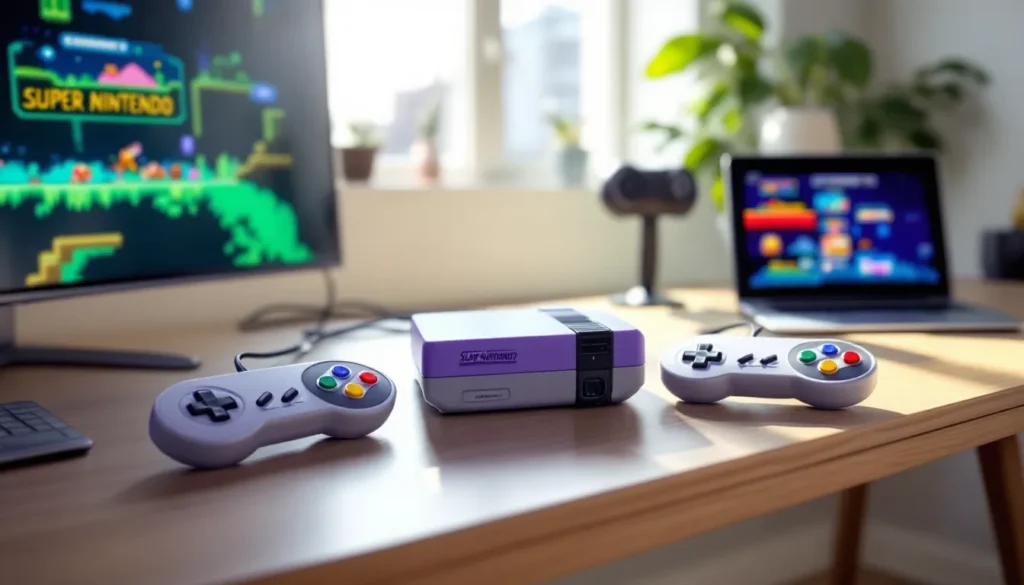
The Super Nintendo Entertainment System: Super NES Classic Edition, commonly called the Super Nintendo Mini, SNES Mini, or SNES Classic, is Nintendo’s miniaturized recreation of their legendary 16-bit console. Released in September 2017, it’s an officially licensed plug-and-play device pre-loaded with 21 games that defined the early-to-mid ’90s gaming landscape.
Unlike sketchy third-party clone consoles, this is genuine Nintendo hardware running accurate emulation. You get authentic controllers (two of them), HDMI output for modern TVs, and a curated library that spans multiple genres. The device measures roughly 5.3 x 4.3 x 1.8 inches, making it about 50% smaller than the original SNES footprint.
Nintendo produced the SNES Classic in both North American and European/Japanese (Super Famicom) variants. The NA version sports the purple-accented design Americans remember, while the Super Famicom Mini rocks the original Japanese colorway. Functionally, they’re identical aside from regional controller aesthetics.
Key Features and Technical Specifications
The Super Nintendo Mini runs a custom Linux-based OS with Nintendo’s proprietary emulation software. Here’s what’s under the hood:
- Processor: Allwinner R16 quad-core ARM Cortex-A7 @ 1.2GHz
- RAM: 256MB DDR3
- Storage: 512MB NAND flash (houses the OS and all 21 games)
- Video Output: HDMI 720p/60Hz
- Controllers: Two wired SNES-style controllers (5-foot cables)
- Ports: HDMI out, micro-USB for power, controller ports
- Power: USB power adapter (5V/1A, sold separately in some regions)
- Save States: Four slots per game with suspend point functionality
The system boots instantly, no load times, no firmware updates to manage. Navigation happens through a clean UI that mimics the classic game selection screens Nintendo fans know. You can apply visual filters, adjust display settings, and manage save states without leaving the interface.
How It Differs from the Original SNES
Obviously, you can’t swap cartridges. The 21-game library is permanent unless you venture into modding territory (which voids any warranty and violates terms of service). But that limitation comes with perks the original hardware couldn’t match.
Modern conveniences include save states at any point in any game, a rewind feature for undoing mistakes, and pixel-perfect HDMI output that looks cleaner than composite or S-Video ever did. The SNES Classic also draws minimal power, you can run it off a phone charger or powered USB port.
Controller differences are subtle but worth noting. The included pads are nearly identical to the originals in feel and button response, but the cables are about two feet shorter than vintage SNES controllers. If you’re sitting across a living room from your TV, you might need an extension cable. On the plus side, SNES Classic controllers work with Wii and Wii U Virtual Console titles via an adapter.
No lag is a common concern with emulation, but Nintendo’s implementation is tight. Input latency measures around 55-60ms total (display-dependent), which is competitive with original hardware on period-appropriate CRT displays. Most players won’t notice a difference unless they’re speedrunning frame-perfect tricks.
The Complete Game Library: All 21 Pre-Loaded Classics
The SNES Classic library spans platformers, RPGs, action titles, puzzlers, and one unreleased game that never saw store shelves in the ’90s. Here’s the full roster:
- Contra III: The Alien Wars
- Donkey Kong Country
- EarthBound
- Final Fantasy III (originally FF VI in Japan)
- F-Zero
- Kirby Super Star
- Kirby’s Dream Course
- The Legend of Zelda: A Link to the Past
- Mega Man X
- Secret of Mana
- Star Fox
- Star Fox 2 (never released until the SNES Classic)
- Street Fighter II Turbo: Hyper Fighting
- Super Castlevania IV
- Super Ghouls ‘n Ghosts
- Super Mario Kart
- Super Mario RPG: Legend of the Seven Stars
- Super Mario World
- Super Metroid
- Super Punch-Out..
- Yoshi’s Island
This isn’t a random selection. Nintendo cherry-picked genre-defining titles that showcase the SNES’s strengths, Mode 7 graphics, rich soundtracks, and gameplay depth that holds up decades later.
Must-Play Titles on the SNES Classic
If you’re new to the platform or working through the library methodically, prioritize these:
Super Metroid remains the gold standard for atmospheric exploration and non-linear level design. The controls feel fluid even by 2026 standards, and the environmental storytelling outclasses most modern indie Metroidvanias.
The Legend of Zelda: A Link to the Past defined action-adventure structure. The light/dark world mechanic, tight dungeon design, and item progression loop influenced two generations of game developers.
Super Mario World is pure platforming excellence. The cape physics, hidden exits, and secret worlds reward exploration without feeling punishing. It’s accessible for newcomers but deep enough for speedrunners to optimize for years.
EarthBound is the cult classic RPG that commands $200+ for original cartridges. The quirky humor, modern setting, and strategic turn-based combat make it feel distinct from the fantasy RPG crowd. Fair warning: the pacing drags in spots, but the writing makes up for it.
Super Mario RPG: Legend of the Seven Stars blends Mario’s world with Square’s RPG expertise. Timed button presses during combat keep battles engaging, and the isometric visuals still pop.
Final Fantasy III (VI) offers 30-40 hours of JRPG depth with one of gaming’s most memorable villains in Kefka. The character-driven narrative and opera house sequence alone justify the playtime.
For multiplayer sessions, Super Mario Kart and Street Fighter II Turbo deliver competitive fun, though the former’s aged physics take adjustment. Secret of Mana supports two-player co-op throughout its entire campaign, making it a rare SNES RPG you can tackle with a friend.
The Star Fox 2 Exclusive
Star Fox 2 is the SNES Classic’s headline exclusive. Nintendo completed this sequel in 1995 but shelved it to avoid competing with the Nintendo 64 launch. The game sat unreleased for 22 years until the mini super nintendo made it playable for the first time.
Star Fox 2 expands the original’s rail-shooter formula with strategic map gameplay. You select pilots, manage resources, defend your home base (Corneria), and intercept enemy threats in real-time between missions. The 3D polygons push the SNES hardware harder than the first game, and the gameplay loop mixes arcade action with light strategy elements.
To unlock Star Fox 2, you need to beat the first level of the original Star Fox, a nice touch that ensures players experience the series evolution chronologically. The sequel’s experimental design explains why Nintendo hesitated to release it in the ’90s, but it’s a fascinating piece of gaming history that adds significant value to the collection.
Setting Up Your Super Nintendo Mini
Setup takes about five minutes, assuming you’ve got the necessary cables and a TV with an HDMI input.
What’s Included in the Box
Nintendo kept the packaging minimal:
- SNES Classic Edition console
- Two wired SNES controllers
- HDMI cable (approximately 4 feet long)
- USB power cable (micro-USB)
- Instruction manual
Notably, North American units don’t include a USB wall adapter. You’ll need to provide your own 5V/1A USB power brick, the same type used for most smartphones. Any standard phone charger works, or you can power the console directly from a TV’s USB port if it supplies enough current.
European and Japanese Super Famicom Mini units include the AC adapter in the box. If you’re buying secondhand, confirm what’s included before purchasing.
Initial Setup and Configuration
Plug the HDMI cable into your TV and the micro-USB cable into the console’s power port. Connect the other end of the USB cable to a power source. Controllers plug into the front panel ports, they’re not wireless, so plan your seating accordingly.
Power on the console using the reset button (yes, the reset button is the power button, Nintendo committed to the retro aesthetic). The system boots directly to the game selection screen. No account creation, no day-one patches, no forced tutorials.
First-time users should jump into the settings menu (press Down on the controller at the main screen):
- Display Settings: Choose between 4:3 and Pixel Perfect modes. The former stretches to fill modern widescreen displays: the latter maintains original aspect ratio with black bars on the sides.
- CRT Filter: Applies scanline effects to mimic old tube TVs. It’s purely aesthetic, some players swear by it for authenticity, others find it distracting.
- Suspend Points: The system automatically creates a suspend point when you press the reset button during gameplay. Configure whether you want the game to resume from this point on next boot.
Controller setup is automatic. Both pads work system-wide, and multiplayer games detect the second controller without configuration. If you want to use original SNES controllers or third-party alternatives, the ports are compatible with most vintage hardware.
Tips and Tricks for Getting the Most Out of Your SNES Classic
The SNES Classic’s built-in features go beyond simple game playback. Understanding the tools at your disposal makes the experience significantly better.
Using Save States and Rewind Features
Each game supports four independent save states plus one auto-suspend slot. Access the save state menu by holding Down + pressing the reset button. This freezes the game and opens the state management interface.
Quick save workflow: Assign one slot as your “main” save and rotate through the others for experimental attempts. Hit a tough boss? Save in slot 1 before each attempt, then reload instantly if you die. This eliminates the frustration of replaying sections in games with sparse checkpoints (looking at you, Super Ghouls ‘n Ghosts).
The rewind function is less obvious. When you create a suspend point by pressing reset during gameplay, the system stores several minutes of previous gameplay. Resume the game, hold Down + Select to rewind time, then release when you’re back before the mistake. It’s limited, you can’t rewind indefinitely, but it’s perfect for undoing a mistimed jump or a bad menu decision in RPGs.
Save states sync per-game, not per-profile. If multiple people play the same game on one console, coordinate which slots belong to whom to avoid overwriting progress.
Display Settings and CRT Filter Options
The Pixel Perfect mode renders games at their native resolution, then scales them to fit modern displays without smoothing or distortion. This is the purist option, you see exactly what developers created, with sharp pixels and no artifacts. Pixel Perfect adds small black borders around all four edges, not just the sides.
4:3 mode stretches the image to fill more screen real estate. On a 16:9 TV, you’ll get vertical black bars. The image is slightly softer due to upscaling, but it approximates how the games looked on old TVs.
The CRT Filter simulates scanlines and phosphor glow from cathode ray tube displays. Tech publications like Digital Trends have noted that modern gamers divide sharply on this feature, nostalgia-driven players prefer it, while newcomers find it muddy. Test it yourself: the toggle is instant.
For optimal visual quality, match your TV’s settings. Disable any motion smoothing, game mode processing, or AI upscaling your TV applies. These features introduce input lag and can make the image look worse. Most TVs have a “game mode” preset that minimizes processing.
Two-Player Gaming Setup
The 5-foot controller cables limit seating arrangements. For comfortable couch co-op, sit within 3-4 feet of your TV or invest in controller extension cables. Third-party extensions are cheap ($10-15) and widely available.
Recommended multiplayer games for local sessions:
- Super Mario Kart: Competitive racing with aged but functional physics. The split-screen mode on modern TVs is more playable than it was on small CRTs.
- Street Fighter II Turbo: Still one of the best fighting games ever made. Master the fundamentals, and you’ll have a blast.
- Contra III: Co-op run-and-gun that’s brutally hard but satisfying when you coordinate.
- Secret of Mana: Full campaign co-op. The ring menu system pauses the game, so coordinate before pulling it up during boss fights.
Don’t sleep on Kirby Super Star, it’s secretly one of the best co-op platformers on the system. Player two controls a helper character with full abilities, making it genuinely collaborative rather than tacked-on.
Where to Buy the Super Nintendo Mini in 2026
Nintendo discontinued production of the SNES Classic in 2019 after meeting demand. You won’t find new units in retail stores anymore, this is a secondhand market exclusively now.
Current Pricing and Availability
As of early 2026, expect to pay $120-180 for a complete SNES Classic in good condition. Pricing fluctuates based on:
- Completeness: Units with original box, manuals, and both controllers command premium prices. Console-only listings save $20-30 but lose collectibility.
- Region: North American units typically sell for slightly more than European/Japanese Super Famicom Minis, even though identical functionality.
- Condition: Yellowing plastic, scuffed controllers, or missing accessories drop value.
The best places to hunt for units:
eBay remains the largest marketplace. Use completed listings to gauge real selling prices, not aspirational asking prices. Filter for “sold” items to see what buyers actually pay. Watch out for auction fatigue, patient buyers score deals when auctions end at odd hours.
Facebook Marketplace and local classifieds occasionally surface units from sellers who don’t know secondhand values. These are where you find $80-100 deals, but availability is hit-or-miss.
Retro game stores stock SNES Classics intermittently. You’ll pay closer to market rate, but reputable shops test hardware and guarantee functionality.
Amazon third-party sellers list units, but prices skew high. Only buy if the seller has strong feedback and clear return policies.
Avoid paying over $200 unless it’s a mint-in-box collector’s item. At that price point, you’re approaching the cost of alternative solutions with broader game libraries.
Spotting Counterfeit Units
Counterfeit SNES Classics exist, though they’re less common than fake NES Classic Editions. Red flags include:
- Suspiciously low prices: New-in-box units under $100 in 2026 are almost certainly fake.
- Incorrect packaging: Compare photos against verified Nintendo packaging. Fakes often have blurry printing, incorrect fonts, or missing legal text.
- Menu differences: Boot the console before completing a local purchase. Counterfeit units run emulation software that looks similar but has different menu layouts and lacks save state functionality.
- Controller feel: Nintendo’s pads have a specific button response and build quality. Fake controllers feel mushier and lighter.
- Model numbers: Authentic NA units are model CLV-201. Check the bottom of the console against verified units.
If buying online, request photos of the console’s underside showing the model number and FCC ID (BCG-CLV201 for NA units). Legitimate sellers provide this without hesitation.
Super Nintendo Mini vs. Other Retro Gaming Options
The SNES Classic competes with several alternatives in 2026, each with different trade-offs.
SNES Classic vs. Nintendo Switch Online
Nintendo Switch Online’s Expansion Pack tier includes a growing library of SNES games playable on Switch hardware. As of early 2026, around 50+ SNES titles are available, with more added periodically.
Switch Online advantages:
- Larger game library that expands over time
- Portable play on Switch or Switch OLED screens
- Online multiplayer for supported titles
- Includes NES, N64, and Genesis games in one subscription
- Regular price: $49.99/year for Expansion Pack
SNES Classic advantages:
- One-time purchase with no ongoing fees
- Star Fox 2 exclusive (not available on Switch as of 2026)
- Authentic controller feel with included hardware
- No internet requirement after initial purchase
- Works indefinitely without service shutdowns
Gaming outlets including Nintendo Life have covered the library comparisons extensively. The Switch version lacks some SNES Classic titles due to licensing (Mega Man X, Street Fighter II Turbo, Secret of Mana, Castlevania IV, and others aren’t available).
For players who already own a Switch and play online regularly, the Expansion Pack makes financial sense. For those wanting a dedicated retro device without subscriptions, the SNES Classic wins.
SNES Classic vs. Original Hardware and Emulation
Original SNES hardware offers the most authentic experience, but comes with complications:
- Cartridge collecting is expensive (Super Mario RPG alone costs $80-120, EarthBound exceeds $200)
- Older cartridges require maintenance (battery replacements for save games)
- Connecting to modern TVs requires upscalers ($50-300 depending on quality)
- No save states or convenience features
Emulation on PC or Raspberry Pi provides maximum flexibility:
- Access to the entire SNES library, including Japan-exclusive titles
- Advanced features like texture packs, widescreen hacks, and fast-forward
- Requires technical setup and navigating ROM legality
- Controller quality varies widely based on what you buy
Tech coverage from sources like The Verge has explored how emulation accuracy has improved dramatically, with projects like bsnes achieving cycle-accurate reproduction. But casual players don’t want to configure emulators or source ROM files.
The SNES Classic’s sweet spot is plug-and-play simplicity with legitimate software. It’s Nintendo-approved, requires zero technical knowledge, and delivers 90% of what most players want from SNES gaming. You give up library depth but gain convenience and peace of mind.
Common Issues and Troubleshooting
The SNES Classic is reliable hardware, but occasional issues pop up:
Console won’t power on: Verify the USB power source supplies adequate current. Phone chargers rated below 1A sometimes can’t provide enough juice. Try a different power adapter or TV USB port. If the LED doesn’t light at all, the USB cable may be damaged.
No HDMI signal: Check that the TV input is set correctly. Try a different HDMI cable, the included cable is functional but not exceptional quality. Power cycle both the TV and console. Some TVs don’t auto-detect low-power HDMI devices: manually select the input rather than relying on auto-switching.
Controller not responding: Unplug and firmly reseat the controller connector. The ports can accumulate dust over years. If one controller works but the other doesn’t, the non-responsive pad may have internal damage. Test with a known working controller to isolate the issue.
Games freezing or graphical glitches: Extremely rare with official hardware. If it happens consistently, the console may have failing NAND storage. This affects a tiny percentage of units. Contact Nintendo support if the console is still under warranty, or consider replacement if out of warranty.
Save states not loading: Save states created during specific game events (mid-animation or during loading screens) occasionally corrupt. Use manual in-game saves as backup when possible. Create multiple save states rather than overwriting the same slot repeatedly.
Reset button unresponsive: The reset button is mechanical and can wear out with heavy use. Pressing harder sometimes works, but a truly dead button requires opening the console (voiding warranty) to replace or clean the switch. This is uncommon unless the console saw extreme use.
Controller cable too short: Extension cables from third-party manufacturers work fine. Look for SNES Classic-specific extensions (usually labeled as NES/SNES Classic compatible). Standard SNES controller extensions fit physically but sometimes have pinout differences that cause connectivity issues.
Is the Super Nintendo Mini Worth It in 2026?
The value proposition depends on your situation and what you want from retro gaming.
Buy the SNES Classic if:
- You want hassle-free access to SNES essentials without subscriptions or technical setup
- The 21-game library includes multiple titles you’ll actually play (especially if you haven’t experienced classics like Super Metroid or A Link to the Past)
- You value official Nintendo hardware and legal software
- You prefer physical devices over cloud-dependent services
- You want Star Fox 2, which remains exclusive to this platform
Skip it if:
- You already play these games via Nintendo Switch Online and don’t need redundancy
- The specific titles you want aren’t included (no Chrono Trigger, no Donkey Kong Country 2, no Super Mario World 2)
- You’re comfortable with emulation and want access to the full SNES library
- $120-180 is steep for your retro gaming budget when alternatives exist
The SNES Classic’s library is curated, not comprehensive. If your favorites didn’t make the cut, that’s a legitimate dealbreaker. But for what it offers, the selection is strong. You’re getting 20-30 hours of gameplay from the shorter titles (platformers, action games) and 100+ hours if you jump into the RPGs.
Compared to 2017 launch: The value has decreased slightly. At the original $79.99 MSRP, this was a no-brainer. At 2026 secondhand prices, it’s still reasonable if the specific game lineup appeals to you, but it’s no longer an impulse purchase.
One underrated aspect: the SNES Classic is a conversation piece. The miniaturized design and retro aesthetic generate interest from both gamers and non-gamers. It’s a functional display item that works perfectly as an entry point for introducing younger players to gaming history.
The hardware won’t age out. There are no online services to shut down, no batteries to die, no moving parts to fail (beyond the reset button). Barring physical damage, a SNES Classic bought today will work identically in 2036.
Conclusion
The Super Nintendo Mini remains one of Nintendo’s smartest products nearly a decade after launch. It captured the essence of 16-bit gaming in a polished, accessible package that respects both the original hardware and modern convenience expectations. The 21-game library won’t satisfy everyone, but it represents the SNES’s greatest hits across multiple genres, and that Star Fox 2 exclusive still holds unique appeal for Nintendo history buffs.
At 2026 secondhand prices, the mini super nintendo occupies a middle ground between Nintendo Switch Online subscriptions and diving into original hardware collecting. It’s neither the cheapest nor the most comprehensive retro gaming solution, but it nails the balance between authenticity, convenience, and legal legitimacy. If the included games align with your interests and you value plug-and-play simplicity, the SNES Classic delivers. Just shop carefully in the secondhand market, verify authenticity, and you’ll have a solid piece of gaming history that works flawlessly for years to come.