The Nintendo 3DS era delivered some of gaming’s most memorable experiences, from Pokemon X and Y to The Legend of Zelda: A Link Between Worlds. But Nintendo’s dual-screen handheld has been discontinued for years, and hardware is getting harder to find. That’s where iOS emulation comes in.
In 2026, playing 3DS games on your iPhone is more accessible than it’s ever been. Thanks to emulator developments and Apple’s shifting policies around sideloading, you’re no longer stuck jailbreaking or jumping through endless hoops. Whether you’ve got an iPhone 15 Pro or you’re holding onto an older device, there are legitimate options that actually work.
This guide breaks down everything you need to know: which emulators perform best, how to install them without voiding warranties, what kind of performance to expect, and how to troubleshoot the inevitable hiccups. No fluff, just the real steps to get your 3DS library running on iOS.
Key Takeaways
- A Nintendo 3DS emulator on iOS replicates the console’s dual ARM11 processors and dual-screen layout, making it possible to play classic 3DS titles like Zelda and Pokémon on modern iPhones with strong performance on A15 Bionic chips and newer.
- Delta Emulator, Citra for iOS, and RetroArch are the top Nintendo 3DS emulator options available, with Delta offering ease of use, Citra providing the most accurate emulation, and RetroArch delivering advanced customization for power users.
- App Store-approved emulators (Delta, Citra, RetroArch) and AltStore sideloading make installation straightforward in 2026, eliminating the need for jailbreaking or complex workarounds that were required in previous years.
- Legally obtaining ROMs by dumping your own 3DS cartridges keeps you on solid ethical ground, while downloading ROMs from the internet constitutes copyright infringement in most jurisdictions regardless of game ownership.
- iPhone 13 Pro or newer is recommended for smooth 60 FPS 3DS emulation in most titles, while iPhone 11 minimum will handle 30-45 FPS gameplay in less demanding games like Fire Emblem Awakening and Zelda: A Link Between Worlds.
- Battery life during 3DS emulation ranges from 2-5 hours depending on device, with optimization tips including lowering screen brightness, enabling Low Power Mode, and using portable battery packs for extended gaming sessions.
What Is a Nintendo 3DS Emulator and How Does It Work?
Understanding Emulation Technology
A Nintendo 3DS emulator is software that replicates the 3DS hardware environment on a different device, in this case, your iPhone. Emulators translate the original console’s instructions into commands your iOS device can understand and execute.
The 3DS presented unique challenges for emulation. It ran on dual ARM11 processors, featured two screens (one with stereoscopic 3D capability), and had specialized graphics hardware. Emulators need to recreate all of that in software, which is computationally expensive.
Modern iOS devices pack enough power to handle this. The A15 Bionic chip and newer can brute-force through most 3DS titles at full speed. Emulators use techniques like dynamic recompilation (dynarec) to convert 3DS code on-the-fly, plus GPU acceleration to handle graphics rendering without melting your battery.
You won’t get the stereoscopic 3D effect on iPhone (obviously), but the dual-screen layout translates surprisingly well to a vertical or split-screen orientation.
Legal Considerations for Emulation on iOS
Emulation itself sits in a legal gray zone, but here’s the reality: creating and using emulators is legal. What crosses the line is how you obtain game files (ROMs) and system files (BIOS).
You’re legally covered if you dump ROMs from 3DS cartridges you physically own. Tools exist for this, though they require a modded 3DS console. Downloading ROMs from the internet, even for games you own, is technically copyright infringement in most jurisdictions.
Apple’s App Store policies historically banned emulators entirely, but that changed in April 2024. Emulators are now allowed on the App Store, provided they don’t include copyrighted game files. This policy shift has been a game-changer (pun intended) for iOS emulation.
Sideloading via AltStore or other signing services operates in another gray area. Apple tolerates it for personal use but doesn’t officially support it. You’re not breaking laws, but you are working around App Store restrictions.
Bottom line: own your games, dump your own files when possible, and you’re on solid ethical ground.
Best Nintendo 3DS Emulators Available for iOS Devices
Delta Emulator: The All-in-One Solution
Delta has become the go-to emulator for iOS users who want multiple retro systems in one package. Developed by Riley Testut (the same developer behind GBA4iOS and AltStore), Delta supports NES, SNES, N64, Game Boy, GBA, and DS, with 3DS support added in version 1.6, released in late 2025.
Delta’s 3DS emulation is built on modified Citra cores, optimized for iOS. The interface is clean, controller support is rock-solid (works with Xbox, PlayStation, and backbone controllers out of the box), and save states work reliably across sessions.
Performance is good on iPhone 12 and newer, though don’t expect miracles on older hardware. Delta prioritizes compatibility and ease of use over cutting-edge performance. You can grab it directly from the App Store as of early 2025, or sideload it via AltStore for access to beta features.
The main downside? 3DS emulation in Delta is still catching up to standalone options. Some games have visual glitches or audio desync issues that dedicated emulators handle better.
Citra for iOS: Dedicated 3DS Emulation
Citra is the gold standard for 3DS emulation on desktop, and the iOS port brings most of that quality to iPhone. The official iOS version launched in early 2024 after Apple changed its emulator policies, though unofficial builds existed for years before that.
Citra for iOS delivers the most accurate 3DS emulation you’ll find on mobile. It handles demanding titles like Super Smash Bros. for Nintendo 3DS and Pokemon Ultra Sun/Moon with fewer graphical artifacts than alternatives. The emulator supports custom texture packs, resolution scaling, and hardware shaders, features that mobile gaming enthusiasts have been requesting for years.
Setup is slightly more involved than Delta. You’ll need to provide system files (aes_keys.txt and firmware dumps) for certain games to boot properly. Once configured, though, it’s the smoothest experience available.
Citra performs best on iPhone 13 Pro and newer, especially for GPU-intensive games. The A17 Pro chip in iPhone 15 Pro can push internal resolution to 2x or even 3x native in less demanding titles.
RetroArch: The Advanced Multi-System Option
For power users, RetroArch offers unmatched customization and features. It’s a frontend for multiple emulator cores, including several 3DS options (Citra core being the most reliable).
RetroArch gives you granular control over everything: input latency reduction, shader pipelines, run-ahead frames, and netplay for supported systems. The learning curve is steep, the UI looks like it was designed in 1997, but the performance tuning options are incredible.
The Citra core in RetroArch trails slightly behind standalone Citra in terms of updates and optimization, but it’s still highly capable. You’ll appreciate RetroArch if you want a unified interface for all retro gaming across multiple systems.
Installation varies. RetroArch is now available on the App Store, but sideloaded versions offer more core options and fewer restrictions. Expect to spend time with documentation and forums getting everything dialed in.
How to Install a Nintendo 3DS Emulator on iPhone
Installing via AltStore (Sideloading Method)
AltStore remains the most reliable sideloading method for iOS emulators in 2026. Here’s the process:
- Download AltServer on your Mac or Windows PC from altstore.io
- Install AltStore on your iPhone by connecting via USB and following AltServer’s prompts
- Sign in with your Apple ID (free accounts work: no developer account needed)
- On your iPhone, open AltStore and navigate to the Browse tab
- Download Delta or your chosen emulator directly, or add a .ipa file from your computer
- AltStore will sign and install the app using your Apple ID certificate
The catch: free Apple IDs limit you to three sideloaded apps, and certificates expire after 7 days. You’ll need to refresh the app weekly by connecting to the same WiFi network as your PC running AltServer. The refresh process is automatic if AltServer is running in the background.
Paid Apple Developer accounts ($99/year) extend certificate validity to one year and remove the three-app limit. Worth it if you’re serious about sideloading multiple emulators.
Direct Installation Through the App Store
The easiest method in 2026 is simply searching the App Store. Delta, RetroArch, and Citra all have official App Store releases as of late 2024/early 2025.
- Open the App Store on your iPhone
- Search for “Delta Emulator” or “RetroArch”
- Tap Get and authenticate with Face ID/Touch ID
- Launch and grant necessary permissions (file access, notifications)
App Store versions update automatically and don’t require certificate management. The trade-off is that some features may be restricted compared to sideloaded builds, Apple’s review process sometimes forces developers to remove advanced options.
This method works on any iOS device running iOS 17.4 or later. No computer required, no certificates to manage, zero technical headaches.
Using Third-Party App Stores and Signing Services
Signing services like Signulous ($19.99/year) or AppDB offer certificate-signing without needing a computer. These services use enterprise certificates or other workarounds to install apps.
The process:
- Subscribe to a signing service and create an account
- Install the service’s configuration profile on your iPhone
- Browse their app library for emulators
- Tap to install directly to your device
Risks: enterprise certificates can be revoked by Apple without warning, breaking all installed apps until the service obtains new certificates. Privacy is another concern, you’re trusting third parties with your device access.
These services filled a gap before App Store emulators existed. In 2026, they’re less necessary unless you want specific builds or features not available elsewhere. Proceed with caution and stick to established services with good track records.
Setting Up Your Emulator: Configuration and BIOS Files
Obtaining and Loading ROM Files
3DS ROMs typically come in .3ds or .cia file formats. Most iOS emulators support .3ds files directly: .cia files may require conversion or aren’t supported at all.
Legal reminder: dump your own cartridges using a modded 3DS and tools like GodMode9. The process is straightforward, tutorials from dedicated gaming communities walk through every step.
Once you have ROM files:
- Transfer them to your iPhone via iTunes file sharing, cloud storage (iCloud, Dropbox, etc.), or direct download in Safari
- Open your emulator and navigate to its file browser
- Grant file access permissions when prompted
- Point the emulator to the folder containing your ROMs
- Games should appear in your library automatically
Citra and RetroArch may require additional system files. For Citra, you’ll need aes_keys.txt (contains encryption keys) and optionally firmware dumps for features like Mii support and system settings. These files go in the emulator’s system directory, usually accessible through the app’s file management interface.
Delta simplifies this, most games work without additional files, though some titles may request system data for specific features.
Configuring Controller Settings and Touch Controls
Touch controls for dual-screen 3DS games can feel cramped on iPhone. Most emulators let you customize on-screen button layouts:
- Delta: Tap and hold any on-screen button to enter edit mode. Resize, reposition, and adjust opacity for each control element. Save multiple controller skins for different game types.
- Citra: Access settings → Input → Touch screen layout. You can toggle screen positions, adjust split ratios, and choose portrait/landscape orientations.
- RetroArch: Navigate to Quick Menu → Controls → On-Screen Overlay. Dozens of community-made overlays are available, or create your own.
Physical controllers eliminate touch control hassles entirely. Supported options include:
- Xbox Series X/S controllers (via Bluetooth)
- PlayStation DualSense and DualShock 4 controllers
- Backbone One and similar iPhone controller attachments
- Nintendo Switch Pro Controller (ironically)
Pair controllers through iOS Settings → Bluetooth, then map buttons in your emulator’s input configuration. Most emulators auto-detect controllers and apply sensible default mappings.
For games that heavily used the 3DS touchscreen (like Pokemon Amie or stylus-based puzzles), you’ll need to use the iPhone screen for touch input. Emulators typically let you swap which screen is touch-enabled during gameplay.
Performance Optimization: Getting the Best Experience on iOS
Recommended Device Specifications
3DS emulation is CPU-intensive. Here’s what you need for playable performance:
Minimum (30-45 FPS in most games):
- iPhone 11 or newer
- A13 Bionic chip or equivalent
- iOS 16.0+
- 4GB RAM
Recommended (60 FPS in most titles):
- iPhone 13 Pro or newer
- A15 Bionic or better
- iOS 17.0+
- 6GB+ RAM
Optimal (full speed with enhancements):
- iPhone 15 Pro/Pro Max
- A17 Pro chip
- iOS 17.4+
- 8GB RAM
Older devices like iPhone X or XS can technically run emulators, but expect frequent slowdown in demanding games. Pokemon titles and simpler RPGs might be okay: action games like Monster Hunter or Smash Bros. will struggle.
Storage isn’t usually an issue, most 3DS ROMs are under 4GB, with a few exceptions like Super Smash Bros. (2.1GB) or bigger RPGs.
Graphics and Frame Rate Settings
Balancing visual quality and performance requires tweaking a few key settings.
In Citra:
- Resolution scaling: Keep at 1x (native) for older iPhones. Bump to 2x on iPhone 13 Pro+, 3x on iPhone 15 Pro for sharper visuals.
- Hardware shader: Enable for massive performance gains. This offloads graphics processing to the GPU.
- Accurate multiplication: Disable unless a game has specific visual bugs. It tanks FPS.
- VSync: Enable to prevent screen tearing, though it may introduce slight input lag.
In Delta:
- Navigate to Settings → 3DS → Graphics
- Toggle frame skip to auto if you’re dropping frames. It’ll skip rendering some frames to maintain speed.
- Disable linear filtering if performance is marginal, slight visual downgrade for better FPS.
In RetroArch:
- Quick Menu → Options → Resolution (set to native or 2x)
- Enable Threaded video in Settings → Video for better frame pacing
- Experiment with different video drivers (Metal is usually fastest on iOS)
Target 60 FPS for action games, rhythm games, and anything with tight timing. 30 FPS is acceptable for slower RPGs and visual novels if you need the performance headroom.
Battery Management During Extended Gaming Sessions
Emulation is a battery killer. The A-series chips are efficient, but maxing CPU and GPU for hours will drain even the best batteries fast.
Expect roughly:
- 2-3 hours on iPhone 13/14 standard models
- 3-4 hours on Pro/Pro Max variants
- 4-5 hours on iPhone 15 Pro Max with optimized settings
Tips to extend battery life:
- Lower screen brightness. Emulation doesn’t need full brightness: 60-70% is plenty indoors.
- Enable Low Power Mode in iOS settings. Some emulators slow down slightly, but battery savings are significant.
- Reduce resolution scaling. Running at native 3DS resolution uses far less power than 2x/3x upscaling.
- Close background apps. Free up RAM and CPU cycles for the emulator.
- Use wired controllers instead of Bluetooth when possible, minor savings, but it adds up.
- Turn off unnecessary features like screen recording, AirDrop, or Location Services.
For marathon sessions, a portable battery pack is your friend. Aim for 10,000mAh or higher with USB-C PD support for fast charging between games.
Troubleshooting Common Issues with 3DS Emulation on iOS
Fixing Crashes and App Instability
Emulator crashes are frustrating but usually fixable. Common causes and solutions:
App crashes on launch:
- Certificate expired (sideloaded apps): Reconnect to AltServer and refresh the app certificate.
- Corrupted installation: Delete the app completely, reboot your iPhone, and reinstall.
- iOS version mismatch: Update to the latest iOS version supported by your device.
Crashes when loading specific games:
- Missing system files: Citra requires aes_keys.txt for encrypted games. Verify it’s in the correct directory.
- Corrupted ROM: Re-dump or re-download the game file. Verify file integrity if checksums are available.
- Incompatible ROM format: Some emulators don’t support .cia files. Convert to .3ds format using desktop tools.
Random crashes during gameplay:
- Overheating: iPhones throttle performance when too hot. Take breaks, remove phone cases, or play in cooler environments.
- Insufficient RAM: Close background apps. If crashes persist on older devices, the game may simply be too demanding.
- Buggy emulator build: Check for updates or roll back to a previous stable version.
Frequent save state corruption:
- Use in-game saves instead of emulator save states when possible. Save states are convenient but less reliable.
- Don’t force-quit apps immediately after creating save states, let the emulator write files properly.
Resolving Audio and Visual Glitches
Audio desync or crackling:
- In Citra: Toggle audio stretching in Settings → Audio. Enable for smoother playback on borderline hardware.
- Reduce emulation speed slightly (95-98%) to let audio catch up. Barely noticeable in most games.
- Disable audio in RetroArch’s latency settings if you’re using Bluetooth headphones, BT latency compounds emulation audio lag.
Screen tearing or flickering:
- Enable VSync/frame limiting in graphics settings. This caps frame rate to prevent tearing.
- Switch video drivers (Metal vs. OpenGL in RetroArch) to see if one performs better.
- Update graphics drivers… oh wait, it’s iOS. Just update iOS itself and the emulator to the latest versions.
Missing textures or black screens:
- Often caused by missing system files. Double-check firmware dumps and encryption keys are loaded.
- Try toggling hardware shader settings, some games have compatibility issues with certain rendering methods.
- Check compatibility lists on emulator wikis. Some games have known issues with specific workarounds documented.
Slow performance in specific game sections:
- Shader compilation causes stuttering when new effects load for the first time. This is normal and smooths out after a few minutes.
- Some games have notoriously demanding areas. Lower resolution scaling temporarily or accept brief slowdown.
Controls not responding:
- For touch controls: Recalibrate in emulator settings or reset to default layout.
- For physical controllers: Disconnect and re-pair Bluetooth. Verify button mappings in input settings.
- Some games have built-in control tutorials that override emulator inputs until completed.
Top Nintendo 3DS Games to Play on Your iPhone
The 3DS library is packed with classics that hold up beautifully on iPhone. Here are the must-plays:
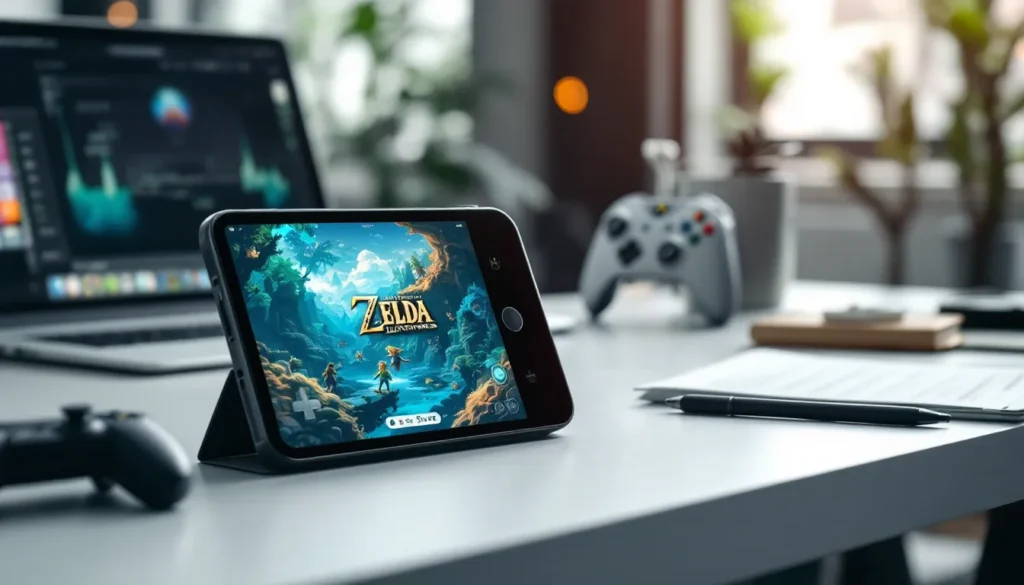
The Legend of Zelda: A Link Between Worlds – One of the best Zelda games ever made. The wall-merging mechanic translates perfectly to single-screen play, and performance is flawless even on older hardware.
Pokemon X/Y and Sun/Moon – The 3D Pokemon generations run great in emulation. X/Y are lighter on resources: Ultra Sun/Moon push hardware harder but look stunning upscaled on iPhone 15 Pro.
Fire Emblem Awakening – Tactical RPG perfection. Turn-based gameplay means frame rate dips won’t ruin the experience, and touch controls work surprisingly well for unit management.
Super Mario 3D Land – Platforming brilliance that doesn’t rely on stereoscopic 3D. Butter-smooth on modern iPhones, and physical controllers make precision jumping a joy.
Animal Crossing: New Leaf – The chill life-sim experience is perfect for mobile. Play in short bursts or lose entire afternoons decorating your virtual home.
Metroid: Samus Returns – MercurySteam’s excellent remake runs beautifully. Action is fast-paced, so aim for 60 FPS if your device can handle it.
Monster Hunter 4 Ultimate – Demanding but incredible. Requires iPhone 13 Pro or better for consistent performance. Physical controllers are mandatory, virtual buttons don’t cut it for this level of action.
Bravely Default – Classic JRPG design with modern QoL features. Performance is no issue, making it ideal for older devices.
Professor Layton vs. Phoenix Wright – Crossover magic that plays great with touch controls. Puzzle-solving and courtroom drama translate seamlessly to iPhone.
Kid Icarus: Uprising – Controversial pick due to controls. The original used stylus aiming on the touchscreen. Emulation with physical controllers improves this significantly, but it’s still a love-it-or-hate-it experience.
Avoid titles that heavily relied on the 3D effect for gameplay (few exist, but some puzzle games and Nintendogs sections feel flat without it).
Alternatives to 3DS Emulation: Other Retro Gaming Options for iOS
If 3DS emulation feels like overkill or your device can’t handle it, iOS has plenty of other retro gaming options.
DS Emulation is significantly less demanding. Delta and RetroArch both handle DS games effortlessly, even on iPhone SE or iPhone 11. The DS library is massive, Pokemon Diamond/Pearl, Chrono Trigger DS, and The World Ends With You all run flawlessly.
Game Boy Advance emulation is perfect for low-spec devices. GBA classics like Pokemon Emerald, Golden Sun, and Metroid Fusion run on practically anything. Delta excels here, with pixel-perfect rendering and zero performance issues.
SNES and Genesis emulation delivers 16-bit nostalgia with minimal battery drain. RetroArch’s accuracy for these systems is incredible, and tech-focused guides often highlight SNES emulation as the ideal starting point for newcomers.
PlayStation 1 emulation via PPSSPP (for PSP) or dedicated PS1 cores in RetroArch opens up another huge library. Final Fantasy VII, Crash Bandicoot, and Metal Gear Solid all run great on iPhone.
N64 emulation in Delta has improved dramatically. Ocarina of Time, Mario 64, and GoldenEye are playable on iPhone 12 and up, though some graphical plugins can be finicky.
Native iOS games deserve a mention. Apple Arcade offers impressive titles like Oceanhorn 2, Fantasian, and What the Golf for $6.99/month. No emulation headaches, full controller support, and zero legal gray areas.
Cloud gaming services like Xbox Game Pass Ultimate (cloud streaming) or GeForce NOW bring modern AAA games to iPhone without local hardware limitations. Not retro, but worth considering if you want variety beyond emulation.
The iOS retro gaming scene in 2026 is legitimately good. Whether you’re chasing 3DS nostalgia or exploring older generations, there’s an option that fits your device and preferences.
Conclusion
Playing Nintendo 3DS games on iPhone in 2026 is no longer a pipe dream or a jailbreak-only fantasy. With App Store-approved emulators, straightforward sideloading options, and hardware powerful enough to run demanding titles at full speed, the barrier to entry has never been lower.
Delta offers the easiest entry point for casual users. Citra delivers the most accurate and feature-rich experience for enthusiasts willing to tinker. RetroArch serves power users who want maximum control and customization.
Whichever route you choose, make sure your device meets the recommended specs, spend time dialing in settings for your specific games, and always source your ROMs legally. The 3DS library deserves to be preserved and enjoyed, and iOS devices are finally capable of doing it justice.
Now stop reading and go play some Zelda.