The Nintendo 64 hit the market in 1996 and fundamentally changed how gamers experienced interactive entertainment. While the Nintendo Switch and Nintendo Switch 2 dominate today’s landscape, the N64 remains the foundation upon which modern console gaming was built. Nearly three decades later, this 64-bit powerhouse still captivates collectors, speedrunners, and nostalgic players who remember blowing into cartridges and gripping that revolutionary three-pronged controller. The Nintendo 64 didn’t just introduce 3D gaming to the masses, it defined what consoles could be, paving the way for every system that followed. Whether you’re revisiting the classics or discovering the N64 for the first time, understanding this console’s impact is essential to appreciating gaming history.
Key Takeaways
- The Nintendo 64 revolutionized gaming by introducing full 3D worlds and the analog stick to mainstream consoles, fundamentally changing how game designers approached player movement, camera control, and input design.
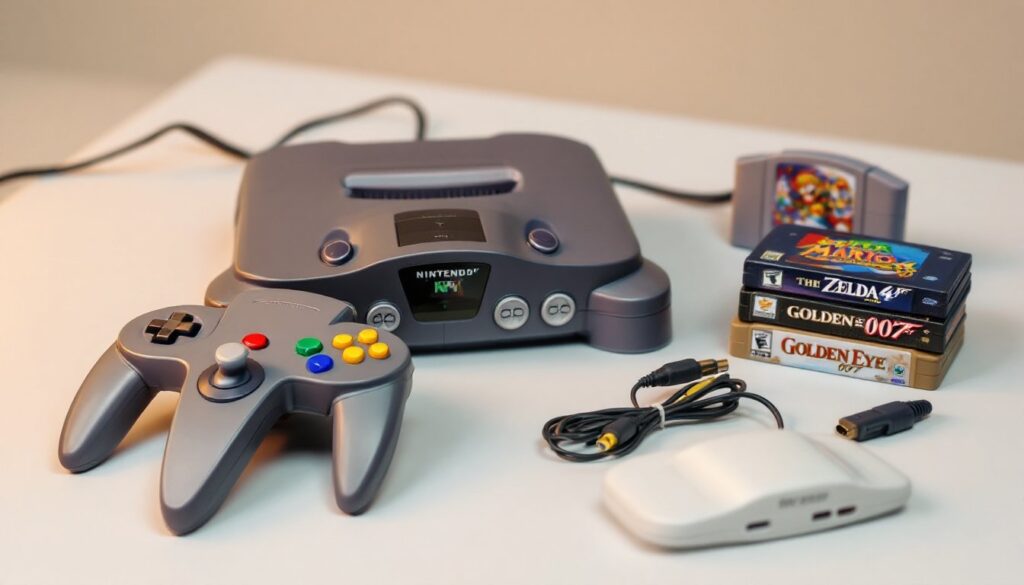
- Iconic Nintendo 64 titles like Super Mario 64, The Legend of Zelda: Ocarina of Time, and GoldenEye 007 set industry standards for 3D platforming, adventure gaming, and multiplayer FPS experiences that influence modern games today.
- The N64’s revolutionary three-pronged controller with asymmetrical ergonomic design and rumble technology feedback became iconic, influencing Nintendo’s future input innovations from the Wii Remote to the Nintendo Switch Joy-Con.
- Collecting authentic Nintendo 64 hardware has become competitive, with mint-condition consoles ranging from $200–$400 and sealed games commanding premium prices, requiring proper preservation through climate control and contact cleaning.
- Modern gamers can access the Nintendo 64 library through Nintendo Switch Online, emulation tools like Mupen64Plus, or reproduction cartridges, offering practical alternatives to original hardware while maintaining the console’s legacy.
- The Nintendo 64 established Nintendo’s design philosophy of prioritizing fun and tight controls over raw processing power, a principle that directly shaped the Nintendo Switch’s massive success and continues to define the company’s competitive advantage.
The Rise of 3D Gaming: How the N64 Changed Everything
Before the Nintendo 64, gaming lived in two dimensions. Sure, Mode 7 scaling gave the illusion of depth, but nothing compared to the full 3D worlds the N64 delivered with games like Super Mario 64. Nintendo’s cartridge-based system pushed polygon counts that rivaled CD-based competitors, thanks to aggressive optimization and a 93 MHz R4300i processor, impressive for 1996.
The shift to 3D wasn’t just technical: it was philosophical. Game designers suddenly had to rethink how players moved through space, how cameras worked, and how input mapped to character control. The analog stick (a feature the Nintendo 64 pioneered for mainstream consoles) became essential. Players went from pressing directional buttons to manipulating a full 3D space with intuitive stick control.
This architectural shift influenced everything that came after. The Nintendo Switch’s motion controls owe a conceptual debt to the N64’s experimental approach to input. Even the Nintendo Switch 2’s rumored hardware improvements follow the legacy of pushing accessible innovation forward. The N64 proved that raw power mattered less than smart design and game feel.
Iconic Games That Defined a Generation
The Nintendo 64’s library was lean compared to its competitors, roughly 387 games across its lifespan, but its hit-to-miss ratio was exceptional. Super Mario 64 didn’t just launch the system: it redefined platforming itself. The game’s analog stick control and camera management became the blueprint for 3D movement. Players spent entire summers mastering wall jumps and triple jumps in Peach’s castle.
The Legend of Zelda: Ocarina of Time represented the pinnacle of adventure gaming for its generation. The Z-targeting system (lock-on camera) solved a problem that plagued early 3D action games. Combat felt responsive, exploration rewarded curiosity, and the ocarina mechanic, playing actual musical sequences, added a layer of interactivity few games dared attempt. Even today, it ranks among the highest-rated games ever made.
Multiplayer titles shaped competitive gaming culture. GoldenEye 007 defined the split-screen FPS experience (no ADS, pure reflexes and map knowledge). Perfect Dark expanded that formula with more weapons and customizable matches. Mario Kart 64 brought battle mode to mainstream audiences. Super Smash Bros. inadvertently created a fighting game franchise that still thrives on the Nintendo Switch today.
According to best N64 games guides, titles like Banjo-Kazooie, Donkey Kong Country 64, and StarFox 64 cemented the console’s reputation for inventive, genre-defining gameplay. Each pushed the hardware and asked “what can we do differently?”
The Controller Innovation That Made It Legendary
The Nintendo 64 controller, that three-pronged, ergonomically bizarre thing, shouldn’t have worked. Yet it became iconic precisely because it solved a problem no one had solved before: how do you hold a device that uses an analog stick, shoulder buttons, and traditional buttons simultaneously?
The answer was asymmetrical design. Your right hand rested on the right prong, your left gripped the center, and your thumb manipulated the analog stick. This freed your right hand for buttons (A, B, Z, R) while keeping your left hand ready for camera control via the C-buttons. It felt alien at first, but once muscle memory kicked in, it felt perfect for the games it was designed for.
The controller featured rumble technology (the Rumble Pak accessory), which was revolutionary for bringing tactile feedback to gaming. Explosions felt heavy. Collisions had weight. This feedback loop made games feel more immersive than anything the PlayStation could offer at the time.
Today, collectors hunt down original controllers in pristine condition, though third-party wireless alternatives have improved durability. The design influenced how Nintendo thought about input going forward, the Wii Remote’s motion wand, the Nintendo Switch’s Joy-Con detachment, and likely features in the Nintendo Switch 2 all trace their experimental DNA back to that three-pronged grip.
Collecting and Preserving Your N64 Today
Collecting authentic Nintendo 64 hardware has become a competitive hobby. Prices for mint-condition consoles and games have climbed steadily. An original console (the gray or Atomic Purple variant) might run $200–$400, while sealed games command five or six figures depending on rarity.
Preservation matters because cartridge contacts degrade. Cleaning contacts with isopropyl alcohol works, but aggressive cleaning risks damaging labels. Capacitors in the motherboard are known to fail: replacement kits exist but require soldering skills. Storage in climate-controlled environments slows decay.
For those unwilling to risk original hardware, reproduction cartridges and flash carts offer practical alternatives. These devices accept ROM files and play on original consoles, letting collectors experience the library without stress. They’re not “authentic,” but they’re honest about what they are.
Many collectors also invest in RGB mods or original S-Video cables to improve image quality on modern displays. Standard composite cables delivered muddy picture quality: better cables make a dramatic difference. The investment, $30–$100, pays dividends if you’re playing regularly.
Emulation and Modern Alternatives for Current Gamers
Not everyone has the budget or space for original hardware. Emulation provides legal access to the Nintendo 64’s catalog through projects like Mupen64Plus and Dolphin. These tools run original ROM files (which you must own or dump yourself) at higher resolutions, with custom controllers, and stability improvements that original hardware struggles with.
Emulation communities continue pushing capabilities forward. Netplay features let geographically distant players compete in GoldenEye or Smash Bros. with minimal latency. Texture packs and upscaling filters modernize visuals without compromising the games’ essential feel. According to gaming news sources, emulation remains a gray area legally, but it’s become the de facto preservation method for gaming’s past.
Nintendo’s official re-releases have been limited. Nintendo Switch Online offers a curated N64 selection, though licensing disputes and technical challenges mean not every game is available. The Nintendo Switch 2 will likely expand this library, but don’t expect a comprehensive catalog anytime soon.
For accessibility, emulation wins. It eliminates cart-blowing, controller degradation, and the need for a CRT monitor (though some players insist old games look best on period-appropriate displays). Modern alternatives balance authenticity and practicality.
The Lasting Legacy of Nintendo’s 64-Bit Console
The Nintendo 64’s influence permeates modern gaming. The analog stick, once controversial, became standard across every console. The concept of “Nintendo polish” (tight controls, forgiving difficulty curves, pure gameplay fun) originated here. Games like Super Mario 64 proved that innovation trumped processing power: elegance beats brute force.
The console established franchises that define Nintendo today. Super Smash Bros. has evolved into a competitive behemoth with million-dollar tournaments. Mario Kart became the best-selling franchise in gaming. Zelda evolved from Ocarina of Time into sprawling open worlds like Breath of the Wild.
Even Nintendo’s philosophy of “fun first, graphics second” traces back to N64 design decisions. When the company competes with Sony and Microsoft today, it doesn’t pretend to match raw power. Instead, it delivers experiences, which is exactly what the Nintendo 64 proved was possible on 64-bit hardware. The Nintendo Switch’s massive success isn’t accident: it’s the spiritual successor to everything the N64 got right.
According to gaming coverage, Japanese developers learned crucial lessons from the N64’s game design. Capcom, Square Enix, and Bandai Namco all cut their teeth designing 3D games for the system. Those lessons informed decades of subsequent titles.
The Nintendo 64 remains relevant because its games are timeless. Ocarina of Time still feels groundbreaking. Super Mario 64 still teaches perfect level design. GoldenEye 007 still delivers satisfying gunplay. These aren’t artifacts, they’re blueprints.
Conclusion
The Nintendo 64 transformed gaming from a 2D medium into a fully realized 3D experience. Its controller, its game design philosophy, and its relentless focus on player joy set standards that persist across modern consoles including the Nintendo Switch and beyond. Whether you’re collecting original cartridges, emulating classics, or discovering the library for the first time, the N64’s influence is undeniable. It didn’t just revolutionize 3D gaming, it built the foundation that gaming still stands on today.