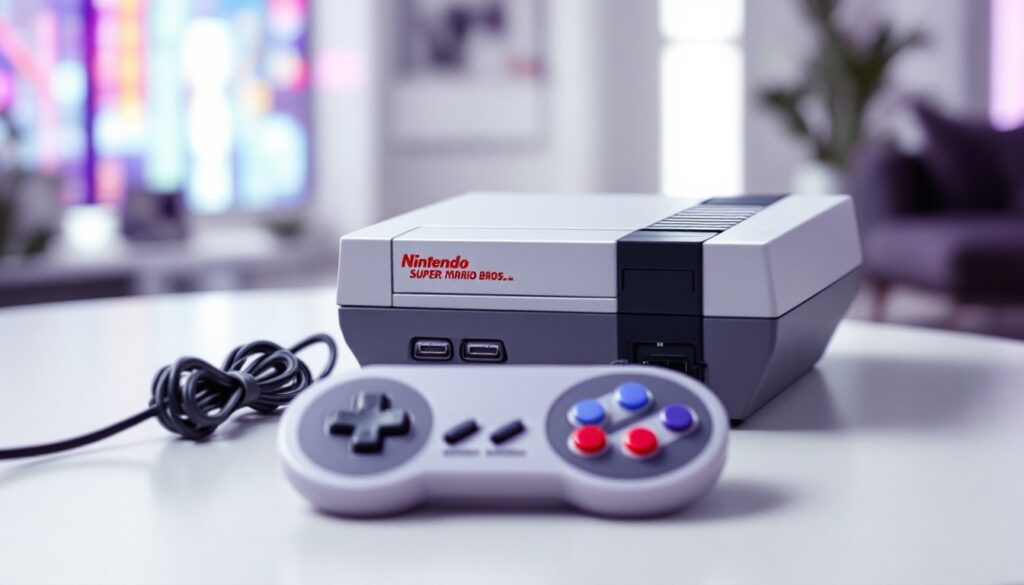
When the video game industry crashed in 1983, most retailers thought home consoles were dead. Then Nintendo arrived with the Nintendo Entertainment System, a gray box that would become a cultural phenomenon. The NES didn’t just resurrect gaming, it fundamentally transformed how consoles were made, marketed, and trusted by consumers. From Mario to Zelda, this 8-bit machine introduced billions to interactive entertainment and established Nintendo as the industry’s quality standard. More than four decades later, the NES remains one of gaming’s most important and beloved systems.
Key Takeaways
- The Nintendo Entertainment System revived a collapsed video game industry in 1985 by prioritizing consumer trust through quality control and strict licensing agreements, making home gaming a global phenomenon.
- Super Mario Bros. and iconic NES titles like The Legend of Zelda and Metroid established franchises and game design principles that shaped the industry for decades and remain culturally influential today.
- The NES’s innovative Game Pak lockout chip and ‘Seal of Quality’ prevented market saturation and low-quality software, a strategy adopted industry-wide and fundamentally changing how consoles are manufactured and trusted.
- Over 61.91 million Nintendo Entertainment System units sold worldwide, transforming home gaming from a niche hobby into the dominant form of interactive entertainment and proof that arcade-quality experiences could reach consumers at home.
- The NES’s 8-bit architecture, featuring the Ricoh 2A03 processor and 5-channel audio system, proved incredibly efficient for developers and enabled composers to create memorable soundtracks within technical constraints that drove creative innovation.
The Origins and Launch of the NES
Nintendo created the Nintendo Entertainment System as a redesigned adaptation of its Japanese Famicom (Family Computer), which launched on July 15, 1983. The Famicom was already a massive success in Japan, but Nintendo knew the North American market demanded a different approach after the industry’s near-total collapse three years earlier.
The company rebranded the system for Western audiences and engineered a careful market strategy. After a limited test launch in New York during October 1985, Nintendo rolled out the console nationwide between February and September 1986. This wasn’t just a new piece of hardware, it was a calculated rebirth of an entire industry. Retailers were skeptical of consoles, but Nintendo’s bundling strategy (pairing the system with Super Mario Bros. and Duck Hunt) proved consumers still wanted home gaming when the product earned back their trust.
The NES differed from the Famicom in several key ways, particularly in its front-loading cartridge design and overall industrial aesthetic. Nintendo also implemented strict quality control and licensing agreements that would become industry standard for decades to come.
The Revolutionary Games That Defined a Generation
The NES library became legendary almost immediately. Early hits like Donkey Kong and Duck Hunt proved the system’s versatility, but it was the games that followed that cemented the console’s place in history.
The Legend of Zelda introduced battery-backed save files and dynamic exploration on a home console, a massive leap forward for adventure gaming. Metroid pioneered atmospheric action with environmental storytelling that influenced game design for decades. Later arrivals like Mega Man, Castlevania, Final Fantasy, and Dragon Quest showed that the NES could deliver depth, challenge, and narrative on par with arcade cabinets.
Super Mario Bros. and Iconic First-Party Titles
Super Mario Bros. deserves special mention because it’s arguably the most important video game ever made. Released in 1985, it sold 40.24 million copies (many bundled with systems), popularized side-scrolling platformers, and created an IP that remains Nintendo’s crown jewel today. Mario’s design was perfection, responsive controls, escalating difficulty, and level design that taught you the rules without tutorials.
Beyond Mario, interesting facts you probably didn’t know about Nintendo reveal how deeply the NES shaped the company’s entire franchise ecosystem. Kid Icarus, Punch-Out.., and early Mario sequels established gaming IPs that are still active today. Nintendo proved that home consoles could deliver quality experiences comparable to, and eventually surpassing, what arcades offered.
Technical Specifications and Hardware Design
The NES was built on the Ricoh 2A03 processor (NTSC regions) or 2A07 (PAL regions), both based on the classic MOS 6502 architecture. While modest by today’s standards, this 8-bit chipset proved incredibly efficient and developer-friendly.
The system displayed games at 256×240 pixel resolution with access to a 54-color palette, delivering visuals that ranged from charmingly simple to genuinely impressive depending on developer skill. The iconic controller featured Nintendo’s directional pad (D-pad), a design innovation that became standard on virtually every gamepad that followed.
What really mattered was the cartridge system itself. The Game Pak format used a proprietary lockout chip (CIC) that Nintendo implemented for licensing control. This seemingly technical detail was revolutionary: it let Nintendo refuse to publish low-quality games, something the Atari 2600 had failed spectacularly to do. That quality control became synonymous with the Nintendo brand and remains embedded in how the company operates.
The audio architecture provided 5 sound channels (pulse, triangle, noise, and DPCM), which composers like Koji Kondo and Nobuo Uematsu leveraged to create some of gaming’s most memorable soundtracks. These constraints forced creativity, a principle that defined the entire NES generation.
Cultural Impact and Legacy in Gaming History
Over 61.91 million NES consoles sold worldwide, an astonishing figure that doesn’t fully capture its cultural reach. More important than the numbers was the normalization of home gaming itself.
The NES made characters like Mario globally recognizable before the internet existed. Parents who’d never owned a console bought one for their kids. Arcades remained popular, but home gaming became the dominant way people experienced interactive entertainment. That shift fundamentally changed the industry’s business model and creative priorities.
How the NES Saved the Gaming Industry
When Nintendo launched in North America, retailers were genuinely hostile toward consoles. The crash had burned them badly, and they doubted whether home gaming could work. Nintendo’s response was brilliant: they treated it like a problem of trust rather than a problem of technology.
The “Nintendo Seal of Quality” and strict third-party licensing model prevented the market oversaturation and low-quality software that had killed the Atari 2600. Retailers could trust that a Nintendo-licensed game met minimum standards. That simple guarantee changed everything.
The Nintendo Entertainment System was celebrated on its 35th anniversary as the console that revived an entire industry. Without it, home gaming might have remained a niche market for much longer, or disappeared entirely. Instead, it became central to global entertainment.
Licensed game production continued into the 1990s, with official releases ceasing in 1994. But the influence continued far beyond, every console manufacturer adopted Nintendo’s licensing and quality-control model.
Collecting and Preserving NES Consoles Today
The NES collecting scene remains remarkably active. Original hardware, whether the front-loader, top-loader, or the Japanese Famicom variant, commands premium prices when boxed and in working condition. Serious collectors seek out early production units and test cartridges that were never meant for retail release.
Nintendo capitalizes on nostalgia through re-releases. The NES Classic Mini represented for modern audiences who don’t want to hunt down working original hardware. The 2016 version sold approximately 2.3 million units before discontinuation in April 2017, followed by a brief mid-2018 restock.
Preservation efforts extend beyond consumer nostalgia. The Video Game History Foundation has documented the launch collection and original hardware, ensuring future generations understand the NES’s technical and cultural legacy. Cartridge conservation, protecting circuit boards from capacitor decay, has become a serious discipline among dedicated collectors.
For those interested in Nintendo’s handheld legacy, the original Nintendo DS revolutionized portable gaming years after the NES established Nintendo’s supremacy in home consoles. The company’s approach to system design, quality control, and first-party software traces directly back to lessons learned in the 8-bit era.