
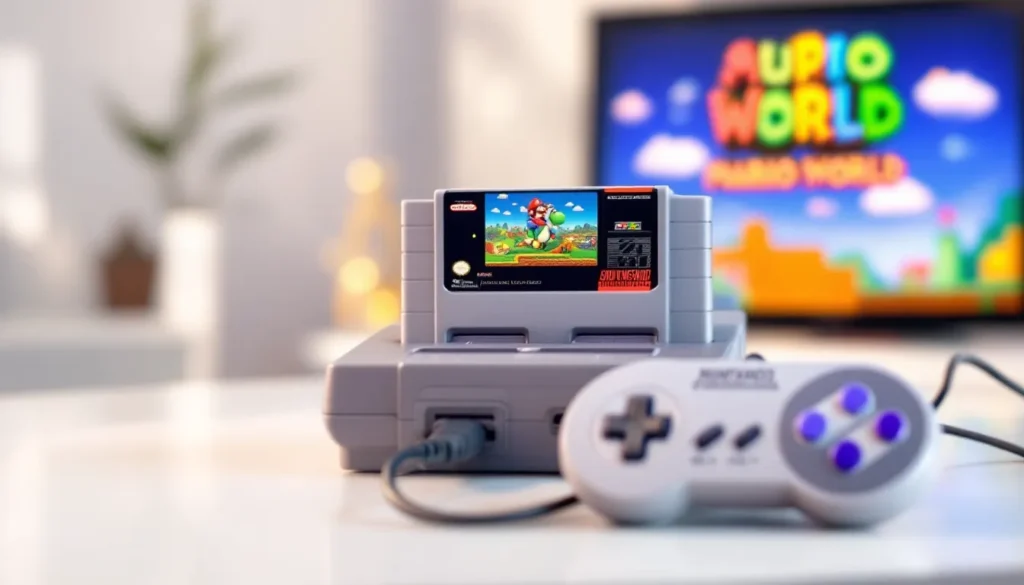
Released in 1990 as a launch title for the Super Nintendo Entertainment System, Super Mario World didn’t just showcase the console’s capabilities, it redefined what a platformer could be. Thirty-six years later, players still discover new secrets, speedrunners continue to shave milliseconds off world records, and a new generation experiences Dinosaur Land for the first time through Nintendo Switch Online.
This wasn’t just another Mario game. It was Nintendo’s statement piece, introducing Yoshi, expanding the level design vocabulary established by Super Mario Bros. 3, and hiding 96 exits across its colorful worlds. Whether you’re chasing 100% completion, hunting for Star Road shortcuts, or simply reliving childhood memories, this guide covers everything from basic mechanics to the deepest secrets buried in Dinosaur Land’s code.
Key Takeaways
- Super Mario World remains one of gaming’s greatest platformers nearly four decades later due to its intuitive design philosophy that teaches mechanics through play rather than tutorials, making it universally accessible to new and veteran players alike.
- The game features 96 exits across seven main worlds and two secret zones, with the Special World unlocked only after discovering all secret exits and providing brutally difficult challenges for true completionists.
- Yoshi fundamentally transforms Super Mario World gameplay as a mount, utility tool, and extra hit point, with four color variants offering distinct abilities like flight, firepower, and ground shockwaves that open up different level routes.
- Finding all four Switch Palaces early unlocks colored blocks that make secret exits significantly easier to reach, making this optimization crucial for 100% completion and efficient progression through Dinosaur Land.
- Modern players can experience Super Mario World legally through Nintendo Switch Online with added features like save states, rewind functionality, and online co-op multiplayer, though original SNES hardware remains the gold standard for an authentic experience.
- The cape feather power-up fundamentally breaks level design in the best way by enabling sequence-breaking flight techniques, making it essential for speedrunning and discovering hidden shortcuts throughout the game.
Why Super Mario World Remains a Gaming Masterpiece in 2026
Most launch titles age poorly. Super Mario World aged like fine wine.
The game’s design philosophy, teaching through play rather than tutorials, still influences modern platformers. World 1-1 introduces every core mechanic without a single word of instruction. Jump on enemies, hit blocks, grab power-ups. By the time players reach Donut Plains, they’re naturally experimenting with cape physics and discovering secret exits.
The pixel art holds up because Nintendo’s artists understood form and readability. Every enemy, platform, and background element communicates its function at a glance. Compare this to many contemporary indie games drowning in visual noise, and Super Mario World’s clarity becomes even more impressive.
Critical reception reflected this quality. The game maintains exceptional review aggregation scores that few platformers have matched, with modern retrospectives continuing to place it among the greatest games ever made. Speedrunning communities keep it relevant too, the any% world record sits under 10 minutes as of 2026, with runners exploiting frame-perfect cape tech and item manipulation glitches Nintendo never intended.
But here’s what really matters: Super Mario World respects player intelligence. It doesn’t hold your hand. It doesn’t lock you into a linear path. From the moment you can access Star Road in Donut Plains, the game opens up, letting you skip entire worlds if you’re skilled enough to find the shortcuts.
That design philosophy, challenge without punishment, exploration without padding, is why new players still fall in love with it today.
Game Overview and Story
Bowser’s kidnapped Princess Toadstool (later renamed Peach) and dragged her to Dinosaur Land for a vacation gone wrong. Mario and Luigi arrive to stop him, with the added wrinkle that Bowser’s seven Koopalings have taken over the region’s castles.
The story’s an excuse, and that’s fine. Super Mario World doesn’t pretend to be narrative-driven. The real draw is exploring Dinosaur Land itself, a sprawling overworld that branches, loops back, and hides entire zones behind secret exits.
Unlike Super Mario Bros. 3’s linear world map, Dinosaur Land feels like an actual place. Multiple paths connect regions. Star Road creates a secret highway through the game. The Special World unlocks after beating Bowser and finding all 96 exits, transforming Dinosaur Land’s aesthetic completely.
Nintendo designed this for the SNES launch, and the difference between this and NES titles was staggering. Mode 7 rotation effects in castle boss fights, four-layer parallax scrolling in Ghost House levels, and transparent water in underwater sections all showcased what the Super Nintendo could do. The audio chip got a workout too, Koji Kondo’s soundtrack used sampled percussion and bass that made the NES sound like a toy in comparison.
The game shipped on a 4-megabit cartridge (512 KB), which was massive for 1990. That space allowed for 72 standard levels, 24 secret exits, ghost houses, castles, switch palaces, and Bowser’s fortress. Every kilobyte was optimized to hell and back.
Gameplay Mechanics and Controls
Super Mario World refined the momentum-based movement from Super Mario Bros. 3 and added a spin jump that opened up new movement possibilities. Hold B to run, press A to jump. Simple inputs, deep mechanics.
The spin jump (executed by pressing A while moving or by jumping off Yoshi) lets Mario break yellow rotating blocks and bounce harmlessly off spiked enemies like Spinies. It’s essential for certain secret exits and speedrun strategies. The physics are different too, spin jumps have slightly reduced horizontal control but allow for more precise landings on narrow platforms.
Cape Mario transforms movement entirely. Grab a cape feather, and suddenly you’re managing lift, dive speed, and momentum conservation. The cape takes practice. Players need to build speed, jump, then hold B while pulling back on the D-pad to gain altitude. A perfectly executed cape flight can cross entire levels, breaking intended routes wide open.
Cape attacks work by spinning (press Y or X while running), which sends Mario into a damaging twirl. It’s slower than Fire Mario’s fireballs but works on enemies resistant to other attacks.
Fire Mario returns from previous games but feels less dominant here. Fireballs bounce along terrain and can hit multiple enemies, but many later levels place Koopas and other enemies in positions where fireballs can’t reach them. Fire flower blocks appear less frequently than cape feathers in the mid-to-late game.
Power-Ups and Special Abilities
Beyond the big three (Mushroom, Fire Flower, Cape Feather), Super Mario World introduced the Super Mushroom’s permanent upgrade system. Get hit while powered up, and Mario shrinks to Super Mario instead of dying instantly. Get hit again, and you’re small Mario, one hit from death.
The P-Balloon is rare but hilarious. It inflates Mario, letting him float for about 20 seconds. It’s required for exactly one secret exit and appears in only a handful of levels. The controls are floaty (pun intended), making precision tricky.
Star invincibility works as expected, grab a star, become temporarily invincible, and sprint through enemies with reckless abandon. The star theme still slaps.
The Reserve Item system lets players store one power-up in a box at the top of the screen. Press Select to activate it. This became crucial for kaizo hacks decades later, but in the vanilla game, it’s mostly a safety net for tricky levels.
Yoshi: Your Trusty Dinosaur Companion
Yoshi changed everything. This dinosaur functions as a mount, extra hit point, and utility tool all at once.
Four Yoshi colors exist: Green (standard), Red (all Koopa shells give fireball spitting ability), Blue (all shells give flight), and Yellow (all shells create ground-pound shockwaves). Color matters when planning routes through levels.
Yoshi eats enemies by extending his tongue (press Y). He can swallow most standard enemies instantly, grab items, and hold Koopa shells in his mouth for later use. A green shell in Yoshi’s mouth does nothing until swallowed. A red shell lets Yoshi spit three fireballs. Yellow shells trigger ground stomps. Blue shells grant temporary flight until Yoshi swallows the shell.
The flight mechanic with Blue Yoshi is absurdly powerful. Grab any shell, keep it in Yoshi’s mouth, and you have unlimited flight time. This breaks level design in the best way, letting players skip entire sections.
Yoshi can’t enter castles, ghost houses, or fortresses. He’ll wait outside, which stings when you’ve gotten used to having that extra hit point. Get hit while riding Yoshi, and he runs away panicking, giving players a few seconds to jump back on before he disappears.
Yoshi dies instantly in lava and bottomless pits, but here’s the dirty secret every experienced player learns: you can sacrifice Yoshi to gain extra jump height. Jump off Yoshi in midair (he’ll fall while you get a boost), and you can reach platforms that would otherwise be impossible. It’s mean. It works. Speedrunners do it constantly.
Complete World and Level Guide
Dinosaur Land’s overworld divides into seven main worlds plus two secret zones. Each world has a distinct theme and difficulty curve, but the order you tackle them isn’t always linear.
Dinosaur Land: Worlds 1-7
Yoshi’s Island (World 1) eases players in with plains, basic enemies, and gentle slopes. Yellow Switch Palace unlocks here, letting players hit yellow blocks throughout the game to spawn platforms. The castle introduces the Koopaling boss structure: dodge attacks, jump on the boss three times, win.
Donut Plains (World 2) introduces ghost houses, secret exits, and the first Star Road access. Donut Plains 1 has the game’s most famous secret exit, grabbing a key and flying it to the keyhole with Cape Mario. The Green Switch Palace appears here, enabling green blocks.
Donut Secret House connects to Donut Secret 1, which leads to Star Road. This shortcut highway lets skilled players skip massive chunks of the game.
Vanilla Dome (World 3) goes underground with cave levels, lava, and the Red Switch Palace. Vanilla Dome’s secret exits are trickier to find, often requiring precise jumps or cape flight through tight corridors. According to coverage from major gaming outlets, many players first struggled here due to the spike in precision platforming.
Twin Bridges Area (World 4) splits into two paths via bridges. It’s lighter on levels but features some of the toughest ghost houses and the Blue Switch Palace, the last switch palace most players find. Blue blocks often appear in late-game levels, creating essential platforms.
Forest of Illusion (World 5) is a maze. Levels loop back on themselves. Secret exits are required to progress. Taking the wrong exit might send you backward. It’s brilliant and frustrating in equal measure. Forest of Illusion connects to Forest Secret Area and eventually to Star Road again.
Chocolate Island (World 6) ramps up difficulty significantly. Levels feature tighter platforming, more aggressive enemy placement, and castle stages that test every skill you’ve learned. Chocolate Island also hides multiple paths to the final area.
Valley of Bowser (World 7) is endgame territory. You’ll need the key from the Valley Fortress to unlock the path forward. Levels here throw everything at you: lava, spike pits, complex enemy patterns, and autoscrolling sections. Valley of Bowser leads to Bowser’s Castle and the final confrontation.
Bowser’s Castle itself is a gauntlet, no checkpoints, just a long sequence of hazards ending in the Koopa Clown Car fight. Dodge Bowser’s fireballs and mechakoopas, then hit him with mechakoopas when he swoops low. Beat him, and Princess Toadstool is saved.
Special World and Star Road Secrets
Star Road has five levels, each offering a shortcut to different worlds. Accessing Star Road requires finding specific secret exits in main worlds:
- Star Road 1: Links to Donut Plains, Twin Bridges, and Soda Lake
- Star Road 2: Connects to Vanilla Dome
- Star Road 3: Routes to Forest of Illusion
- Star Road 4: Accesses Chocolate Island and Valley of Bowser
- Star Road 5: Leads to the Special World entrance
Each Star Road level has a secret exit leading to the next Star Road level, creating a chain. Find all five Star Road secret exits to unlock the Special World.
The Special World contains eight brutally difficult levels with names like Tubular, Gnarly, and Funky. These levels demand mastery of every mechanic, cape flight, Yoshi tech, spin jumps, pixel-perfect timing.
Tubular is infamous. It’s a P-Balloon level requiring near-flawless floating through narrow gaps filled with enemies. Drop too fast, and you die. Float too high, and you hit the ceiling and lose momentum. Players have been cursing this level since 1990.
Complete all eight Special World levels, and Dinosaur Land undergoes a cosmetic transformation. Enemies change sprites (Koopa Troopas become Mario-faced creatures called “Mask Koopas”), and the season shifts to autumn with orange foliage. It’s a nice touch that rewards full completion.
Secret Exits and Hidden Levels
96 exits. That’s the magic number for 100% completion. 72 levels with 24 secret exits scattered throughout.
Secret exits usually lead to alternate paths, hidden levels, or Star Road access. Spotting them requires attention to level design. Look for suspicious gaps, floating key blocks, or areas requiring specific power-ups to reach.
Key and keyhole exits are the most common secret type. Find a key (often hidden in a ? block or carried by a flying enemy), carry it to a keyhole somewhere in the level, and unlock the secret path. Donut Plains 1’s secret exit is the tutorial version, the keyhole sits in plain sight above the level, reachable by cape flight.
Alternate goal posts appear in some levels. Instead of hitting the standard goal tape, players find a second tape hidden behind a wall, underwater, or in an alternate route. Chocolate Island 2 has multiple exits determined by the in-game timer, if the timer ends in an odd number, one exit opens: even numbers open another.
Hidden platforms and pipes lead to secret areas. Cheese Bridge Area has a secret exit requiring players to eat a brown platform-climbing Koopa with Yoshi, then use the platform gap to reach a hidden pipe. Without Yoshi, you can’t access it.
Some secret exits are mean. Vanilla Secret 1 requires cape flight through a narrow ceiling gap while enemies harass you. Forest of Illusion 1 has a secret exit hidden behind a Giant Gate, you need to explore beyond the obvious goal.
The game never explicitly tells you secrets exist. You discover them through exploration, experimentation, or that one friend who read Nintendo Power religiously in 1991.
Tracking progress is built-in. The file select screen shows the number of exits found (up to 96). Levels with secret exits display a red dot on the overworld once found, while standard exits show yellow.
Tips and Strategies for 100% Completion
Hunting for 100% completion means finding all 96 exits and collecting every Dragon Coin. It’s a satisfying grind, but having a roadmap helps.
Collecting All 96 Exits
Start by unlocking all four Switch Palaces early. The colored blocks they enable make later secret exits significantly easier to reach:
- Yellow Switch Palace (Yoshi’s Island) – Accessible immediately
- Green Switch Palace (Donut Plains 2 secret exit required) – Often missed by casual players
- Red Switch Palace (Vanilla Dome 2) – Mid-game unlock
- Blue Switch Palace (Forest of Illusion 3 or Forest Secret Area) – Late discovery for most
With all switches activated, revisit earlier levels. Many secret exits become trivial with the right colored blocks spawned.
Carry power-ups strategically. If you’re hunting a secret exit that requires cape flight, grab a cape feather and store it in reserve. Reset the level if you lose it before finding the exit.
Use Yoshi color mechanics. Some exits require Blue Yoshi’s flight or Red Yoshi’s fireballs. If you don’t have the right color, check Star World for Yoshi eggs or grab a shell and use color-specific abilities.
Don’t skip ghost houses. Every ghost house has a secret exit. They’re often the hardest to find, involving looping rooms, false walls, or timed door sequences. Ghost House walkthroughs are your friend here, some solutions are borderline obscure.
Map out Star Road connections. Star Road’s branching structure can confuse navigation. Draw a map or reference a guide to understand which Star Road exit leads where. This prevents backtracking.
Finding Every Dragon Coin
Each level contains five Dragon Coins, large coins marked with a Yoshi face. Collecting all five in a single playthrough of a level grants an extra life.
Dragon Coins aren’t required for 100% completion in terms of game tracking, but completionists hunt them anyway. They’re usually placed along the main path or slightly off the beaten track.
Some Dragon Coins require specific power-ups:
- Cape flight to reach high platforms
- Yoshi to eat enemies blocking coin access
- Spin jumps to break blocks hiding coins
Unlike secret exits, Dragon Coins don’t show progress on the file select screen. You’ll need to manually track which levels you’ve fully cleared if you’re going for true 100%.
A few Dragon Coins are evil. Vanilla Dome 3 hides one inside a pit that looks like instant death but actually has a floor you can land on. Chocolate Island 4’s autoscroll section has a Dragon Coin requiring precise cape timing while the screen pushes you forward.
The payoff? Bragging rights and the satisfaction of knowing you squeezed every secret out of one of gaming’s greatest platformers.
Boss Battles and How to Defeat the Koopalings
Boss fights in Super Mario World follow a pattern: learn the attack, dodge it, jump on the boss’s head three times. Simple concept, escalating execution.
The seven Koopalings each rule a world’s castle. They share the basic structure but vary attacks:
Iggy Koopa (Yoshi’s Island Castle) balances on a tilting platform over lava. The platform physics are the real challenge, timing jumps while the floor shifts takes practice.
Morton Koopa Jr. (Donut Plains Castle) climbs walls and stomps the ground, causing the ceiling to drop spiked balls. Stay mobile, watch for the stomp tell, and punish him when he lands.
Lemmy Koopa (Vanilla Dome Castle) rides a ball while circus-themed hazards bounce around. Identify the real Lemmy among decoy balls, then jump on him. The Mode 7 rotation effect here was mind-blowing in 1990.
Ludwig von Koopa (Twin Bridges Castle) shoots fireballs and performs high jumps. His pattern is more aggressive, he’ll jump toward Mario’s position, forcing reactive dodges.
Roy Koopa (Forest of Illusion Castle) is the tankiest Koopaling. He climbs walls and creates shockwaves when landing. The shockwave lingers, so jump timing is crucial.
Wendy O. Koopa (Chocolate Island Castle) throws rings that bounce off walls at weird angles. The rings create zone control, limiting safe space. Patient play wins here.
Larry Koopa (Valley of Bowser Castle 1) is similar to Iggy but faster. The platform tilts more aggressively, and Larry’s movement is less predictable.
All Koopaling fights allow cape or fire flower attacks, but jumping is usually faster and more reliable.
Reznor guards fortresses. Four Reznor ride spinning platforms above a lava pit. Hit the platforms from below to knock Reznor off, then avoid their fireballs. Take out all four to proceed. It’s a puzzle disguised as a boss fight.
Bowser’s final battle happens in the Koopa Clown Car. The fight has two phases:
- Phase One: Bowser flies around, dropping Big Steelies (heavy bowling balls) and throwing mechakoopas. Dodge everything. You can’t damage him yet.
- Phase Two: The Clown Car’s propeller breaks. Bowser starts swooping lower, tossing more mechakoopas. Grab a mechakoopa and throw it up at Bowser when he swoops. Hit him twice to win.
The fight’s rhythm-based. Learn the swoop timing, position yourself under Bowser’s arc, and punish him when he drops mechakoopas.
Cape Mario trivializes most bosses, the spin attack often hits multiple times per swing, but Bowser’s fight requires the mechakoopa throw, so power-ups don’t help much.
How to Play Super Mario World Today
Original SNES cartridges still work if you’ve maintained the hardware, but most players in 2026 choose modern options for convenience and quality-of-life features.
Original SNES Hardware vs. Modern Options
Playing on original SNES hardware provides the authentic experience, CRT scanlines, original controller feel, minimal input lag. Cartridge prices vary wildly depending on condition, but loose copies hover around $20-$30 USD as of 2026. Boxed copies with manuals command higher prices among collectors.
The downside? CRT TVs are increasingly rare. Playing on modern HDTVs via composite cables introduces input lag that makes precise platforming feel mushy. Upscalers like the RetroTINK-5X or OSSC solve this but add $300+ to the setup cost.
Super Famicom versions (the Japanese release) are identical gameplay-wise but slightly cheaper on the secondhand market. The SNES is region-locked, so you’d need a cartridge adapter or a modified console.
Alternatively, the Super NES Classic Edition (released 2017, occasionally restocked) includes Super Mario World pre-loaded along with 20 other games. It outputs HDMI, has minimal lag, and includes a rewind feature for tough sections. It’s the best plug-and-play option if you can find one at MSRP.
Nintendo Switch Online and Emulation
Nintendo Switch Online subscribers get access to Super Mario World via the SNES library. It’s the easiest legal method in 2026, $20/year for the basic tier, $50/year for the Expansion Pack (which includes N64 and Genesis games too).
The Switch version includes save states, rewind functionality, and online multiplayer co-op. Yes, you can play Super Mario World co-op online with a friend in 2026, which is surreal and delightful. Input lag is present but minimal on wired connections.
As detailed by community-focused Nintendo coverage, the Switch Online emulation has improved significantly since launch, with most sprite flickering and audio issues patched out.
Emulation on PC offers the most flexibility. SNES9x and bsnes are the gold-standard emulators, both offering pixel-perfect accuracy, save states, fast-forward, and custom filters. ROM legality is a gray area, if you own the original cartridge, it’s ethically defensible, but technically still piracy in many jurisdictions.
Emulation enables romhacks. The SNES homebrew and kaizo scene has produced thousands of custom Super Mario World levels and total conversion mods. Kaizo Mario World, Item Abuse, and Grand Poo World are legendary difficulty hacks that make the Special World look like a tutorial.
For speedrunning, BizHawk or lsnes with low-latency monitors are preferred. The speedrunning community accepts emulator runs for most categories, though console runs are verified separately.
Mobile emulation exists via apps like Delta (iOS) or RetroArch (Android), but touchscreen controls are miserable for precision platforming. Pair a Bluetooth controller for a playable experience.
Conclusion
Super Mario World still teaches modern game designers how to build a platformer. Its level design conveys mechanics through environment rather than tutorials. Its secrets reward curiosity without requiring a guide. Its difficulty curve respects the player’s time while pushing their skills.
36 years later, it’s still fun. That’s the only metric that matters.
Whether you’re chasing the 96-exit milestone, optimizing speedrun routes, or introducing a younger player to Dinosaur Land, Super Mario World holds up. The game doesn’t need nostalgia to justify its place in the canon, it earns that spot through tight controls, creative level design, and a willingness to let players break it in the best ways.
Fire up your SNES Classic, boot up Switch Online, or dust off that old cartridge. Dinosaur Land is waiting, and Yoshi’s still the best mount in gaming history.