Before Mario jumped on Goombas, before the NES revolutionized home gaming, and before Shigeru Miyamoto ever sketched a single concept art, Nintendo was in a completely different business: making playing cards. Not just any cards, though, hanafuda, the traditional Japanese flower cards that have been a cultural fixture since the Edo period. These ornate, beautifully illustrated cards weren’t just Nintendo’s first product: they were the foundation that kept the company alive for nearly a century before video games even existed.
Most gamers know Nintendo as the house that built the Switch, the company that saved the industry in 1985, or the stubborn giant that refuses to put Mario on smartphones (well, mostly). But the story of how a small Kyoto card-making workshop survived long enough to become a gaming empire starts with hanafuda, and it’s way more interesting than you’d think. These cards are still in production today, still bearing the Nintendo name, and they represent a direct line from 19th-century Japan to the modern gaming landscape.
Key Takeaways
- Nintendo Hanafuda cards, first produced in 1889, served as the financial foundation that sustained the company for over a century before the video game era began.
- Hanafuda cards feature 48 traditionally illustrated flower cards (4 for each of the 12 months) with distinct point values, including 5 high-value Bright cards worth 20 points each.
- The yakuza’s preference for Nintendo hanafuda as the standard for gambling operations gave the company massive, reliable sales that competitors couldn’t match during its early decades.
- Koi-Koi is the most popular hanafuda game variant, combining memory, probability calculation, and strategic risk assessment through matching and yaku (scoring combinations).
- Modern Nintendo hanafuda options range from traditional Tengu and Miyako no Hana decks (¥1,000-1,500) to limited-edition gaming-themed sets like Mario and Pokémon versions that appeal to collectors and new audiences.
- Digital hanafuda adaptations on Nintendo Switch, Steam, and mobile apps make the game accessible to modern gamers while physical cards remain preferred by experienced players for their tactile experience.
What Are Hanafuda Cards?
Hanafuda (literally “flower cards”) are traditional Japanese playing cards used for a variety of games. Unlike Western playing cards with their suits of hearts, diamonds, clubs, and spades, hanafuda decks use a completely different system based on the 12 months of the year, each represented by a specific plant or flower.
The cards themselves are smaller and thicker than standard playing cards, typically measuring about 2.1 inches by 1.3 inches. They’re made from stiff cardstock, traditionally constructed from layered Japanese paper (washi) and tree bark, though modern versions use more durable materials. There are no numbers or letters printed on them, just beautiful, stylized illustrations that players learn to recognize through gameplay.
Hanafuda originated in the 16th century as a way to circumvent gambling bans in Japan. When Portuguese traders introduced Western playing cards, the Japanese government repeatedly outlawed them due to their association with gambling. Crafty Japanese manufacturers kept redesigning the cards to slip past regulations, and hanafuda was the design that stuck. By removing obvious numerical values and using floral imagery, these cards technically weren’t “Western” playing cards, allowing them to proliferate even during strict prohibition periods.
The Structure and Design of a Hanafuda Deck
A standard hanafuda deck contains exactly 48 cards, four cards for each of the 12 months. Each monthly suit has a distinct visual theme, and the four cards within each month vary in point value and rarity.
The point value system breaks down like this:
- Bright cards (Hikari): 20 points each, 5 in the deck
- Animal/Ribbon cards (Tane): 10 points each, 9 in the deck
- Ribbon cards (Tanzaku): 5 points each, 10 in the deck
- Chaff cards (Kasu): 1 point each, 24 in the deck
The “Bright” cards are the most valuable and immediately recognizable, they include iconic images like the crane with the sun (January), the curtain with cherry blossoms (March), and the moon with geese (August). These high-value cards often feature red or gold accents that make them stand out from the rest of the deck.
Nintendo’s hanafuda cards follow this exact structure, maintaining the traditional design elements that have been passed down for generations. The company’s versions are known for exceptionally clean printing and vibrant colors that make the cards both functional and collectible.
Understanding the 12 Suits and Their Symbolism
Each month in a hanafuda deck carries specific cultural significance tied to the Japanese calendar and seasonal celebrations. Here’s the complete breakdown:
- January – Pine (Matsu): Symbolizes longevity and steadfastness, includes a Bright card with a crane
- February – Plum Blossom (Ume): Represents perseverance, features a bush warbler
- March – Cherry Blossom (Sakura): Spring and renewal, contains a Bright card with a curtain
- April – Wisteria (Fuji): Nobility, includes a cuckoo
- May – Iris (Ayame): Courage, features a water bridge
- June – Peony (Botan): Prosperity, includes butterflies
- July – Bush Clover (Hagi): Autumn and change, features a boar
- August – Susuki Grass (Pampas): Harvest, contains a Bright card with the moon and geese
- September – Chrysanthemum (Kiku): Longevity, features a sake cup
- October – Maple (Momiji): Beauty in change, includes a deer
- November – Willow (Yanagi): Adaptability, contains a Bright card with a man holding an umbrella (often called the “Rainman”)
- December – Paulownia (Kiri): Nobility, features a Bright card with a phoenix-like bird
Learning to recognize these suits is fundamental to playing any hanafuda game. Experienced players can identify each card at a glance, reading the point values and potential combinations instantly, similar to how poker players automatically recognize straight or flush possibilities.
Nintendo’s Origins: From Card Maker to Gaming Giant
The Nintendo that exists today, valued at over $50 billion, responsible for franchises like Zelda, Pokémon, and Animal Crossing, started as a tiny workshop in Kyoto producing hanafuda cards by hand. The transformation from traditional card maker to global gaming corporation took nearly a century and involved several near-death experiences for the company.
Fusajiro Yamauchi and the Birth of Nintendo in 1889
Fusajiro Yamauchi founded Nintendo Koppai (roughly translating to “leave luck to heaven”) on September 23, 1889, in the Shimogyō ward of Kyoto. At the time, Japan was during the Meiji Restoration, rapidly modernizing and opening up to Western influence after centuries of isolation.
Yamauchi didn’t invent hanafuda, the cards had existed for centuries, but he recognized a business opportunity. In 1886, Japan had lifted a long-standing ban on playing cards, creating a sudden legal market for card games. Yamauchi positioned himself to capitalize on this newly legitimate industry.
His workshop produced handmade hanafuda cards using traditional methods: mulberry tree bark for the card stock, crushed seashells for white pigment, and hand-painted designs. The quality was exceptional, and the Nintendo brand quickly became associated with premium hanafuda cards in the Kyoto region.
Fusajiro ran the company until 1929, when he retired and passed leadership to his son-in-law, Sekiryo Kaneda (who took the Yamauchi name). Fusajiro died in 1940, decades before his company would become a household name worldwide, but his initial success with hanafuda cards ensured Nintendo survived long enough to reach the video game era.
How Hanafuda Cards Saved Nintendo from Obscurity
Hanafuda cards weren’t just Nintendo’s origin story, they were the company’s lifeline during multiple existential crises. For nearly 80 years, from 1889 to the late 1960s, playing cards were essentially Nintendo’s entire business model.
The cards provided steady, reliable income through Japan’s turbulent 20th century. During World War II, when luxury goods were scarce and many businesses collapsed, Nintendo survived by producing cards for the Japanese military. The immediate post-war period saw another boom as returning soldiers sought entertainment, and Nintendo’s established brand gave them a crucial advantage.
In 1949, Hiroshi Yamauchi (Fusajiro’s great-grandson) took over the company at age 21. He aggressively modernized production, introducing plastic-coated cards and forming a distribution deal with Disney in 1959 to produce Western-style playing cards featuring Disney characters. This Disney deal was massively successful and made Nintendo the dominant playing card company in Japan.
But Hiroshi Yamauchi recognized a fundamental problem: the playing card market had a ceiling. People don’t buy cards frequently, one deck lasts for years. In the 1960s, Nintendo attempted to diversify into everything from instant rice to taxi services to a chain of “love hotels.” Nearly all of these ventures failed spectacularly.
What kept Nintendo afloat during these failed experiments? Hanafuda cards. The traditional cards continued selling steadily, providing the financial cushion that allowed Yamauchi to keep trying new ventures without bankrupting the company. When Nintendo finally struck gold with electronic toys in the 1970s and arcade games in the early 1980s, hanafuda sales were still contributing to the bottom line.
Even today, hanafuda cards remain in Nintendo’s product catalog, a 137-year-old product line that outlasted everything from Labo to the Virtual Boy.
Why Hanafuda Cards Became Nintendo’s First Success
Nintendo wasn’t the only hanafuda manufacturer in late 19th-century Japan, so what made their cards stand out? The answer combines quality craftsmanship, strategic branding, and a bit of underworld connection.
First, the quality was genuinely superior. Fusajiro Yamauchi used thicker card stock than competitors, making Nintendo hanafuda more durable, crucial for cards that would see heavy use in extended gaming sessions. The printing was cleaner, the colors more vibrant, and the finish smoother. Players could feel the difference, and in gambling circles (which, let’s be honest, was where most hanafuda saw use), card quality mattered.
Second, Nintendo cultivated relationships with the yakuza, Japan’s organized crime syndicates. This isn’t a secret or conspiracy theory: it’s well-documented history. Gambling was (and largely remains) illegal in Japan, but it was also incredibly popular. The yakuza controlled much of the illegal gambling scene, and they preferred Nintendo cards. Having the yakuza as steady customers provided massive, reliable sales volume that smaller competitors couldn’t match.
Nintendo never advertised this connection, but they didn’t need to. Word-of-mouth in gambling circles spread the reputation: if you were running a serious game, you used Nintendo hanafuda. This association was so strong that when Hiroshi Yamauchi took over in 1949, one of his first moves was to distance the brand from its yakuza associations to make the company more respectable and expand into mainstream markets.
Third, Nintendo innovated on tradition while respecting it. In 1953, they became the first company to produce plastic-coated hanafuda cards, making them water-resistant and even more durable. Traditional purists initially objected, but players loved the practical improvement. This willingness to modernize while maintaining core design elements became a Nintendo trademark, you can see the same philosophy in how they approach hardware design today.
Finally, Nintendo understood distribution. They established relationships with toy stores, general stores, and wholesalers throughout Japan, ensuring their cards were available nationwide. Competitors often remained regional operations: Nintendo became the national standard.
By the 1960s, Nintendo held an estimated 80% market share of hanafuda cards in Japan, a dominance that funded their pivot into toys and eventually video games. The lessons learned from hanafuda, quality over quantity, careful iteration on tradition, and building distribution networks, would serve Nintendo well when they entered the home console market in 1983.
Nintendo’s Hanafuda Collections: Classic and Modern Editions
Nintendo still manufactures and sells hanafuda cards in 2026, making them one of the few gaming companies that maintains a product line stretching back over a century. The current offerings range from traditional designs virtually unchanged since the 19th century to limited-edition sets that crossover with their gaming franchises.
Traditional Red and Black Nintendo Hanafuda Decks
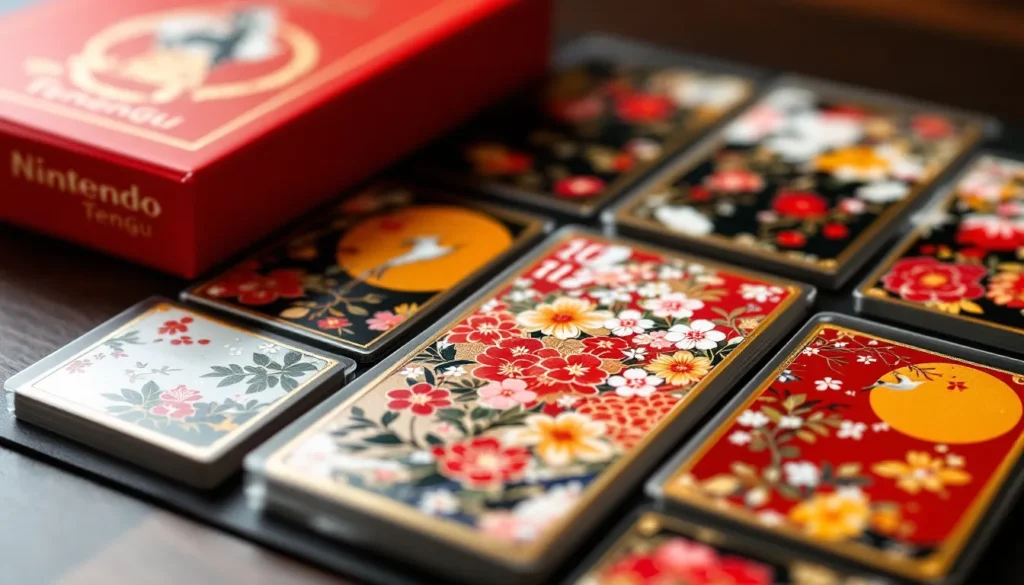
Nintendo’s classic hanafuda cards come in two primary varieties: Tengu (red box) and Miyako no Hana (black box). Both use traditional artwork and follow the standard 48-card configuration, but they have subtle differences in illustration style.
The Tengu deck, featuring a red box with a long-nosed goblin (tengu) on the packaging, is Nintendo’s most popular traditional offering. The card designs are slightly more stylized, with bolder colors and thicker outlines. These are the cards you’ll most commonly see in Japanese gift shops and game stores. They retail for approximately ¥1,000-1,500 (around $7-10 USD) in Japan.
The Miyako no Hana (“Flowers of the Capital”) deck uses more subdued colors and delicate linework, appealing to traditionalists and collectors who prefer the aesthetic of older hanafuda designs. The black packaging is more understated, and these cards are often preferred for serious gameplay rather than casual use.
Both varieties are manufactured with Nintendo’s plastic-coating process, making them significantly more durable than uncoated traditional hanafuda. The coating also provides a smooth shuffle and consistent feel that serious players appreciate, similar to how competitive card game players have strong preferences about card finish and texture.
Nintendo also produces uncoated, traditional-style hanafuda using methods closer to the original 19th-century production. These premium versions appeal to collectors and purists but are significantly more expensive and less practical for regular play.
Limited Edition Gaming-Themed Hanafuda Sets
This is where things get interesting for modern gamers. Nintendo has released several limited-edition hanafuda sets that replace traditional floral imagery with characters and elements from their video game franchises.
The Mario Hanafuda set, first released in 2007 and periodically re-released, reimagines the 12 months with Mario universe characters. January’s pine becomes a level with Bullet Bills, March’s cherry blossoms feature Princess Peach, and August’s moon showcases Boo ghosts. The cards maintain the traditional point values and gameplay structure, only the artwork changes. These sets typically retail for ¥2,500-3,500 (around $17-25 USD) and have become collector’s items, with some early editions selling for significantly more on the secondary market.
In 2015, Nintendo released a Pokemon Hanafuda set exclusively through the Pokemon Center stores. Each month features different Pokemon: Charizard for the high-value cards, Pikachu integrated throughout, and various Gen 1 favorites filling out the deck. The artistic style blends traditional hanafuda composition with Pokemon’s character designs, Pikachu posed like the traditional crane, Vileplume replacing the peony flowers. This set sold out quickly and now commands premium prices from collectors.
Nintendo has also produced limited runs featuring Animal Crossing, Splatoon, and regional Japanese exclusives that never reached international markets. These gaming-themed sets serve dual purposes: they’re functional hanafuda decks for actual gameplay, and they’re collectible merchandise for fans who might never learn to play Koi-Koi but appreciate the artistic crossover.
In 2026, these limited edition sets periodically appear on Nintendo Life, where collectors track restocks and new releases. The gaming-themed hanafuda represent an interesting full-circle moment, Nintendo using their video game success to keep their original product line relevant to new generations.
How to Play Hanafuda: Popular Game Variations
Hanafuda cards support dozens of different games, from simple matching games for kids to complex gambling games with intricate scoring systems. Learning to play hanafuda isn’t quite as straightforward as picking up poker or blackjack, the lack of numbers means you’re memorizing visual patterns and card combinations rather than calculating numeric values.
Koi-Koi: The Most Popular Hanafuda Game
Koi-Koi is the most widely played hanafuda game and the best starting point for newcomers. It’s a two-player game focused on forming specific card combinations (called “yaku”) to score points. Think of it like gin rummy but with flower cards instead of numbers.
Basic Setup:
- Players are dealt 8 cards each
- 8 cards are placed face-up on the table (the “field”)
- The remaining 32 cards form the draw pile
Gameplay Flow:
On each turn, a player does two things:
- Play one card from their hand. If it matches the month of any card on the field, capture both cards. If not, it stays on the field.
- Flip the top card from the draw pile. Again, if it matches a field card, capture both: otherwise, it stays on the field.
Captured cards are set aside in the player’s scoring area. When a player completes a yaku (scoring combination), they can either declare “Koi-Koi” (continue playing to build bigger combinations for more points) or end the round and collect their score. The risk: if you declare Koi-Koi and your opponent completes a yaku before you score again, they get double points.
Common Yaku (Scoring Combinations):
- Five Brights (Gokou): All 5 Bright cards (15 points, instant win in most rule variants)
- Four Brights (Shikou): Any 4 Bright cards (10 points)
- Poetry Ribbons (Akatan): The three red poetry ribbons (5 points)
- Blue Ribbons (Aotan): The three blue ribbons (5 points)
- Viewing the Moon (Tsukimi-zake): Moon card + sake cup card (5 points)
- Viewing the Flowers (Hanami-zake): Curtain card + sake cup card (5 points)
- Animals (Tane): Any 5 animal/ribbon cards (1 point, +1 for each additional)
- Ribbons (Tan): Any 5 ribbon cards (1 point, +1 for each additional)
- Chaff (Kasu): Any 10 chaff cards (1 point, +1 for each additional)
Games typically continue until one player reaches a target score (common thresholds are 50 or 100 points, though this varies by region and house rules).
Koi-Koi combines memory, probability calculation, and risk assessment. Experienced players track which cards have been played, calculate the odds of drawing needed matches, and make tactical decisions about when to call Koi-Koi versus securing guaranteed points. The strategic depth keeps the game interesting even after hundreds of plays.
Hachi-Hachi and Other Traditional Variations
Hachi-Hachi (“88”) is a more complex three-player game popular in Japanese gambling circles. The name comes from the total value of all cards in the deck adding up to 264 points, with each player aiming to reach exactly 88 points per round.
Hachi-Hachi involves:
- More complicated deal structure (7 cards per player, 6 on the field)
- A “banker” role that rotates between players
- Betting mechanics with points wagered before each round
- Additional yaku combinations not found in Koi-Koi
- Penalties for exceeding the 88-point target
The game has a steeper learning curve than Koi-Koi and traditionally involved real money wagering, which is why it was favored in the yakuza-controlled gambling dens where Nintendo cards built their early reputation.
Other notable variations include:
- Sakura: A simplified version for 2-7 players, often played by families with children
- Sudaoshi: A showdown-style game where players try to complete specific yaku before opponents
- Roppyakken: A regional variant from Nagoya with unique scoring rules
- Mushi: Technically a separate card game using only 40 hanafuda cards (removing certain months entirely)
Each regional area of Japan developed its own rule variations, making hanafuda a living game tradition with dozens of legitimate rule sets. This regional diversity mirrors how Western playing card games evolved differently across cultures, poker in America, tarot in Europe, etc.
Modern rule standardization for tournament play has emerged in recent decades, with organizations like the Japan Karuta Association establishing official Koi-Koi rules for competitive events. But, casual play still follows family and regional traditions, which sometimes results in amusing arguments when players from different areas meet.
Where to Buy Authentic Nintendo Hanafuda Cards in 2026
Finding authentic Nintendo hanafuda depends largely on where you’re located and which specific deck you want. The traditional red and black decks are relatively easy to acquire: limited-edition gaming sets require more effort and often command premium prices.
In Japan:
Nintendo hanafuda are widely available throughout Japan at:
- Toy stores and hobby shops (standard decks are common inventory)
- Department stores in the games/toys section
- Convenience stores (particularly larger 7-Eleven and Lawson locations)
- Tourist shops in Kyoto, Tokyo, and other major cities
- Nintendo’s official store in Shibuya Parco, Tokyo
Prices in Japan are generally ¥1,000-1,500 for traditional decks and ¥2,500-4,000 for limited-edition gaming sets (when available). These are legitimate retail prices: expect them to be your cheapest option if you’re physically in Japan.
International Purchase Options:
For buyers outside Japan, several reliable options exist:
Amazon Japan ships internationally and carries both traditional and limited-edition hanafuda. Shipping costs add $10-20 USD depending on location, but you’re guaranteed authentic Nintendo products. The interface has English language options, making the purchase process straightforward even if you don’t read Japanese.
Specialty import stores like Japan Trend Shop, JapanLA, and Tokyo Otaku Mode periodically stock Nintendo hanafuda. Prices are marked up compared to Japanese retail (expect $15-25 for traditional decks, $30-60 for limited editions), but shipping is often faster and customer service is in English.
eBay and secondary markets have listings, but buyer beware: counterfeit hanafuda exist, particularly for the Mario and Pokemon sets. Check seller ratings carefully, examine photos for printing quality (Nintendo’s colors are vibrant and registration is perfect), and be suspicious of prices that seem too good to be true. Authentic limited-edition sets from 2015 or earlier legitimately cost $50-100+ due to scarcity.
Nintendo’s Online Store (Japan) occasionally stocks hanafuda, but international shipping is limited and the site is Japanese-only. You’ll need a Japanese address or a package forwarding service like Tenso or Buyee.
Coverage of new releases and restocks frequently appears on Gematsu, particularly when Nintendo announces limited-edition sets tied to game anniversaries or special events.
What to Check for Authenticity:
- Nintendo logo clearly printed on the box and card backs
- High-quality printing with no color bleeding or misalignment
- Smooth plastic coating (if applicable) with no bubbling
- Cards should be uniformly cut with no irregular edges
- Box should have clean, professional printing and construction
Counterfeit hanafuda tend to have duller colors, misaligned printing layers, and cheaper cardstock that feels noticeably thinner. If you’re holding a genuine Nintendo deck and a counterfeit side-by-side, the difference is immediately obvious.
For collectors specifically seeking limited editions, joining hanafuda enthusiast communities on Reddit (r/Hanafuda) or Discord can provide heads-up alerts when restocks happen or when community members are selling legitimate sets.
Digital Hanafuda: Playing on Nintendo Switch and Mobile Devices
Physical hanafuda cards are the traditional experience, but digital versions bring the game to modern platforms with tutorials, AI opponents, and online multiplayer. Several options exist for playing hanafuda on Switch, mobile devices, and PC.
Clubhouse Games: 51 Worldwide Classics (Nintendo Switch) includes Hanafuda as one of its 51 games. Released in June 2020, this compilation includes both Koi-Koi and Hachi-Hachi with full rule explanations, tutorial modes, and AI opponents of varying difficulty.
The Switch version is particularly beginner-friendly. The tutorial breaks down each yaku combination with clear visual examples, and the AI difficulty scaling lets players learn at their own pace. Online multiplayer allows matches against other players worldwide, and the interface highlights possible matches during play, helpful for newcomers still memorizing the card designs.
The game retails for $39.99 USD and includes far more than just hanafuda (chess, checkers, various card games, etc.), making it solid value for anyone interested in classic games generally. The hanafuda implementation uses traditional card designs, not the Mario or Pokemon versions, maintaining the authentic aesthetic.
Koi-Koi Japan is a series of PC games available on Steam that combines hanafuda gameplay with visual novel elements. The series includes multiple entries (Koi-Koi Japan, Koi-Koi Japan UKIYOE, etc.) featuring anime-style characters and storylines wrapped around Koi-Koi matches.
These aren’t pure hanafuda simulators, they’re clearly targeting anime/VN fans rather than traditional card game enthusiasts, but the underlying Koi-Koi implementation is mechanically sound. Prices range from $3-10 USD depending on the entry, and Steam sales frequently drop them to under $2.
Mobile options are plentiful but quality varies dramatically:
Koi-Koi by Cross Field Inc. (iOS/Android) is a straightforward, free implementation with no frills. It includes AI opponents, basic tutorials, and traditional card designs. Ads are present but not intrusive, making it a solid free option for casual practice.
Hanafuda Koi-Koi by Jupiter Corporation (iOS/Android) offers a more polished experience with better graphics, smoother animations, and more detailed statistics tracking. It’s free with optional in-app purchases for cosmetic elements.
Koi-Koi Hanafuda by Zoo Corporation (iOS) is another quality free option with clean interface design and helpful highlighting of possible plays.
When evaluating mobile hanafuda apps, check for:
- Accurate yaku recognition (some poorly coded apps miss or miscount combinations)
- Clear visual indicators of matching cards
- Adjustable AI difficulty
- Rule variant options (regional rules differ)
- Online multiplayer (if you want to play against humans)
Japanese gaming culture coverage on Siliconera occasionally highlights new hanafuda releases, particularly when they tie into larger franchises or represent notable digital adaptations.
The Digital vs. Physical Experience:
Digital hanafuda solves the biggest barrier to entry: learning the game. Physical cards with no text leave newcomers completely lost: digital versions with highlighted matches and pop-up yaku explanations make learning far less intimidating.
But, experienced players often prefer physical cards. The tactile experience of shuffling, the visual clarity of spreading cards across a table, and the social element of face-to-face play create an atmosphere that digital versions can’t fully replicate. It’s similar to how serious poker players prefer live games even though online poker’s convenience.
The ideal approach: learn digitally, play physically once you’ve internalized the basics.
The Cultural Legacy of Hanafuda in Modern Gaming
Hanafuda’s influence extends beyond being Nintendo’s origin story, the game has left fingerprints across gaming culture, from visual design to game mechanics to how Japanese game companies think about product longevity.
Visual Influence in Game Design:
Hanafuda’s aesthetic appears repeatedly in Japanese games. The distinctive art style, bold outlines, flat colors, stylized natural elements, influenced early Nintendo game art and can be traced through decades of design evolution. The red bridge in the May (Iris) hanafuda cards bears a striking resemblance to bridges in early Donkey Kong levels. The floral motifs appear in everything from Animal Crossing patterns to Okami’s artistic style.
Several games incorporate hanafuda directly as collectibles or minigames:
- The Yakuza/Like a Dragon series includes hanafuda parlors where players can compete in Koi-Koi
- Sakura Wars features hanafuda card battles as a core gameplay mechanic
- Clubhouse Games and its predecessor, 42 All-Time Classics, included hanafuda variations
- The Pokemon TCG includes occasional hanafuda-style promotional cards
These inclusions serve dual purposes: they’re mechanically interesting minigames, and they’re cultural references that resonate with Japanese players who grew up seeing hanafuda in family gatherings.
The Longevity Philosophy:
Nintendo’s decision to keep producing hanafuda cards for 137 years, even as they became a tiny fraction of revenue, reflects a business philosophy that shaped their approach to gaming. Where many Western companies chase quarterly results and abandon product lines the moment profits dip, Nintendo maintains traditions even when they’re not maximally profitable.
This same philosophy explains why Nintendo still produces the 3DS cartridge-compatible New 2DS XL in select markets even though the Switch’s dominance, why they maintained Wii U eShop support for years after the console died, and why they’re notoriously slow to sunset online services. Hanafuda cards taught Nintendo to think in decades, not fiscal quarters.
Gateway to Japanese Gaming Culture:
For Western gamers interested in Japanese gaming culture, hanafuda serves as an accessible entry point. Learning Koi-Koi provides insight into traditional Japanese gaming preferences, the emphasis on memorization, pattern recognition, and risk assessment that appears in everything from mahjong to gacha game meta analysis.
Hanafuda also appears frequently in Japanese media (anime, manga, dramas), and recognizing the cards adds depth to cultural references. When a character in an anime plays hanafuda, it’s often character development, the specific game variant and how they play reveals personality traits in the same way poker tells do in Western media.
Preservation and Evolution:
Hanafuda represents a successful case of cultural preservation through commercial viability. The game survived modernization not by being locked in a museum but by remaining commercially relevant, first through Nintendo’s quality manufacturing and distribution, later through digital adaptations and crossover merchandise.
Younger Japanese gamers who might never have learned hanafuda through family traditions discovered it through the Mario hanafuda sets or Clubhouse Games. These modern touchpoints ensure the tradition continues evolving rather than calcifying into pure historical artifact.
The lesson applies broadly to gaming preservation: keeping old games alive means making them accessible and relevant to new audiences, not just archiving them. Nintendo’s approach to hanafuda, maintaining traditional options while creating limited-edition crossovers, balances preservation with evolution.
Conclusion
Hanafuda cards occupy a unique space in gaming history: they’re simultaneously a traditional Japanese cultural artifact and the foundation of the world’s most influential gaming company. The beautifully illustrated flower cards that Fusajiro Yamauchi crafted in his Kyoto workshop in 1889 generated enough revenue to sustain Nintendo through eight decades of economic upheaval, failed business experiments, and massive industry changes.
Without hanafuda, there’s no Nintendo surviving to 1977 when Shigeru Miyamoto joined the company. No Color TV-Game. No Donkey Kong. No NES saving the industry in 1985. No Game Boy revolutionizing portable gaming. The entire trajectory of gaming history shifts dramatically if Nintendo’s card business failed in the early 20th century.
But hanafuda’s legacy goes beyond survival economics. The cards represent Nintendo’s core identity: respecting tradition while embracing innovation, prioritizing quality and craftsmanship, thinking in generational timescales rather than quarterly reports, and maintaining product lines because they matter culturally, not just financially. These principles, forged in 19th-century card manufacturing, guide Nintendo’s gaming philosophy to this day.
Whether you’re playing with traditional Tengu-backed cards in Kyoto, using a Mario-themed deck with friends, or tapping through Koi-Koi on Clubhouse Games, you’re participating in a gaming tradition that predates Pong by three centuries and directly funded the company that built the modern gaming industry. That’s a pretty incredible heritage for a deck of flower cards.