When the Nintendo 64 hit shelves in 1996, it wasn’t just another gaming console, it was a fundamental shift in how games looked, played, and felt. With its 64-bit MIPS-based processor and focus on 3D graphics, the N64 challenged the PlayStation’s dominance and proved that raw polygons weren’t everything. The cartridge-based system delivered near-instantaneous load times and introduced the controller design that would influence gaming forever. For millions of players, the Nintendo 64 represented their first real jump into three-dimensional gaming, and it set standards that games are still following today.
Key Takeaways
- The Nintendo N64 revolutionized 3D gaming in 1996 by prioritizing 64-bit performance, cartridge-based speed, and innovative controller design that influenced the industry for decades.
- Super Mario 64 and The Legend of Zelda: Ocarina of Time established the template for 3D platforming and open-world design that modern games still follow today.
- The N64’s unique three-pronged controller with its central analog stick and Z-trigger became the foundation for how 3D games are controlled across all platforms.
- Local multiplayer experiences like GoldenEye 007, Mario Kart 64, and Super Smash Bros. transformed the Nintendo N64 into a social gaming phenomenon that defined an entire generation.
- The Nintendo N64’s legacy lives on through Nintendo Switch Online, which brought original cartridge games to modern hardware in 2024, and continues to influence contemporary game design philosophy.
The Rise of 64-Bit Gaming: What Made N64 a Game-Changer
Released in Japan and North America in 1996, then Europe in 1997, the Nintendo N64 arrived with ambitions that matched its name. The NEC VR4300 processor running at 93.75 MHz powered a system that Nintendo built specifically around 64-bit 3D performance. While competitors leaned into CD technology for storage, Nintendo stuck with cartridges, a choice that meant less storage space but dramatically faster load times and seamless gameplay experiences.
The real magic came from the “Reality Coprocessor,” a custom graphics chip that handled both rendering and audio. This allowed the N64 to carry out hardware features that were cutting-edge for the time: z-buffering, perspective-correct texture mapping, and anti-aliasing. Pair this with 4 MB of RAM (expandable to 8 MB with the Expansion Pak) and you had a system capable of producing some genuinely impressive visuals for 1996.
What set the Nintendo N64 apart wasn’t just its technical specs, it was Nintendo’s philosophy. The company approached the console as a platform for 3D gameplay innovation, not just incremental power increases. This mindset would define an entire generation of games and fundamentally reshape how developers approached camera systems, control schemes, and level design in three dimensions.
Legendary Games That Defined a Generation
The Nintendo 64’s library wasn’t massive by some standards, but it was absolutely stacked with masterpieces. Super Mario 64 (1996), The Legend of Zelda: Ocarina of Time (1998), GoldenEye 007 (1997), Mario Kart 64 (1996/97), Super Smash Bros. (1999), Star Fox 64 (1997), Banjo-Kazooie (1998), Perfect Dark (2000), and Donkey Kong 64 (1999) formed the core of the system’s identity. These weren’t just good games, they were genre-defining titles that established templates other developers would follow for years.
Many of these games set new standards for how 3D games should play. The freedom of movement, the intelligent camera systems, the level design philosophy of open spaces with multiple objectives, these came straight out of the Nintendo 64’s DNA. According to rankings of N64’s most essential games, the impact of titles like Ocarina of Time and Super Mario 64 remains unmatched even by modern standards.
Super Mario 64 and the Birth of 3D Platforming
When Super Mario 64 launched alongside the console, it didn’t just show off what the system could do, it showed the entire industry what 3D platforming could be. The game introduced a free-roaming 3D level structure with an adjustable in-game camera controlled by the C-buttons, an analog stick that gave players 360-degree movement, and an objective-based progression system using collectible Stars. Each star represented a different challenge or goal within the same space, encouraging players to explore levels from multiple angles and approaches.
This design philosophy would influence 3D game design across the industry. The shift from linear, forward-moving platformers to explorable 3D spaces with multiple objectives became the template for countless games that followed, from Banjo-Kazooie to modern action-adventures.
Zelda: Ocarina of Time and Multiplayer Classics
The Legend of Zelda: Ocarina of Time took what was possible with the Nintendo 64’s 3D capabilities and created something that felt genuinely cinematic and alive. The game introduced Z-targeting, a lock-on camera system that let players target enemies and objects while maintaining control of the camera. Context-sensitive controls meant that the same button could open doors, push blocks, or climb ledges depending on what you were standing next to. An interconnected world that felt massive for the time created an adventure that seemed limitless.
Beyond single-player campaigns, the Nintendo 64 became synonymous with local multiplayer. GoldenEye 007 brought split-screen first-person shooter matches to consoles in a way that felt natural and addictive. Mario Kart 64 supported four-player racing. Super Smash Bros. launched the franchise that would define 4-player fighting games for decades. These weren’t just features, they were social experiences that defined how a generation of gamers played together.
Hardware, Controllers, and Collectibility Today
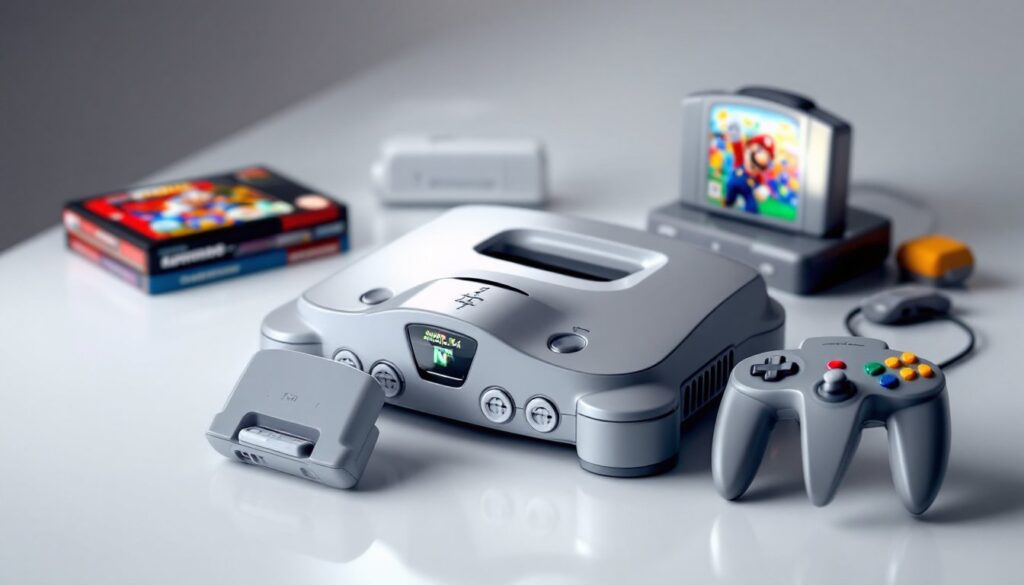
The Nintendo 64 wasn’t just memorable for its games, the hardware itself became iconic. That unique three-pronged controller with its central analog stick was one of the earliest mainstream 3D analog controllers. The dedicated Z-trigger and C-buttons gave developers tools for camera control and quick actions that felt intuitive. It looked weird if you were coming from cartridge-based consoles, but once you held it, the design made sense.
The system’s peripheral ecosystem expanded its capabilities significantly. The Rumble Pak added physical feedback to games, the Expansion Pak doubled the RAM for better graphics, and the Controller Pak stored game saves locally. These weren’t just add-ons, they were essential tools that developers integrated into their games.
Today, the Nintendo N64 has become a serious collectibles market. Complete-in-box (CIB) cartridges command premium prices, especially rare titles like ClayFighter Sculptor’s Cut, Harvest Moon 64, and Conker’s Bad Fur Day. Limited-color consoles and boxed systems are highly sought after. For collectors, the Nintendo 64 represents both nostalgia and investment. The Nintendo DS XL and other retro Nintendo systems have sparked renewed interest in classic hardware, but the N64 maintains its special place in the collecting world.
The N64’s Legacy in Modern Gaming
The Nintendo 64’s influence stretches far beyond its original lifespan. Modern open-world design owes a debt to how Ocarina of Time structured its world and objectives. The analog-stick control scheme became the standard for 3D games everywhere. The 3D camera systems, the context-sensitive controls, and the multiplayer-first mentality all trace back to decisions made on this 64-bit system.
Nintendo has kept the N64 alive through Nintendo Switch Online, bringing the original games to modern hardware without emulation compromises. N64 games arrived on Switch Online in September 2024, introducing a new generation of players to the originals while satisfying longtime fans who wanted official ways to play these classics. The Nintendo Switch 2 will likely continue this tradition.
The influence also extends to spiritual successors and modern franchises. Games like Tears of the Kingdom draw directly from Ocarina of Time’s design philosophy. The success of local multiplayer gaming on Nintendo Switch owes everything to how the N64 made couch gaming synonymous with fun. From the Nintendo DS Release Date through today’s Switch ecosystem, Nintendo has consistently revisited the principles the N64 established. Modern game developers still study how these cartridges structured gameplay, and scholars still cite them as reference points in game design theory.
Conclusion
The Nintendo 64 wasn’t just a console, it was a pivot point. It proved that 3D gaming could be creative, accessible, and fundamentally fun. Three decades later, its influence remains embedded in how modern games handle cameras, controls, and multiplayer experiences. For gamers and historians alike, the Nintendo N64 remains essential.