When Super Mario Galaxy launched in November 2007, it didn’t just bring Mario to space, it fundamentally changed how 3D platformers could work. The gravity-defying mechanics transformed the genre, letting players traverse spherical planets, walk upside down, and experience platforming from angles no Wii game had attempted before. This title became a franchise milestone, proving that the Wii’s motion controls and processing power could deliver genuinely innovative gameplay. Even today, over a decade later, Galaxy stands as one of the most influential Mario titles alongside classics like Super Mario World and recent hits like Super Mario Odyssey. Its legacy shaped how modern platformers approach level design, exploration, and creative use of unique mechanics.
Key Takeaways
- Super Mario Galaxy revolutionized 3D platformers in 2007 by introducing gravity-defying mechanics that let players traverse spherical planets and walk upside down, fundamentally changing how the genre approaches level design and exploration.
- The game’s innovative gravity-shifting system eliminates invisible walls and frustration by allowing Mario to reorient on curved surfaces automatically, enabling both accessibility and challenging puzzle design that influenced modern platformers like Super Mario Odyssey.
- Super Mario Galaxy proved that motion controls and the Wii’s limited technical specs could deliver genuinely innovative gameplay, demonstrating that creative solutions matter more than raw processing power when designing engaging experiences.
- With over 12 million copies sold and 120 Power Stars to collect, the game balances accessibility for casual players with substantial post-game content for completionists through flexible progression and well-designed checkpoint systems.
- The game’s enduring legacy shaped how contemporary platformers approach mechanical clarity, world-building with distinct visual identities, and player empowerment, making it essential study material for level designers and game developers.
Game Overview And Release History
Super Mario Galaxy launched exclusively on Nintendo Wii in November 2007 in Japan, with worldwide releases following shortly after. The game sold over 12 million copies across the Wii’s lifetime, making it one of the system’s definitive titles. A sequel arrived in 2009, but the original remains the more celebrated entry for its groundbreaking mechanics and level design.
The premise strips away complex narratives: Bowser steals Princess Peach and her castle using a comet, scattering Power Stars across the galaxy. Mario must travel from galaxy to galaxy, collecting these stars to power a comet that will let him chase Bowser down. It’s Mario’s thinnest plot wrapper, but it works because the gameplay carries everything. The game features roughly 120 Power Stars total (if you count bonus challenges), though you only need 60 to reach the final confrontation, giving completionists substantial post-game content.
Graphically, Galaxy pushed the Wii harder than most titles. The spherical level design required smart optimization, and developers at Nintendo EAD created vibrant, imaginative worlds that still hold up visually. Compared to other platformers on the system, Galaxy’s art direction feels purposeful, every galaxy has a distinct visual identity that reinforces its mechanic or theme.
Innovative Gravity-Based Gameplay Mechanics
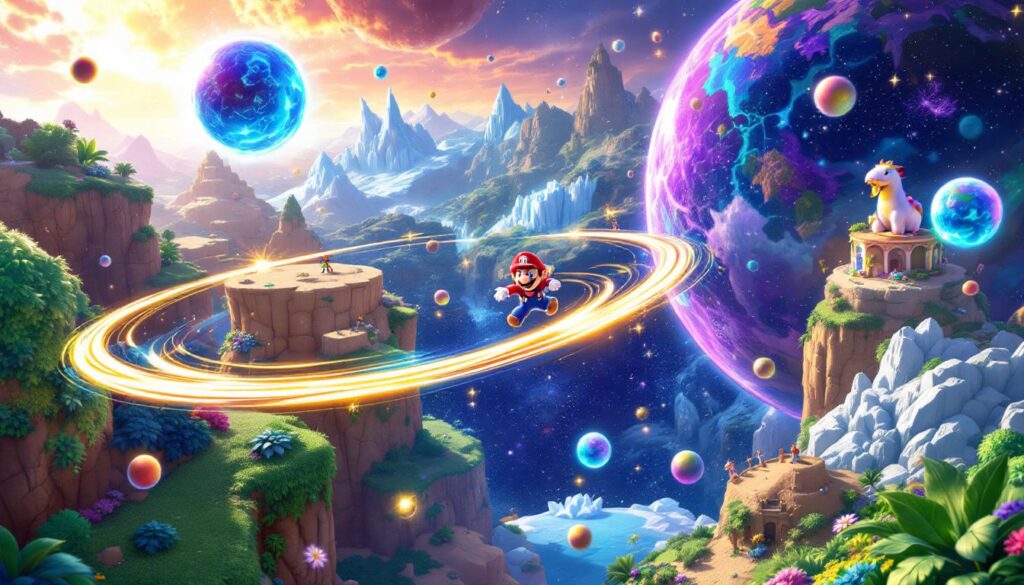
The core innovation that makes Galaxy tick is how it handles gravity. Instead of traditional left-right platforming on flat ground, levels exist on spherical or irregular surfaces where gravity pulls toward the planet itself. Walking “up” the side of a sphere means you’re actually walking normally relative to the planet’s center. This simple concept opens countless design possibilities.
Mario can run around a small sphere, jump to another nearby sphere, and immediately reorient as gravity shifts. Later levels introduce cylindrical planets where gravity affects only specific surfaces, or split-gravity zones where different areas have different gravitational pulls. The game never explains this with dialogue, players learn through play, which is good design.
Motion controls integrate meaningfully without gimmickry. Tilting the Wii Remote lets Mario perform a spin attack, useful for breaking obstacles, attacking enemies, and gaining extra height on jumps. Shaking the Remote isn’t required for basic movement, which keeps accessibility intact. Some collect-a-thons use motion controls to grab floating objects, but these feel natural rather than forced.
How Gravity Shifting Works
When Mario approaches a curved surface, his orientation adjusts automatically, his feet point toward the surface, his head away. Camera movement follows smoothly, making the transition disorienting at first but intuitive after the first galaxy. Jumping off one sphere toward another involves a brief moment in zero gravity where Mario floats freely before the next planet’s gravity grabs him.
This mechanic eliminates the frustration of “invisible walls” that plague traditional 3D platformers. If you want to explore every angle of a sphere, you can, the level design ensures nothing breaks. Later games like Super Mario Odyssey borrowed this accessibility philosophy, proving that freedom of movement doesn’t require sacrificing challenge or direction. The gravity shifting also enables unique puzzle segments, like navigating tiny planet clusters or walking along thin beams where one misstep means falling into space (though checkpoints prevent cheap deaths).
Exploration And Collectibles Across Galaxies
Galaxy structures its progression around six main galaxies, each with multiple planetoids and challenges. The Gold Leaf Galaxy, for example, features giant trees where Mario navigates between branches, leaf-themed enemies, and puzzles involving gravity-shifting platforms. The Sand Spiral Galaxy wraps around a massive cone, requiring players to climb upward while managing gravity shifts and enemy encounters.
Secondary galaxies unlock as you progress, offering quick challenges or themed variants. The Daredevil Galaxy strips away health recovery, forcing perfect platforming, a design choice that rewards skilled players without gatekeeping the main story. Purple Coins hidden throughout levels reward thorough exploration. Unlike collectibles in many platformers, these feel rewarding to hunt because the game’s traversal is genuinely fun.
Checkpoints balance challenge with accessibility. Dying respawns you nearby without harsh penalties, making retry loops fast. Boss fights are the real skill tests, but even these have generous checkpoint placement. The difficulty curve ramps gradually: early galaxies teach mechanics, mid-game galaxies test combinations of skills, and post-game content for completionists demands precision.
The game respects player choice. You’re not forced into linear progression, grab Power Stars in any order from available galaxies. Some players speedrun Galaxy by exploiting gravity mechanics for sequence breaks, finding optimal routes on Nintendo Life, while others enjoy taking their time collecting every coin. This flexibility made the game accessible to casual players while rewarding dedicated fans.
Why Super Mario Galaxy Remains A Fan Favorite
Galaxy’s enduring appeal comes from mechanical clarity combined with creative expression. Every level teaches its gimmick, lets you practice it safely, then creates a challenging scenario that combines it with previous mechanics. This careful progression means both casual players and completionists feel challenged at their level.
The art direction sells every galaxy as a unique destination. From the serene Beach Bowl Galaxy to the chaotic Bedroom Galaxy (where you’re the size of a toy in a child’s room), each world feels distinct. Sound design amplifies this, Koji Kondo’s orchestral score captures the wonder of exploring space while still feeling distinctly Mario.
Replay value comes naturally. Speed-running certain challenges, collecting every coin, or simply revisiting favorite galaxies because the controls feel responsive makes replaying levels satisfying rather than tedious. Critical reception across gaming media was overwhelmingly positive, with reviewers praising its innovation and execution, and this consensus still holds up.
Unlike some games that become dated, Galaxy’s art style and gameplay remain timeless. The Wii’s lower technical specs forced creative solutions rather than brute-force visuals, resulting in a game that aged better than many contemporaries.
Legacy And Impact On Modern Platformers
Galaxy’s influence ripples through platformers released since 2007. The gravity mechanic itself spawned imitators, some direct (Galaxy 2’s expanded use), others thematic (mechanics that shift perspective or orientation). More importantly, Galaxy proved that motion controls could enhance rather than gimmick up gameplay, influencing how developers approached innovation on motion-enabled systems.
Super Mario Odyssey (Switch, 2017) borrowed Galaxy’s philosophy of empowering player movement while maintaining tight controls. The way Odyssey lets Mario explore freely around planets echoes Galaxy’s spherical design philosophy. The camera work, the way levels teach and escalate challenges, these are Galaxy’s direct descendants. Similarly, games like Gravity Rush (PS Vita/PS4) directly inherited gravity-shifting mechanics as core gameplay.
Platformers like Kirby’s Epic Yarn and later Kirby titles borrowed Galaxy’s approach of giving each world a unique visual identity tied to specific mechanics. Even competitive platformers and speedrunning communities cite Galaxy as a technical reference point, its glitch routes and speedrun optimizations remain studied by runners chasing PRs.
Galaxy also demonstrated that Nintendo could innovate on hardware limitations rather than even though them. The Wii was less powerful than PS3 or Xbox 360, yet Galaxy became the system’s prestige title. This influenced how Nintendo approached game design going forward, craft around your hardware’s strengths rather than chase rival specs. Further reading on platformer.
Conclusion
Super Mario Galaxy stands as one of gaming’s most important platformers because it proved that innovation comes from mechanical clarity and creative confidence. Its gravity-shifting design influenced a generation of platformers, from Odyssey to indie titles pushing similar ideas. If you’ve never played it, the original Wii version remains accessible and genuinely engaging, motion controls aged better here than most Wii games, and the core platforming holds up completely. For anyone designing levels or mechanics, Galaxy is essential study material.